
Ingredients
Vegetables
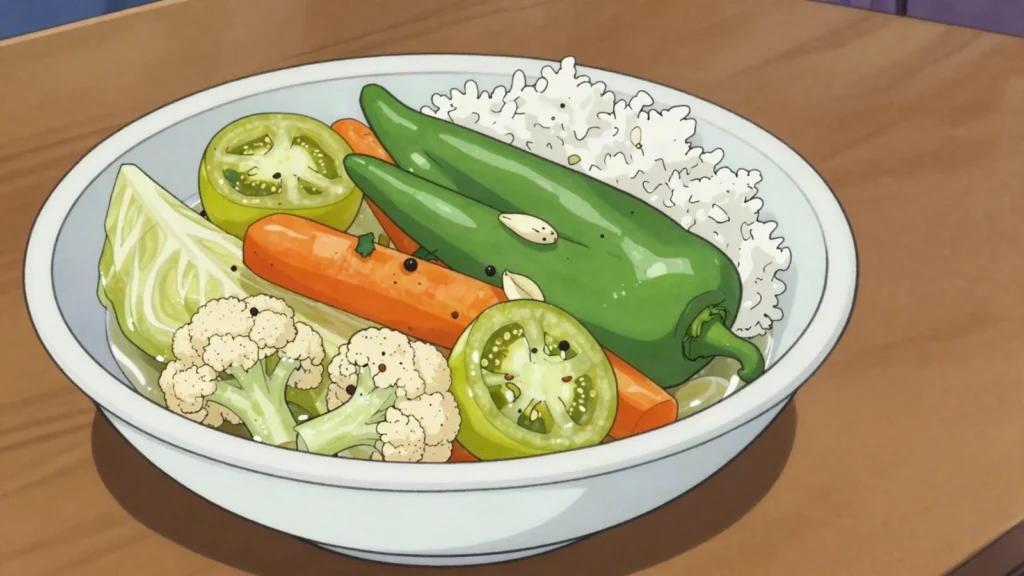
- 500 gcabbage, cut into 4 cm chunks
- 400 gcauliflower, in small florets
- 300 gcarrots, in thick coins
- 300 ggreen tomatoes, quartered
- 300 glong green peppers, cut into 3 cm lengths
- 2celery stalks with leaves, cut into batons
- 6small green chillies, left whole and pierced once
Brine and vinegar
- 1.2 litreswater
- 600 mlwhite wine vinegar or spirit vinegar of 5 percent acidity
- 90 gcoarse non-iodised salt
- 2 tbspsugar, optional
Aromatics
- 1 headof garlic, cloves peeled
- 2 tbspblack peppercorns
- 2 tbspcoriander seeds
- 4bay leaves
- 1 tbspdried dill or a few fresh dill heads
Equipment
- 2sterilised jars of 1.5 litres with vinegar-proof lids
- a small glass weight or a clean stone per jar
Directions
- Wash and cut the vegetables so every piece is roughly the same size, then salt the cabbage and peppers lightly and leave 30 minutes to draw out surface water.
- Sterilise the jars by washing in very hot soapy water, rinsing and drying them in a 120°C (250°F) oven for 15 minutes.
- Pack the vegetables into the jars in tight alternating layers, tucking in the garlic, bay, chillies and dill as you go, and pressing down firmly to leave as few air pockets as possible.
- Bring the water, vinegar, salt and sugar to a boil with the peppercorns and coriander seed, stirring until the salt has fully dissolved, then let it cool to lukewarm.
- Pour the brine over the vegetables to cover them by 2 cm, tapping the jar and sliding a knife down the side to release trapped bubbles.
- Weigh everything below the surface with a glass weight. Anything that floats above the brine will grow mould and spoil the jar.
- Seal, keep at room temperature, around 18 to 20°C (70°F), for the first 5 to 7 days, opening the lid briefly each day to release gas as the ferment starts and the brine clouds.
- Move to a cool dark place at 10 to 14°C (55°F) and mature 3 to 6 weeks, until the brine has cleared again, the cabbage is translucent and the carrot is sour right through. It keeps six months unopened.
Technique
- Salt at 5 to 6 percent of the water weight, which is what 90 g per 1.2 litres gives, is the working range. Below 3 percent soft spoilage bacteria take over, and above 8 percent nothing ferments at all.
- Use non-iodised salt and vinegar of at least 5 percent acidity. Iodine inhibits the lactic bacteria and weak vinegar will not protect the jar.
- A cloudy brine and bubbling in the first week are correct. Slimy strings, a soft mushy texture, a domed lid or any sign of fuzzy mould mean the jar must be thrown out.
Substitutions
- For a purely lactic pickle with no vinegar, use brine alone at 5 percent salt and ferment 3 weeks; expect a rounder, less sharp result.
- Beetroot, small cucumbers, green beans, unripe plums and cauliflower stalks can all go into the same jars without changing the method.
Variations
- The Albanian winter turshi leans on cabbage, green tomatoes and long peppers in a mostly salt brine, put up in autumn and eaten through the cold months alongside beans and cornbread.
- The Afghan turshi is much more vinegar-forward and hotter, built on carrot, cauliflower and plenty of chilli and garlic, and is eaten as a sharp relish with rice and bread.
- Turshi liter, the mixed Balkan jar, is chopped small and dressed with olive oil at the table.
History
Every household fills jars in autumn; the word comes from Persian torshi, sour, carried west by Ottoman cooking.
Frequently asked questions
What is Turshi?
Turshi is a fermented & pickled from Afghanistan: vegetables soured in vinegar and salt, served alongside rice and kebab. Every household fills jars in autumn; the word comes from Persian torshi, sour, carried west by Ottoman cooking.
How long does Turshi take to make?
Turshi takes 40 min of preparation and 10 min plus 3 to 6 weeks maturing of cooking. The recipe makes 2 jars of 1.5 litres. It is rated easy to make.
What can I substitute in Turshi?
Yes, within limits. For a purely lactic pickle with no vinegar, use brine alone at 5 percent salt and ferment 3 weeks; expect a rounder, less sharp result. Beetroot, small cucumbers, green beans, unripe plums and cauliflower stalks can all go into the same jars without changing the method.
What is the most important thing to get right in Turshi?
A cloudy brine and bubbling in the first week are correct. Slimy strings, a soft mushy texture, a domed lid or any sign of fuzzy mould mean the jar must be thrown out.