The sweet orange root that is in the base of half the world’s soups and stews without being tasted — and, on its own, roasted or raw, one of the sweetest vegetables there is.
Where it comes from
Wild carrot grows across Europe and Asia, but the cultivated carrot was domesticated in Afghanistan and Persia around a thousand years ago, and it was purple and yellow, not orange. Purple carrots spread west with the Arabs and east to China and India; the orange carrot was bred in the Netherlands in the seventeenth century from yellow stock and, being sweeter and cleaner-tasting, displaced the others almost everywhere. Purple and yellow varieties have returned recently as heirlooms.
In European cooking the carrot is a foundation vegetable — one third of a mirepoix with onion and celery, in a soffritto, in every stock — and its job there is sweetness and body rather than flavour. On its own it is roasted, glazed, grated into salads and cakes and, in Persia and India, cooked into sweets: the Indian gajar ka halwa is grated carrot cooked slowly in milk and ghee.
Varieties
- Nantes — Cylindrical, blunt-ended, sweet and tender; the classic French carrot for eating fresh.
- Chantenay — Short, broad-shouldered, conical; sweet, stores well, good roasted whole.
- Imperator — Long, tapered; the standard supermarket carrot, bred for length and shipping.
- Purple and black carrot — The ancestral colour, from anthocyanins; earthier, sometimes orange inside. In Afghan, Turkish and Indian cooking, and in the fermented Turkish drink şalgam.
- Yellow and white carrot — Milder and less sweet; grown mostly for colour in mixed bunches.
- Baby carrot — True baby carrots are small young roots; the bagged American kind are large carrots machine-cut and rounded.
In the kitchen
Roasting concentrates their sugar: cut lengthways, oil, salt, and roast hot until the edges caramelise. Glazing — cooking in a little water, butter and sugar until the liquid becomes a glaze — is the classic French method. In a stock or a stew, cut them large so they do not dissolve; in a mirepoix, small so they melt into the base.
Raw, they are sweetest grated fine and dressed — with lemon and parsley, with orange and cumin in Morocco, with sesame in Japan. Carrot pairs with cumin, coriander, orange, ginger, honey, butter and thyme, and with dill and yoghurt in the east.
Choosing and keeping
Firm, smooth, bright, without cracks or a green shoulder; if the leaves are on they should be fresh, and should be removed for storage since they draw moisture from the root. Carrots keep weeks in the fridge in a bag; bunched young carrots a few days.
Peeling is optional — a scrub does for young carrots — but old carrots have a bitter skin. A carrot that has gone rubbery can be crisped in a bowl of iced water.
Dishes with carrot
 Sauerkraut soupSour cabbage soup with pork and pearl barley.
 MaraqClear goat or camel broth with potato and coriander, spooned over rice
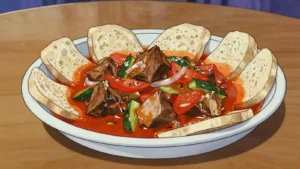 Gursanthin dried bread layered under stewed meat and vegetables
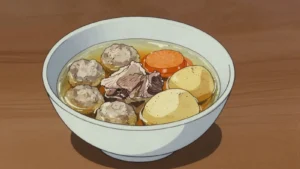 SoddClear mutton broth with meatballs, carrot and potato, served at celebrations.
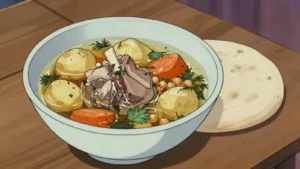 Shurboslow lamb soup with potato and chickpeas
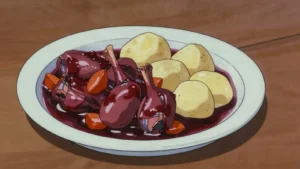 HuesenziwwiHare jugged in red wine and its own blood, an autumn game dish
 BramboračkaRustic potato soup with forest mushrooms and marjoram.
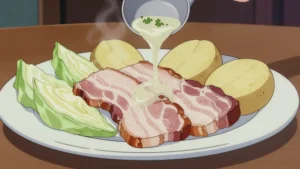 Bacon and cabbageBoiled bacon joint with cabbage and floury potatoes.
Carrot is tagged on 365 dishes from 152 countries in the atlas. These notes are written from general knowledge and carry no per-fact citation — see About.