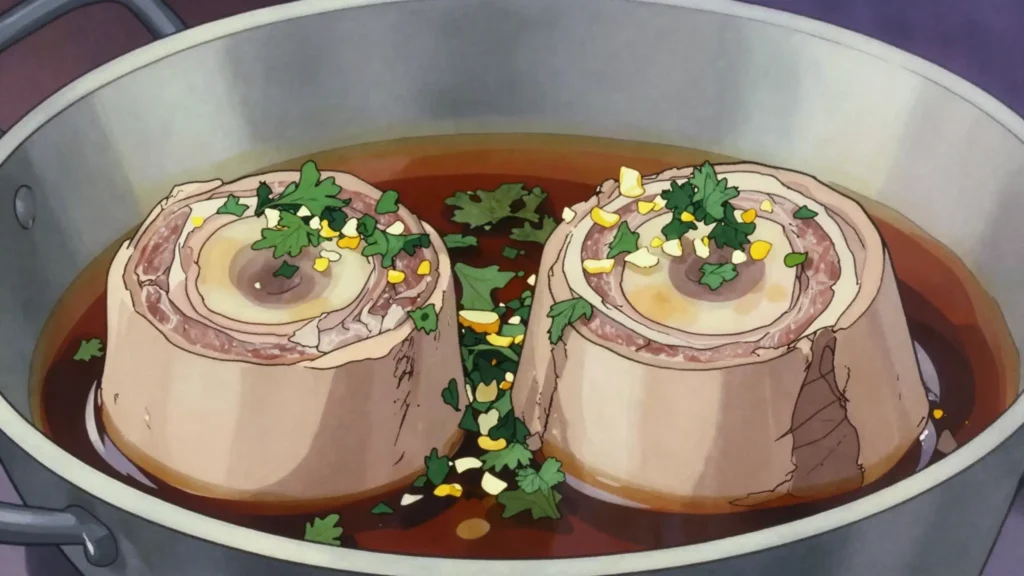

Ingredients
Veal
- 4cross-cut veal shanks, 4 cm thick, with the marrow bone
- plain flour, for dusting
- salt and pepper
- kitchen string
Soffritto
- 60 gbutter
- 2 tbspolive oil
- 1onion, finely diced
- 1carrot, finely diced
- 1 stickcelery, finely diced
Braise
- 250 mldry white wine
- 400 mlveal or chicken stock
- 2bay leaves
- 1 sprigthyme
Gremolata
- grated zest of 1 lemon
- 1 clovegarlic, very finely chopped
- 1large bunch flat parsley, finely chopped
To serve
- risotto alla milanese
- or polenta
Directions
- Tie a length of string around the circumference of each shank. Cut through the outer membrane in two or three places with a small knife. Season the shanks well and dust them lightly with flour, shaking off the excess. Flour them thinly and brush the excess off, or it burns in the pan and thickens the sauce into paste.
- Heat the butter and oil in a heavy pot and brown the shanks hard on both sides, one or two at a time. Brown them properly and do not crowd the pot. Lift them out and set them aside.
- Add the diced onion, carrot and celery to the same pot and cook slowly for 12 to 15 minutes until soft and sweet. Dice the soffritto small and cook it slowly without browning, because it dissolves into the sauce and gives it body.
- Pour in the wine and let it bubble hard for 3 to 4 minutes, scraping up everything stuck to the base. Let the wine reduce properly before the stock goes in, or the sauce tastes sharp and raw.
- Return the shanks in a single layer, add the stock, bay and thyme, and bring it to a bare simmer. The liquid should come about two thirds up the shanks and no further. Cover and cook very gently, on the hob or in a 160°C (320°F) oven, for 2 to 2 hours 30 minutes. Turn the shanks once, carefully, halfway through.
- Keep it at the barest simmer. It is done when the meat gives completely under a fork but the shank is still whole. Chop the lemon zest, garlic and parsley together and mix them. Make it fresh and never in advance. Gremolata is entirely about the volatile oils in the raw zest and garlic, and it goes dull within the hour.
- Serve with risotto alla milanese, which is the classic Milanese pairing, or with polenta. Serve a marrow spoon or a small fork with each plate, because getting the marrow out is part of eating it.
Technique
- The older Milanese version, in bianco, uses no tomato at all, which is what this recipe follows.
- Ossobuco alla milanese with tomato is also traditional and equally common now.
- It is better made a day ahead, though the gremolata is always fresh.
Substitutions
- Beef shin, which needs a longer braise and gives a stronger flavour.
- Lamb shanks, prepared the same way.
Variations
- With tomato in the braise.
- With anchovy in the gremolata, which is traditional in some versions.
- Made with beef shin.
History
Braised veal shanks, cooked slowly with vegetables, white wine and broth until the meat becomes extremely tender and separates easily from the bone, its name meaning literally bone with a hole, referring to the marrow-filled center of the shank bone, developed in Milan, in the Lombardy region of northern Italy. Its marrow, traditionally eaten directly from the bone using a small specialized spoon, is considered by many Milanese diners one of the dish’s most prized elements, and ossobuco is traditionally served with a gremolata garnish of lemon zest, garlic and parsley to cut through the dish’s richness, along with risotto alla milanese as a classic pairing. Ossobuco remains one of Milan’s most iconic and internationally recognized traditional dishes.
Frequently asked questions
What is Ossobuco?
Ossobuco is a main from Italy: braised veal shanks finished with lemony gremolata. Braised veal shanks, cooked slowly with vegetables, white wine and broth until the meat becomes extremely tender and separates easily from the bone, its name meaning literally bone with a hole, referring to the marrow-filled center of the shank bone, developed in Milan, in the Lombardy region of northern Italy. Its marrow, traditionally eaten directly from the bone using a small specialized spoon, is considered by many Milanese diners one of the dish’s most prized elements, and ossobuco is traditionally served with a gremolata garnish of lemon zest, garlic and parsley to cut through the dish’s richness, along with risotto alla milanese as a classic pairing. Ossobuco remains one of Milan’s most iconic and internationally recognized traditional dishes.
How long does Ossobuco take to make?
Ossobuco takes 25 min of preparation and 2 hr 30 min of cooking. The recipe makes 4 servings. It is rated medium to make.
What can I substitute in Ossobuco?
Yes, within limits. Beef shin, which needs a longer braise and gives a stronger flavour. Lamb shanks, prepared the same way.
What is the most important thing to get right in Ossobuco?
Tie a length of string around the circumference of each shank. Cut through the outer membrane in two or three places with a small knife. Season the shanks well and dust them lightly with flour, shaking off the excess. Flour them thinly and brush the excess off, or it burns in the pan and thickens the sauce into paste.