
Ingredients
Dough
- 500 gplain flour, type 00
- 100 gstrutto, pork lard
- 1 tspsalt
- 1 tspbicarbonate of soda, or 5 g baking powder
- about 220 ml warm water or milk
Classic filling
- 300 gsquacquerone cheese
- 150 gprosciutto crudo di Parma
- a handful rocket
Other fillings
- mozzarella and tomato
- sausage and greens
- Nutella, for a sweet one
Equipment
- a testo, or a heavy flat pan or griddle
Directions
- Butter is not traditional and gives something closer to a scone. In Rimini and the south of Romagna the piadina is thin, about two or three millimetres, and larger.
- Rub the lard into the flour, salt and bicarbonate with your fingertips until it looks like coarse crumbs. Work the fat in thoroughly before any liquid, which is what makes the dough short rather than bready. Now add warm water gradually and bring it together.
- Use warm liquid rather than cold, which softens the lard and makes the dough easier to work. Knead it for five minutes until smooth, and no longer. Do not overknead, since developing too much gluten makes a tough piadina that cracks when folded.
- Roll from the centre outwards, turning the disc as you go to keep it circular. Roll them thinner than seems right, since they thicken slightly as they cook. Prick them all over with a fork. Pricking stops the piadina ballooning into a pocket, which is what happens if steam is trapped underneath. Heat a heavy flat pan or griddle over a medium-high heat.
- Use no oil or fat in the pan at all, since piadina is dry-cooked and the fat is already in the dough. Test the heat with a scrap of dough, which should colour within thirty seconds.
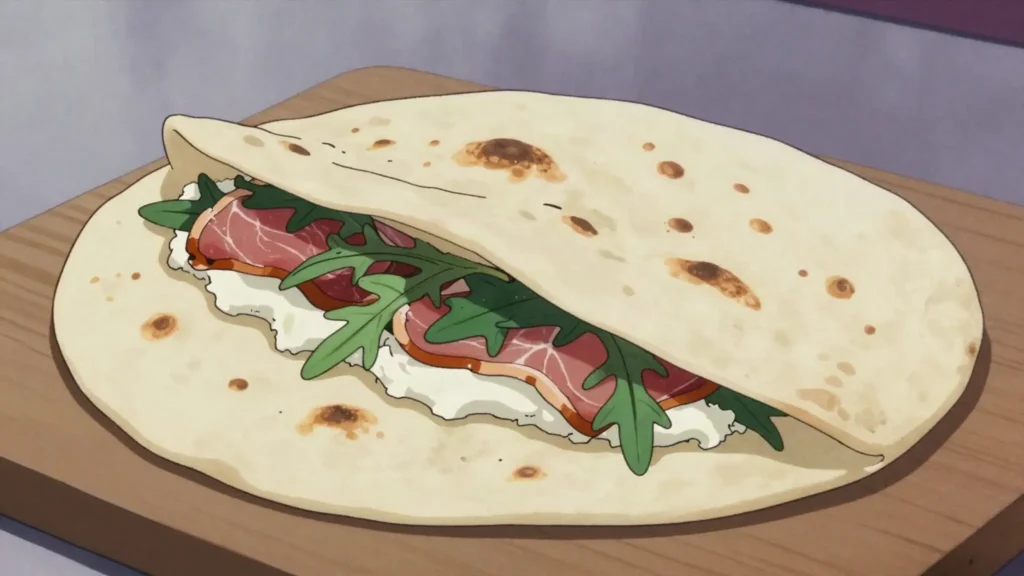
- Press it lightly with a spatula as it cooks so the whole surface makes contact. Those characteristic brown speckled blisters are what a piadina should look like, and a pale even one is undercooked.
- Spread the cheese over half, lay the prosciutto and rocket over it, and fold it in half. Fill it warm rather than hot, since a hot piadina melts the cheese into a puddle. Serve it immediately, folded and eaten in the hand. It goes stiff as it cools, so it is made to order everywhere it is sold.
Technique
- A traditional piadina contains no yeast at all.
- Pork lard is the traditional fat and gives it its character.
- Stack them under a cloth so the steam keeps them pliable.
Substitutions
- Olive oil in place of lard, as in the Rimini style.
- Stracchino or another soft fresh cheese in place of squacquerone.
Variations
- Cassone or crescione, folded and sealed before cooking.
- The thicker Forlì style.
- Filled with sausage and cooked greens.
History
A thin, unleavened flatbread, cooked on a flat griddle and typically folded around a filling of prosciutto, cheese and arugula, documented across the Emilia-Romagna region of Italy for many generations as a traditional street food, with roots tracing back through peasant cooking, since piadina was historically a simple, affordable bread eaten by rural farming communities well before its later popularity as a street food snack. Its thin, quickly cooked dough, requiring no yeast or long fermentation, reflects a practical, accessible bread that could be prepared quickly by rural households, later reinvented as a popular grab-and-go street food from small piadina stands across the region. Piadina remains closely associated with the Romagna area’s regional culinary identity within Italy.
Frequently asked questions
What is Piadina?
Piadina is a street food from Italy: romagna flatbread folded with squacquerone, prosciutto, arugula. A thin, unleavened flatbread, cooked on a flat griddle and typically folded around a filling of prosciutto, cheese and arugula, documented across the Emilia-Romagna region of Italy for many generations as a traditional street food, with roots tracing back through peasant cooking, since piadina was historically a simple, affordable bread eaten by rural farming communities well before its later popularity as a street food snack. Its thin, quickly cooked dough, requiring no yeast or long fermentation, reflects a practical, accessible bread that could be prepared quickly by rural households, later reinvented as a popular grab-and-go street food from small piadina stands across the region. Piadina remains closely associated with the Romagna area’s regional culinary identity within Italy.
How long does Piadina take to make?
Piadina takes 20 min plus 30 min resting of preparation and 20 min of cooking. The recipe makes 6 piadine. It is rated easy to make.
What can I substitute in Piadina?
Yes, within limits. Olive oil in place of lard, as in the Rimini style. Stracchino or another soft fresh cheese in place of squacquerone.
What is the most important thing to get right in Piadina?
Rub the lard into the flour, salt and bicarbonate with your fingertips until it looks like coarse crumbs. Work the fat in thoroughly before any liquid, which is what makes the dough short rather than bready. Now add warm water gradually and bring it together.