A family of fruit where nearly every familiar type is a hybrid of just three or four wild ancestors, and where the peel is often worth more to a cook than the juice.
Where it comes from
Almost all cultivated citrus descends from crossing and recrossing a small number of wild species — citron, pomelo, mandarin and papeda — which originated in the foothills of the eastern Himalaya and in Southeast Asia. The orange is a mandarin–pomelo cross, the grapefruit a pomelo–orange cross, the lemon a citron–bitter orange cross.
Citrus travelled west with Arab traders and agriculture, reaching the Mediterranean well before it reached northern Europe, and went to the Americas with the Spanish and Portuguese, where limes and oranges naturalised completely.
Varieties
- Lemon — High acid, aromatic peel. The default souring agent across Europe and the Middle East.
- Lime — Sharper, more floral, and it goes bitter when cooked long. The souring agent of Latin America and Southeast Asia.
- Orange — Sweet, and its peel carries more aroma than its juice.
- Bitter / Seville orange — Too sour to eat. Marmalade, and the base of many Latin American marinades.
- Kaffir / makrut lime — Grown for the leaf, which is one of the defining aromas of Thai cooking. The fruit is barely used.
- Yuzu, sudachi, calamansi — East and Southeast Asian citrus used almost entirely for peel and juice as seasoning.
- Preserved lemons — Salted whole and fermented for weeks. The rind becomes the ingredient, and it tastes nothing like fresh lemon.
- Pomelo, grapefruit, mandarin — Eaten as fruit, and the pomelo is a salad ingredient across Southeast Asia.
In the kitchen
Zest and juice are different ingredients. The aromatic oils are almost entirely in the coloured outer skin; the juice is acid and sugar. A recipe wanting lemon flavour usually wants zest, and one wanting sharpness wants juice.
The white pith is bitter. Zesting is a technique for taking the colour and leaving the white.
Citrus juice loses its aroma within minutes of squeezing and turns dull and slightly bitter. Squeeze it when you need it; bottled juice is a different substance.
Lime cooked for a long time turns bitter in a way lemon does not — which is why Thai and Mexican cooking add it at the end.
Dishes with citrus
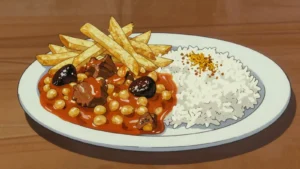 Gheimehsplit-pea and lamb stew with dried lime, crowned with fries
 Arak eshkoliyotArak poured long over ice with fresh grapefruit juice, clouding milky white.
 ChuflaySingani lengthened with ginger ale and lime over ice
 AlmdudlerAlpine herb lemonade, Austria's cherished soft drink.
 Kuvano vinoRed wine simmered with sugar, cloves and citrus, served hot.
 Lemon, Lime and BittersLemonade, lime cordial and a dash of Angostura; the standard pub soft drink.
 CevicheSea bass cured in lime with coriander and onion
 Noomi Basradried black limes, boiled then sun-dried, crushed into stews and brewed as tea
Citrus is tagged on 365 dishes from 144 countries in the atlas. These notes are written from general knowledge and carry no per-fact citation — see About.