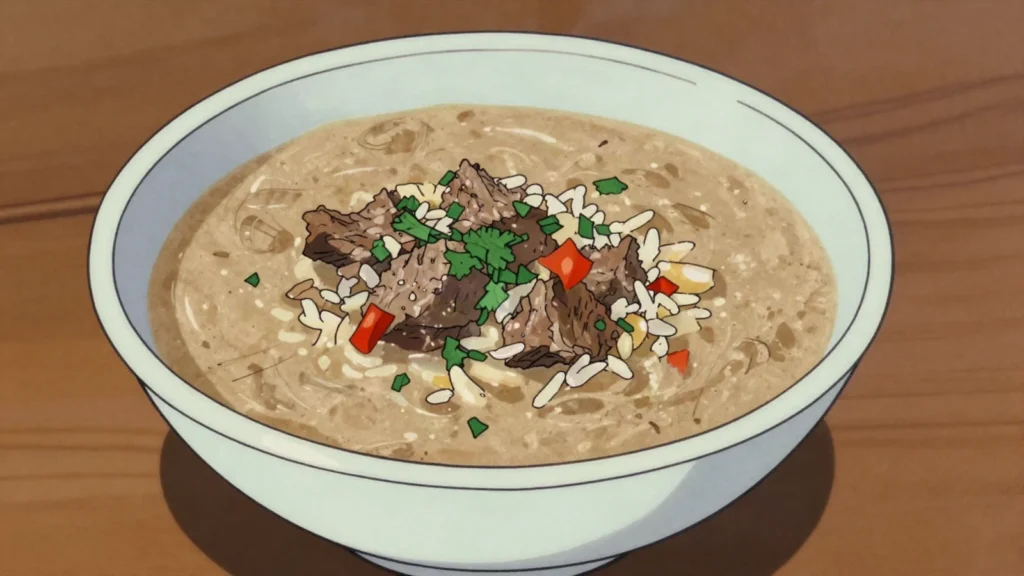

Ingredients
The meat
- 700 gbeef
- shin, skirt or brisket
- pounded or minced twice
- very finely
The base
- 2onions, finely chopped
- 1red pepper, chopped
- 3spring onions, sliced
- 4garlic cloves, crushed
- 3 tablespoonsoil
- or lard
- 2bay leaves
The liquid
- 2 litresbeef stock
- or water
- 1 teaspoonground cumin
- salt and black pepper
The grain
- 150 gshort grain rice
- or 150 g fine noodles
- added near the end
- chopped parsley, to finish
Directions
- Mince it twice for a genuinely fine texture. Bought mince is usually too coarse for this. Keep raw mince cold until it goes into the pot. Wash hands, boards and the mincer after use. Do not leave minced meat standing at room temperature.
- Mince spoils faster than whole cuts do. Thick meat soup bubbles heavily and spits. Keep the heat moderate and use a deep pot. Stir with a long spoon and stand back. Trim the beef of any large pieces of gristle. Cut it away carefully before you mince. Some fat is good and should be left on. Mince the beef twice through a fine plate. Chill the meat before mincing for a cleaner cut.
- Warm meat smears rather than cutting cleanly. A food processor works if you have no mincer. Cut the beef into cubes and pulse it in batches. Heat the oil in a large heavy pot. Use a genuinely heavy based pot for this. Thin pots scorch the meat on the bottom. Use one considerably larger than it seems to need.
- Add the onion and red pepper and cook them down. Give them about twelve minutes over a moderate heat. Add the garlic and the sliced spring onion. Garlic burns and turns bitter within a minute.
- Stir them constantly so they do not catch. Add the finely minced beef to the pot. Break it up thoroughly as it goes in. Stir it constantly so no lumps form at all. Lumps of mince never break down later. Cook the meat until it loses its raw colour. Give it about eight minutes of stirring.
- Keep breaking it up throughout that time. Mince clumps together as soon as it heats. Press any lumps against the side of the pot. Break them apart with the back of a spoon. Pour in the stock and add the bay leaves. Keep hot stock ready to add more. Simmer the soup gently for about forty minutes.
- Keep it at a bare simmer rather than a boil. Foam and fat rise during the first half hour. Skim them off with a spoon and discard them. Stir it regularly right through the simmering.
- Add the rice or noodles for the last stretch. Rice needs about eighteen minutes in the pot. Add more hot stock if it becomes too thick. Add it a ladleful at a time rather than all at once. Stir more often once the grain is in the pot. That is where it burns if left alone. Season the soup well with salt, pepper and cumin. Taste it carefully and adjust it properly.
- Add the salt near the end rather than at the start. A teaspoon for this quantity is about right. Add it with the liquid so it cooks through. Taste the rice or noodles before serving. The rice should be entirely soft with no hard core.
- Ladle the hot soup into deep bowls. Stir the pot well before ladling it out. Each bowl should get a fair share of both. Scatter chopped parsley over each bowl. Add it at the last moment before serving. It is filling enough to need nothing more.
Technique
- The meat must be genuinely fine rather than ordinary mince — mince it twice through a fine plate, since one pass gives an ordinary texture and the second gives the fineness this soup depends on. Bought mince is usually too coarse; process it further if that is all you have.
- Break the mince up thoroughly as it goes into the pot and keep stirring — it clumps as soon as it heats, and lumps never break down later. Press any against the side of the pot with the back of a spoon.
- Minced beef must be cooked right through, since mincing spreads surface bacteria through the meat; this soup simmers well past any concern. Keep raw mince cold until it goes in and wash hands, boards and the mincer afterward — mince spoils faster than whole cuts.
Substitutions
- Fine noodles replace the rice and both are genuinely used in Paraguayan homes, though rice thickens the soup rather more. Rice needs about eighteen minutes in the pot and fine noodles only about eight — added too early either turns to mush.
- Shin, skirt or brisket all work; these cheaper working cuts carry more flavour than lean ones and the long cooking softens them entirely. A wooden mortar, the angu’a, is the original tool and gives a slightly different fibrous texture — both routes are correct.
Variations
- So’o means meat and josopy means pounded in Guaraní, an official language of Paraguay spoken alongside Spanish by a large majority. Many Paraguayan dishes carry Guaraní names used in ordinary Spanish speech — chipa, mbeju and so’o josopy among them. It is sometimes written soyo in Spanish spelling.
- Trim large pieces of gristle before mincing, since gristle does not break down and stays as tough threads in the soup, but leave some fat on. Chill the meat before mincing, since warm meat smears rather than cutting cleanly.
- This is a thick soup closer to a stew than a broth, thickened by both the meat and the grain, and it thickens further as it stands. Stir more often once the grain goes in, scraping the base, since rice settles and sticks readily. The rice should be entirely soft with no hard core — this is not a dish where grain stays al dente.
History
The Guaraní name means pounded meat; a Paraguayan home lunch and market counter dish.
Frequently asked questions
What is So’o josopy?
So’o josopy is a soup & stew from Paraguay: thick soup of pounded beef with rice or noodles and onion. The Guaraní name means pounded meat; a Paraguayan home lunch and market counter dish.
How long does So’o josopy take to make?
So’o josopy takes 30 minutes of preparation and 1 hour of cooking. The recipe makes serves 6. It is rated medium to make.
What can I substitute in So’o josopy?
Yes, within limits. Fine noodles replace the rice and both are genuinely used in Paraguayan homes, though rice thickens the soup rather more. Rice needs about eighteen minutes in the pot and fine noodles only about eight — added too early either turns to mush. Shin, skirt or brisket all work; these cheaper working cuts carry more flavour than lean ones and the long cooking softens them entirely. A wooden mortar, the angu’a, is the original tool and gives a slightly different fibrous texture — both routes are correct.
What is the most important thing to get right in So’o josopy?
Mince it twice for a genuinely fine texture. Bought mince is usually too coarse for this. Keep raw mince cold until it goes into the pot. Wash hands, boards and the mincer after use. Do not leave minced meat standing at room temperature.