
Ingredients
Cake
- 500 galmidón, cassava starch
- 300 gqueso Paraguay, or a firm salty fresh cheese, grated
- 100 gpork lard or butter
- 1 tspsalt
- 150 mlmilk, as needed
Optional
- 1egg
- 100 gcornflour, for a firmer cake
To cook
- a little lard for the pan
To serve
- cocido, burnt yerba mate tea
Directions
- Mbeju means cake in Guaraní, and it has no flour, no leavening and no binder beyond the cheese and the fat.
- Rub the lard into the cassava starch with your fingertips until the whole mixture looks like coarse breadcrumbs.
- Rub it in thoroughly, as you would for pastry. The fat has to coat every grain of starch, and this is what makes the finished cake crumble rather than set solid.
- Add the grated cheese and the salt and mix them through.
- Now add the milk a tablespoon at a time, tossing the mixture with your fingers rather than stirring it.
- Add barely any milk, and stop early. The mixture must stay loose and crumbly and should never come together into a dough.
- The test is this: squeeze a handful and it should just hold its shape, then fall apart when you poke it.
- If it forms a smooth dough you have gone too far, and the mbeju will be dense and rubbery instead of crumbly.
- Heat a heavy frying pan over a medium heat and grease it lightly with lard.
- Tip a quarter of the crumb mixture into the hot pan and press it down flat with a spatula into a round about 1 cm thick.
- Press it into the hot pan directly. There is no rolling out and no shaping in advance, because the mixture will not hold together off the heat.
- Cook 5 to 6 minutes without moving it, until the underside is set and golden.
- Leave it alone while the base sets. Poked or shifted early it simply falls into crumbs in the pan.
- Now the flip, which is the moment of truth: slide it onto a plate and invert it back into the pan, or turn it in one confident movement.
- Cook the second side 4 to 5 minutes until golden and firm.
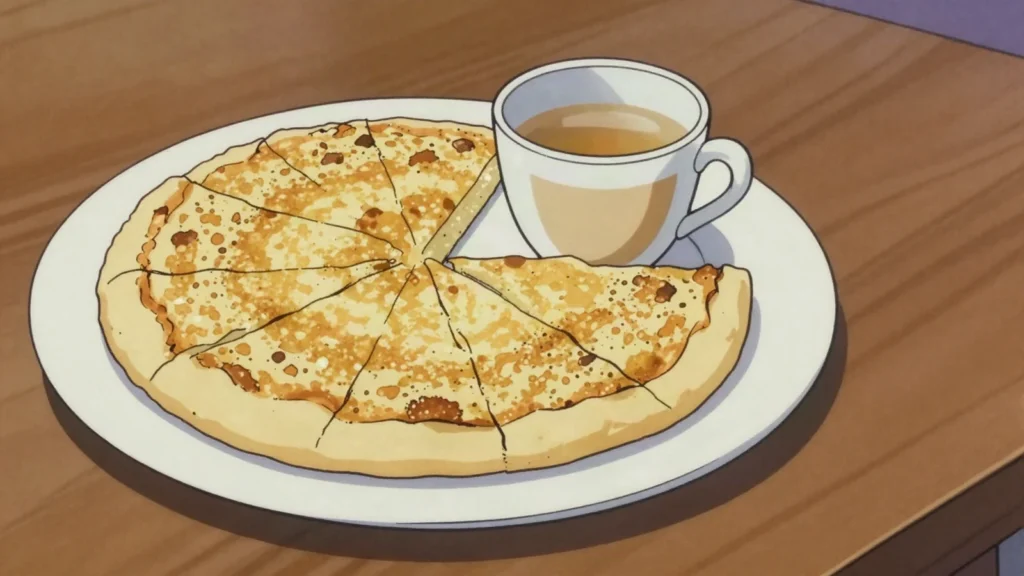
- Serve it hot, cut into wedges, with cocido.
- It goes hard and dry within an hour, so it is cooked and eaten immediately rather than made ahead.
- It is winter food in Paraguay, eaten at breakfast or in the afternoon with the burnt yerba mate tea, and it comes from Guaraní cooking by way of the Jesuit missions.
- Chipa guazú and sopa paraguaya are the related cheese-and-maize dishes, and none of the three is what its name suggests.
Technique
- Queso Paraguay is fresh, firm and salty; a young halloumi or a firm feta is closer than mozzarella.
- Some households add an egg, which makes it hold together more easily but less crumbly.
- Almidón is sweet cassava starch, sold as tapioca starch or polvilho doce.
Substitutions
- Tapioca starch or polvilho doce for almidón.
- Butter in place of lard, which is milder.
Variations
- Mbeju mestizo, made with cornflour as well as cassava starch.
- With anise seed through the mixture.
- Cooked thinner and crisper.
History
Starch and cheese griddle cake from Guarani and Jesuit mission cooking; the Guarani name means cake.
Frequently asked questions
What is Mbeju?
Mbeju is a snack from Paraguay: griddled starch-and-cheese flatcake, crumbly winter treat. Starch and cheese griddle cake from Guarani and Jesuit mission cooking; the Guarani name means cake.
How long does Mbeju take to make?
Mbeju takes 15 min of preparation and 20 min of cooking. The recipe makes 4 large cakes. It is rated medium to make.
What can I substitute in Mbeju?
Yes, within limits. Tapioca starch or polvilho doce for almidón. Butter in place of lard, which is milder.
What is the most important thing to get right in Mbeju?
Rub the lard into the cassava starch with your fingertips until the whole mixture looks like coarse breadcrumbs.