
Ingredients
Base
- 400 gdried locro maize, soaked overnight
- 300 gdried beans, soaked overnight
- 3 litreswater
Meat
- 500 gbeef ribs or salted beef
- 200 gpork ribs
Sofrito
- 2 tbsplard
- 2onions, chopped
- 1sweet pepper, chopped
- 3 clovesgarlic
- 2tomatoes, chopped
- 1 tspground cumin
- 1 tspdried oregano
- salt
To finish
- 2 tbspchopped parsley
- spring onion
To serve
- mandioca
Directions
- Soak the maize and the beans separately overnight, and drain both.
- Boil the maize on its own first for about an hour before anything else joins it.
- Maize takes far longer than beans. Started together, the beans dissolve completely while the maize is still hard, which is the usual way this dish goes wrong.
- Add the beans and the meat and simmer for another hour, until everything is tender.
- Skim the surface as it cooks and keep the pot at a bare simmer.
- Make the sofrito separately: fry the onion, pepper and garlic in the lard until soft, then add the tomatoes, cumin and oregano and cook it down.
- Stir the sofrito into the pot for the last 20 minutes.
- Adding it late keeps it distinct. Cooked in from the start it disappears entirely into the starch.
- Mash a ladleful of the beans against the side of the pot to thicken it.
- It should be thick and soupy at once, not a clear broth and not a solid mass.
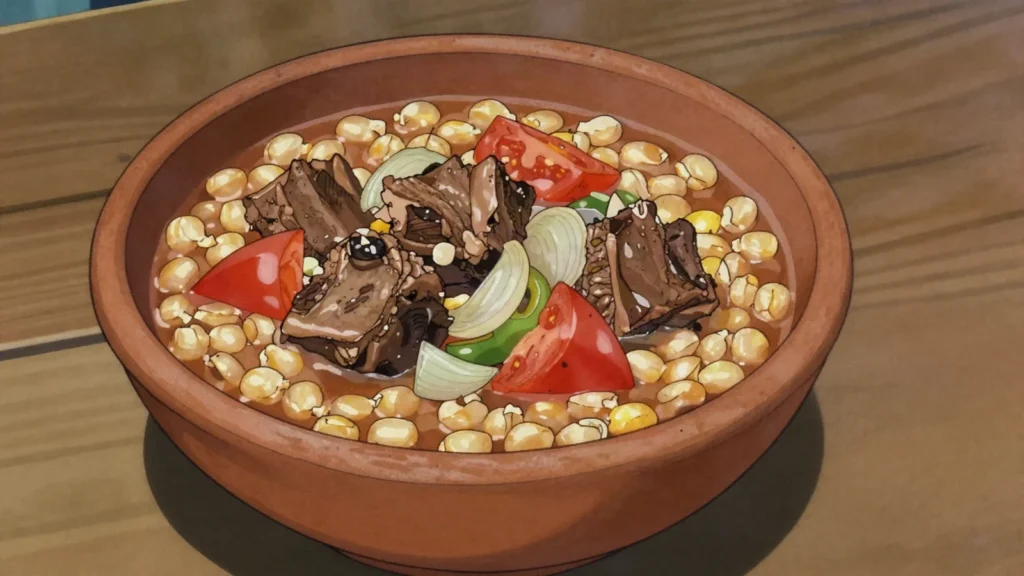
- Season, stir in the parsley and spring onion, and serve with boiled mandioca.
- It is eaten on the first of October, for Karai Octubre, a Guaraní tradition in which a full pot on that day is said to keep hunger from the house for the rest of the year.
- The name means mixture in Guaraní, and it is used in Paraguay for anything blended, including the mixed Spanish and Guaraní people speak.
Technique
- Locro maize is a large dried white variety, and hominy is the nearest thing elsewhere.
- It is deliberately humble food, and the point of the tradition is that everyone has a full pot that day.
- It is better the next day and is usually made in quantity.
Substitutions
- Tinned hominy and beans, cutting the cooking to under an hour.
- Any stewing beef in place of ribs.
Variations
- Meatless, which is how many households make it.
- With more pork and a smoked bone in the pot.
- Thicker, closer to the Argentinian locro.
History
Made to chase off Karai Octubre, the spirit of hunger; the name means mixture in Guaraní.
Frequently asked questions
What is Jopara?
Jopara is a soup & stew from Paraguay: stew of maize and beans eaten on the first of October. Made to chase off Karai Octubre, the spirit of hunger; the name means mixture in Guaraní.
How long does Jopara take to make?
Jopara takes 20 min plus overnight soaking of preparation and 2 hr of cooking. The recipe makes 8 servings. It is rated easy to make.
What can I substitute in Jopara?
Yes, within limits. Tinned hominy and beans, cutting the cooking to under an hour. Any stewing beef in place of ribs.
What is the most important thing to get right in Jopara?
Maize takes far longer than beans. Started together, the beans dissolve completely while the maize is still hard, which is the usual way this dish goes wrong.