The green herb of European and Middle Eastern cooking — clean, grassy, faintly peppery — and the one that is as often the main ingredient of a dish as its garnish.
Where it comes from
Parsley is native to the central Mediterranean and was grown by the Greeks and Romans, who used it more for wreaths and medicine than for the pot. It became the everyday herb of French, Italian and Levantine kitchens over the Middle Ages and has stayed there: it is the green in a bouquet garni, in persillade, in gremolata, and in the Lebanese tabbouleh, which is mostly parsley with a little bulgur rather than the other way round.
Two forms are grown. Flat-leaf, or Italian, parsley has a stronger, sweeter flavour and is the cook’s parsley across the Mediterranean and Middle East. Curly parsley is milder, coarser in texture, and was for a century the default garnish of the English-speaking world, which is largely why it acquired a reputation for tasting of nothing.
Varieties
- Flat-leaf (Italian) — Dark, flat, serrated leaves; robust and sweet. The parsley for cooking and for salads like tabbouleh.
- Curly — Tightly ruffled leaves, milder, chewier. Better for frying crisp or for a garnish than for flavour.
- Hamburg (root) parsley — Grown for its white, parsnip-like root, which is cooked as a vegetable in German and Eastern European soups.
- Giant of Italy — A large flat-leaf variety with big, tender leaves; the one most often grown for market.
In the kitchen
Parsley takes heat better than most soft herbs and can go in early — stalks tied into a stock or stew, leaves stirred in near the end. Finely chopped with garlic and lemon zest it becomes gremolata for osso buco; with garlic alone, persillade for anything from potatoes to snails.
The stalks have more flavour than the leaves. Save them for stock, or chop them fine and use them; a fistful of leaves chopped fine and folded through warm grains or beans at the end is the Middle Eastern way, and is about quantity — cups, not sprigs.
Choosing and keeping
Bunches should be deep green and firm, without yellowing or slime at the stems. In a glass of water in the fridge, loosely covered, a bunch lasts a week or more.
Dried parsley is a waste of a jar. Frozen chopped parsley, though, keeps its flavour reasonably for cooked dishes; it goes limp on thawing, so use it straight from the freezer.
Dishes with parsley
 Filet américainSeasoned raw minced beef spread on bread or with fries.
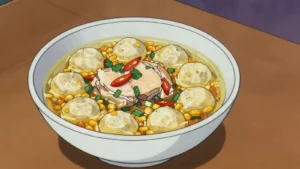 Vori voriChicken broth with corn-and-cheese dumpling balls
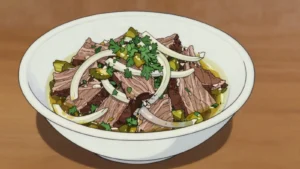 FeierstengszalotCold boiled beef salad with onion, vinegar, mustard and parsley.
 Tlitlirice-shaped pasta baked with chicken, chickpeas and cinnamon; a Constantine wedding dish
 Hortobágyi palacsintasavory crepes filled with paprikash meat, gratinéed in sauce
 Zrazybeaten meat or potato patties rolled around a savoury filling
 Brikshatteringly crisp malsouka pastry around runny egg, tuna, capers and parsley
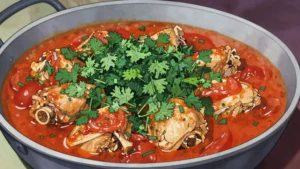 Chakhokhbilichicken stewed with tomatoes and huge handfuls of fresh herbs
Parsley is tagged on 429 dishes from 117 countries in the atlas. These notes are written from general knowledge and carry no per-fact citation — see About.