
Ingredients
The broth
- 1.5 kgbeef bones
- marrow and knuckle
- 500 gbeef shin or brisket
- optional, for a richer broth
- 2onions, halved, skin on
- 2carrots, halved
- 1parsnip
- or a piece of celeriac
- 1leek, split and washed
- a few parsley stalks
- 6black peppercorns
- 2bay leaves
- a small piece of lovage
- or a pinch of dried, optional
- 3 litrescold water
- salt, to taste
The pancakes
- 3eggs
- 250 mlmilk
- 125 gplain flour
- a pinch of salt
- butter or oil, for the pan
- a pinch of grated nutmeg
- optional
To finish
- a handful of chives
- finely sliced
- or parsley, chopped
Directions
- Start with cold water and never let it boil. That is all it should ever do. Put them cut side down in a dry pan. Cook them until the surface is genuinely blackened. That takes about five minutes.
- Leave the skins on for more colour. Rinse the bones under cold water. Put them in a large pot. Cover them with cold water. Bring them slowly to a bare simmer. Grey foam rises in the first twenty minutes. Skim it off carefully with a spoon. Keep skimming until the foam stops rising.
- Add the charred onions, carrot, parsnip and leek. Add the parsley stalks, peppercorns and bay. Add the lovage if you have it. Simmer it uncovered for about three hours.
- Keep it at the barest simmer throughout. Top up with hot water if bones become exposed. Do not stir it at all. Salt it near the end, not at the start. Lift out the bones and vegetables carefully. Strain the broth through muslin or a fine sieve. Do not press the solids at all.
- Let it drip rather than helping it. Let the broth cool and refrigerate it. Lift it off cleanly. That is far easier than skimming warm fat. Keep a little fat if you like a richer broth. A good broth should be clear enough to see the bottom of the bowl.
- Whisk two egg whites into the cold broth. Heat it slowly, stirring until it approaches a simmer. Then stop stirring. Ladle the clear broth out from beneath it. These are thin unsweetened crêpes.
- Whisk the eggs and milk together. Whisk in the flour and salt. Whisk until completely smooth. Add nutmeg if you like. It should be thin, like single cream. Add more milk if it is thick. Thick batter gives heavy pancakes. Rest the batter for thirty minutes. Heat a small frying pan over a medium heat. Brush it with a little butter.
- Pour in just enough batter to coat the base. Swirl the pan to spread it thin. These must be genuinely thin. Pour off any excess batter if you overpour. Cook for about a minute until set and lightly golden.
- Flip it and cook thirty seconds more. Adjust and carry on. Stack the cooked pancakes on a plate. Let them cool completely. Warm pancakes tear when rolled and cut. Cool ones roll and slice cleanly. Roll each pancake into a tight cylinder. Slice it across into thin ribbons. Aim for about half a centimetre wide.
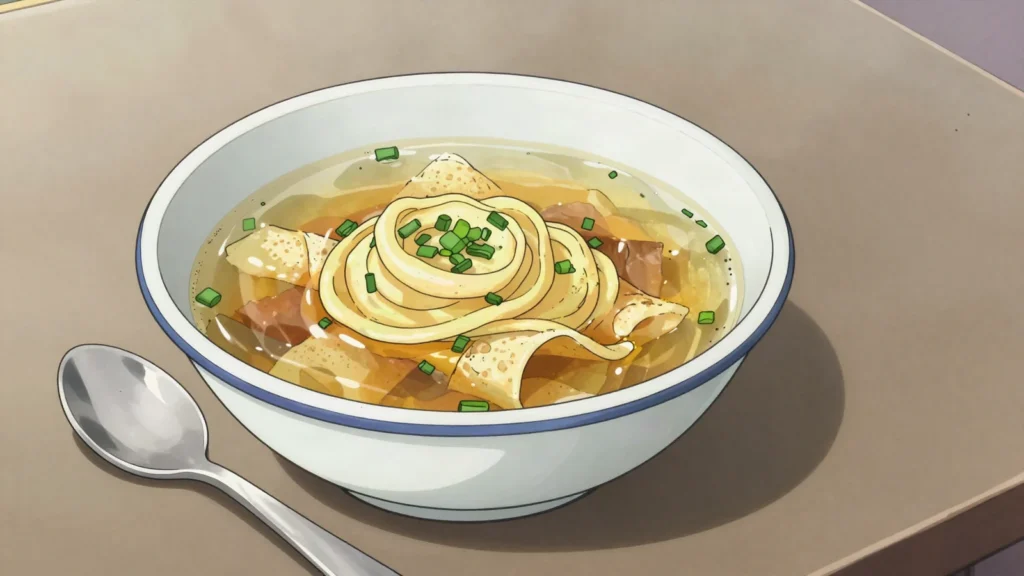
- Heat the strained broth until steaming hot. Taste it and correct the salt. Put a nest of pancake ribbons in each bowl. Pour the hot broth over them at the table. Left too long they go soggy and fall apart.
- Scatter chives over each bowl. The broth keeps five days refrigerated. Freeze it in portions. The pancakes keep two days refrigerated. Stack them with greaseproof paper between. Slice them fresh when you serve them.
Technique
- Never let the broth boil. A bare simmer with the occasional bubble is all it should ever do — boiling emulsifies fat and protein into the liquid and makes it permanently cloudy, which no amount of straining fixes.
- Skim the grey foam off in the first twenty minutes and keep skimming until it stops rising. That foam is what clouds a broth.
- Strain through muslin without pressing the solids. Pressing forces particles through; let it drip instead.
- Char the halved onions cut-side down in a dry pan until genuinely blackened, and leave the skins on. It is five minutes’ work for real colour and depth.
- Salt near the end, not at the start. The broth reduces considerably over three hours.
- Refrigerate the broth and lift the set fat off in one layer. That is far easier and cleaner than skimming warm fat.
- A cloudy broth can be rescued by whisking two egg whites into it cold, heating slowly while stirring until it nears a simmer, then leaving it alone. The whites coagulate into a raft that traps the particles, and you ladle the clear broth out from beneath.
- Make the pancakes genuinely thin — the batter should be like single cream — and rest it thirty minutes so the flour hydrates and the gluten relaxes.
- Cool the pancakes completely before rolling and slicing. Warm ones tear; cool ones cut cleanly into fine ribbons.
- Slice thin, about half a centimetre. Thick ribbons dominate a soup that is broth first and pancake second.
- Pour the broth over the ribbons at the table. They soften as they sit and go soggy if assembled early.
- Lovage tastes strongly of celery and is used constantly in Austrian soups — its other name, Maggikraut, comes from how closely it resembles Maggi seasoning. Celery leaf is the nearest substitute.
- This soup has nowhere to hide. There is no spice or sauce to cover a weak broth, which is why the broth deserves the three hours.
- An Austrian Frittate is a thin crêpe, not the thick set omelette an Italian frittata is. The word travelled through the Habsburg lands and changed meaning.
Substitutions
- A good shop-bought beef stock replaces homemade at a real cost in flavour; reduce it to concentrate it.
- Beef shin or brisket cooked in the broth adds flavour and gives a second course of boiled beef.
- Celeriac replaces parsnip and is at least as common in Austrian soups.
- Celery leaf replaces lovage; a pinch of dried lovage also works.
- Chicken broth replaces beef for a lighter soup, though beef is traditional.
- Chives or parsley both serve as the finishing herb.
Variations
- Leberknödelsuppe puts a liver dumpling in the same broth.
- Griessnockerlsuppe uses semolina dumplings.
- Kaspressknödelsuppe uses flattened cheese dumplings from the Tyrol.
- Nudelsuppe uses fine noodles instead of pancake ribbons.
- Tafelspitz serves the boiled beef from the same pot as a main course.
- Backerbsensuppe scatters small fried batter pearls into the broth.
Frequently asked questions
What is Frittatensuppe?
Frittatensuppe is a soup & stew from Austria: clear beef broth with sliced-pancake ribbons.
How long does Frittatensuppe take to make?
Frittatensuppe takes 20 minutes of preparation and 3 hours for the broth, 20 minutes for the pancakes of cooking. The recipe makes serves 6. It is rated medium to make.
What can I substitute in Frittatensuppe?
Yes, within limits. A good shop-bought beef stock replaces homemade at a real cost in flavour; reduce it to concentrate it. Beef shin or brisket cooked in the broth adds flavour and gives a second course of boiled beef. Celeriac replaces parsnip and is at least as common in Austrian soups. Celery leaf replaces lovage; a pinch of dried lovage also works. Chicken broth replaces beef for a lighter soup, though beef is traditional. Chives or parsley both serve as the finishing herb.
What is the most important thing to get right in Frittatensuppe?
Start with cold water and never let it boil. That is all it should ever do. Put them cut side down in a dry pan. Cook them until the surface is genuinely blackened. That takes about five minutes.