
Ingredients
Syrup
- 300 gcaster sugar
- 150 mlwater
- 1 tsplemon juice
- 1 tbsprosewater
- 1 tbsporange blossom water
Dough
- 400 gakkawi cheese, or unsalted mozzarella
- 150 gfine semolina
- 150 mlwater
- 100 gcaster sugar
- 1 tbsprosewater
Ashta filling
- 500 mlfull-fat milk
- 3 tbspcornflour
- 2 tbspcaster sugar
- 100 mldouble cream
- 1 tsprosewater
To finish
- 50 gground pistachios
- extra syrup, to pour
- dried rose petals, if wanted
Directions
- Cut it into small cubes and put it in a bowl of cold water. Leave it to soak for at least four hours, changing the water every hour. Taste a cube after each change until it tastes only faintly salty. A salty dough will ruin the whole dish, so do not cut this short. Drain the cubes and press out the water in a cloth. Low-moisture unsalted mozzarella can be used and needs no soaking.
- Put the sugar, water and lemon juice in a pan over a medium heat. Stir until the sugar dissolves and then stop stirring. Simmer it for eight minutes until it thickens very slightly. Take it off the heat and stir in the rosewater and orange blossom water. Let it cool completely, since hot syrup on hot dough goes sticky.
- Whisk the cornflour into a little of the cold milk to make a smooth paste. Heat the rest of the milk with the sugar in a saucepan. Pour the cornflour paste into the warming milk, whisking constantly. Bring it to a simmer, still whisking, and cook it for three minutes. It should thicken to a heavy custard that holds a line.
- Take it off the heat and beat in the cream and the rosewater. It needs to be properly cold and firm before you fill anything. Put the water and sugar in a wide non-stick pan and heat until dissolved.
- Cook it for two minutes until it thickens into a paste. Add the drained cheese cubes and lower the heat. Stir constantly with a spatula as the cheese softens and melts. Keep the heat low, since high heat makes the cheese tough and rubbery. It will look lumpy and wrong for several minutes before it comes together.
- Keep working it and it will turn into a smooth stretchy mass. Stir in the rosewater once it is smooth. It is ready when it pulls away from the pan in one piece and stretches when lifted. Brush a work surface or a large tray with cooled syrup. Tip the hot dough onto it and flatten it with a syrup-dipped spatula. Roll it out to about three millimetres thick with a syrup-brushed rolling pin.
- Work fast, since the dough stiffens as it cools and cracks when cold. Reheat it briefly in the pan if it has gone too stiff to roll. Cut the sheet into rectangles about eight centimetres wide. Pipe or spoon a line of cold ashta along one edge of each rectangle.
- Roll each one up over the filling into a neat cylinder. Do not overfill, since the cream squeezes out of the ends. Trim the ends neatly with a wet knife. Now finishing, which is done just before serving.
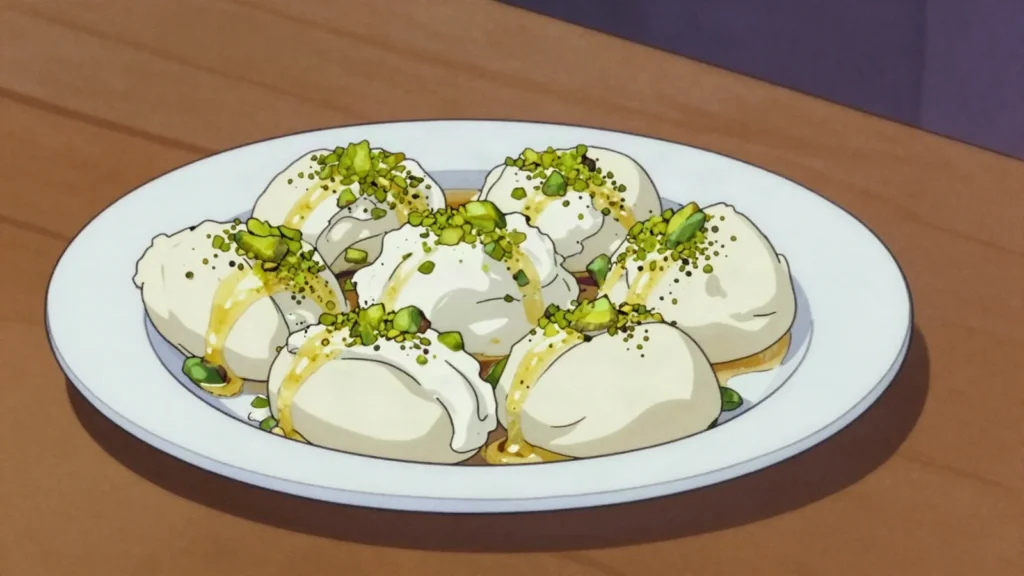
- Lay the rolls on a serving plate, seam side down. Pour a little of the cool syrup over them. Scatter ground pistachios over the top and along the visible cream. Add dried rose petals if you have them. Chill them for thirty minutes before serving. Serve them cool, not cold, since fridge-cold cheese goes firm.
Technique
- Soak the cheese for hours and taste it, since a salty dough ruins the dish.
- Melt the cheese over a low heat, as high heat turns it rubbery.
- Roll the dough while hot, since it cracks once cold.
Substitutions
- Low-moisture unsalted mozzarella, which needs no soaking.
- Shop-bought ashta or thick clotted cream in place of the cooked filling.
Variations
- Made as a flat tray, cut into squares.
- With mastic ground into the dough.
- Filled with plain clotted cream and no rosewater.
History
Semolina and cheese dough rolled around ashta cream, from Hama, served with rosewater syrup.
Frequently asked questions
What is Halawet el-jibn?
Halawet el-jibn is a dessert from Syria: sweet cheese rolls filled with clotted cream, rosewater syrup; Hama origin. Semolina and cheese dough rolled around ashta cream, from Hama, served with rosewater syrup.
How long does Halawet el-jibn take to make?
Halawet el-jibn takes 45 min plus soaking of preparation and 20 min of cooking. The recipe makes 12 rolls. It is rated hard to make.
What can I substitute in Halawet el-jibn?
Yes, within limits. Low-moisture unsalted mozzarella, which needs no soaking. Shop-bought ashta or thick clotted cream in place of the cooked filling.
What is the most important thing to get right in Halawet el-jibn?
Cut it into small cubes and put it in a bowl of cold water. Leave it to soak for at least four hours, changing the water every hour. Taste a cube after each change until it tastes only faintly salty. A salty dough will ruin the whole dish, so do not cut this short. Drain the cubes and press out the water in a cloth. Low-moisture unsalted mozzarella can be used and needs no soaking.