The only food produced solely to be food, and one most adult humans could not digest until a genetic change spread through some dairying populations and not others.
Where it comes from
Cattle, sheep, goats, buffalo, camels, yaks, horses and reindeer are all milked somewhere. Which animal a culture milks follows directly from what its land supports — buffalo in the wet tropics of South Asia, camels in the Sahara and Horn, yaks on the Tibetan plateau, reindeer in the far north.
All mammals stop producing lactase after weaning. Persistence of the enzyme into adulthood evolved separately in northern Europe, in parts of East and West Africa and in the Arabian peninsula, in each case among dairying peoples. Most of the world’s adults are lactose intolerant, and that is the normal human condition rather than a disorder.
This is exactly why so much traditional dairy is fermented. Yoghurt, cheese and soured milks have had much of their lactose eaten by bacteria, which is what made dairy usable in places where fresh milk was not.
Varieties
- Cow — The default in the West. Mild, and the basis of most industrial dairy.
- Buffalo — Much higher in fat and solids. Mozzarella di bufala, and most Indian dairy.
- Goat — Distinctive tang from its fatty acids; the fat globules are smaller, so it does not cream off.
- Sheep — Very rich, high in solids. Roquefort, pecorino, feta, and most of the Mediterranean’s best cheeses.
- Camel — Saltier, does not curdle easily into cheese. Drunk fresh or soured across the Sahara, the Horn and Arabia.
- Mare — Fermented into kumis across the Central Asian steppe — slightly alcoholic, and a staple rather than a curiosity.
In the kitchen
Milk scorches because its proteins and sugars settle and stick. Low heat, a heavy pan, and stirring are what stop it, not watching it.
Milk curdles when acid or heat destabilises its proteins. In a tomato or lemon sauce that is a fault; in paneer or ricotta it is the recipe.
Choosing and keeping
Raw milk carries a real risk of listeria, salmonella and E. coli, which is why it is regulated or banned in many places. Pasteurisation was not a flavour decision.
Dishes with milk
 Tolmincfirm alpine cow's cheese from the Soča valley, nutty and sweet
 CuajadaFresh soft curd cheese eaten with hot tortillas and beans
 ByaslagMild unsalted cheese pressed from yak or cow milk
 Air BandungRose syrup stirred into evaporated milk and served bright pink over ice
 RožataDubrovnik crème caramel perfumed with rose liqueur
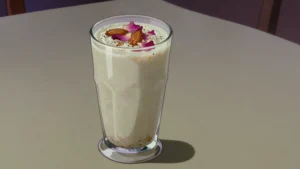 ThandaiCold milk ground with almonds, fennel, poppy seed, pepper and rose
 Königsberger KlopseVeal meatballs in creamy caper sauce with boiled potatoes.
 Laban rayebRaw milk left to sour and set into a tangy curd, eaten cold
Milk is tagged on 800 dishes from 172 countries in the atlas. These notes are written from general knowledge and carry no per-fact citation — see About.