
Ingredients
Fish
- 2whole fish of 700–800 g each (red snapper, bourgeois, job fish, capitaine or jack), scaled, gutted and scored 3 times a side to the bone
- 2 tspcoarse sea salt
- Juice of 2 limes
Baste
- 8garlic cloves
- 40 gfresh ginger, peeled
- 2red chillies, or 1 tsp crushed bird’s eye chilli
- 1 tspcoarse salt
- 1 tspblack pepper
- 2 tbspvegetable oil
- 1 tbspsoy sauce (optional, common in modern island kitchens)
- Juice of 1 lime
- 1 sprigthyme, leaves picked
Chatini
- 1green papaya or 2 golden apples (300 g), peeled and grated
- 1small onion, finely sliced
- 1red chilli, minced
- Juice of 2 limes
- 1 tspsalt
- 1 tbspvegetable oil
To serve
- 400 gwhite rice, steamed
- Lentil dhal
- Lime wedges
Directions
- Score the fish three times on each side, cutting on the diagonal all the way down to the bone. Rub with the coarse salt and lime juice, inside the cavity too, and leave 15 minutes while you make the baste.
- Pound the garlic, ginger, chilli, salt and pepper in a mortar to a rough paste. A mortar gives a fibrous, clinging paste; a blender gives a wet purée that slides off the fish.
- Loosen the paste with the oil, lime juice, soy sauce if using, and the thyme leaves. It should be spoonable but thick.
- Push two-thirds of the baste deep into the scores and the belly cavity with your fingers and marinate 30 minutes at room temperature, no longer, or the lime begins to cook the surface.
- Light a charcoal fire, ideally with coconut husk in it, and let it burn down to grey-ashed embers. Medium heat: you should be able to hold a hand 10 cm above the grate for 4 seconds.
- Oil the grill bars and the skin of the fish well. Lay the fish on and leave it completely alone for 10–12 minutes, until the skin lifts cleanly off the bars when you slide a fish slice under it.
- Turn once, brush with the remaining baste, and grill a further 8–10 minutes. The fish is done when the dorsal fin pulls out with no resistance and the flesh at the backbone is opaque, about 60°C (140°F).
- While it grills, mix the chatini: toss the grated papaya with the onion, chilli, lime, salt and oil and let it sit 15 minutes. It should be sharp, crunchy and salty, the counterpoint to the smoky fish.
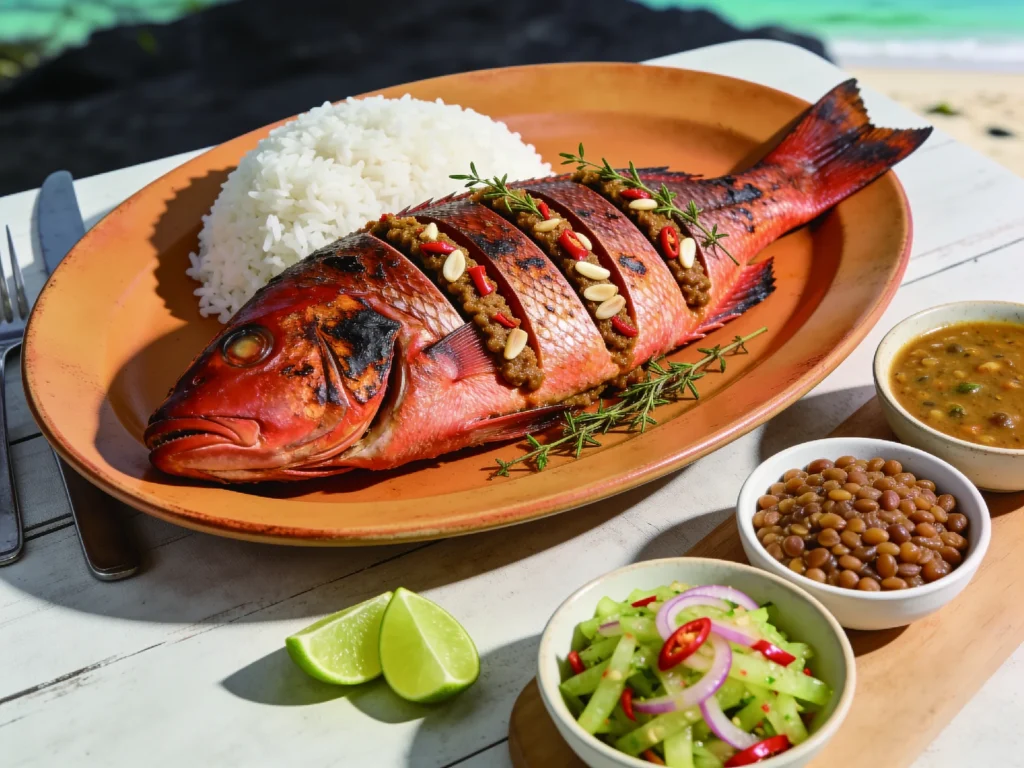
- Rest the fish 5 minutes on a warm platter, then serve whole with rice, dhal, the chatini and lime wedges. Eat the crisp skin; it carries all of the baste.
Technique
- Coconut husk charcoal is the traditional Seychellois fuel and gives a distinctly sweet smoke. If you can get coconut shell charcoal, use it; it burns hot and clean.
- Turn the fish once. Repeated turning tears the skin, and once the skin goes, the flesh dries out over the fire in minutes.
- The baste is applied twice: once before grilling, once at the turn. Do not brush a raw-garlic baste on at the very end and serve it, and do not put lime-heavy baste on early in the cooking, where it burns.
- Grilled fish, rice, dhal and chatini is the standard Seychellois plate, eaten at home and at every Creole beach takeaway, and the chatini changes with what is ripe.
Substitutions
- No charcoal? Roast at 220°C (425°F) for 25 minutes then blast under a hot grill for 4–5 minutes to blister the skin, or use a ridged grill pan for a smaller fish.
- Any firm whole fish works: sea bass, bream, snapper or grey mullet. Avoid very delicate flat fish, which stick and fall apart.
- Green papaya for the chatini can be replaced by grated green mango, green apple or even white cabbage with extra lime.
Variations
- Pwason griye ar sos kreol, served under a cooked tomato, onion and chilli sauce.
- Fish grilled in banana leaf, which steams it and keeps it very moist.
- A version basted with a mix of the same paste and thick coconut milk, brushed on in the last 3 minutes.
History
Grilled fish, simply seasoned and cooked over an open flame, considered a defining everyday dish across the Seychelles, reflecting the archipelago’s heavy reliance on fresh, locally caught fish given its remote Indian Ocean location and limited land available for large-scale agriculture. Its straightforward preparation, typically requiring little more than salt, lime and sometimes a simple chili sauce on the side, lets the quality and freshness of the fish itself remain the clear focus rather than being disguised by elaborate seasoning. Pwason griye remains one of the most commonly eaten dishes across Seychellois households and restaurants alike, considered an essential and unpretentious staple of daily Seychellois cooking.
Frequently asked questions
What is Pwason griye?
Pwason griye is a main from Seychelles: grilled catch-of-the-day with garlic, ginger and chili baste. Grilled fish, simply seasoned and cooked over an open flame, considered a defining everyday dish across the Seychelles, reflecting the archipelago’s heavy reliance on fresh, locally caught fish given its remote Indian Ocean location and limited land available for large-scale agriculture. Its straightforward preparation, typically requiring little more than salt, lime and sometimes a simple chili sauce on the side, lets the quality and freshness of the fish itself remain the clear focus rather than being disguised by elaborate seasoning. Pwason griye remains one of the most commonly eaten dishes across Seychellois households and restaurants alike, considered an essential and unpretentious staple of daily Seychellois cooking.
How long does Pwason griye take to make?
Pwason griye takes 25 min plus 30 min marinating of preparation and 25 min of cooking. The recipe makes 4 servings. It is rated easy to make.
What can I substitute in Pwason griye?
Yes, within limits. No charcoal? Roast at 220°C (425°F) for 25 minutes then blast under a hot grill for 4–5 minutes to blister the skin, or use a ridged grill pan for a smaller fish. Any firm whole fish works: sea bass, bream, snapper or grey mullet. Avoid very delicate flat fish, which stick and fall apart. Green papaya for the chatini can be replaced by grated green mango, green apple or even white cabbage with extra lime.
What is the most important thing to get right in Pwason griye?
The baste is applied twice: once before grilling, once at the turn. Do not brush a raw-garlic baste on at the very end and serve it, and do not put lime-heavy baste on early in the cooking, where it burns.