The one major protein still substantially hunted rather than farmed, and the one whose flesh needs the least cooking of anything on a plate.
Where it comes from
Fish are eaten everywhere there is water, and the preservation methods — salting, drying, smoking, fermenting, pickling — built trades that shaped whole economies. Salt cod fed Atlantic Europe and the Caribbean; dried and fermented fish sauces underpin Southeast Asian cooking; smoked herring did the same for the Baltic and the North Sea.
Roughly half the fish eaten now is farmed. Salmon, carp, tilapia and pangasius are largely farmed; most white sea fish is still wild-caught, and which stocks can bear it changes faster than any cookbook can keep up with.
Varieties
- Oily fish — Salmon, mackerel, herring, sardine, tuna. Fat through the flesh, strong flavour, and they take smoking and grilling well.
- White round fish — Cod, haddock, hake, pollock. Lean, flaky, mild — the fish for frying and poaching.
- Flat fish — Sole, plaice, turbot, halibut. Fine-textured, delicate, and easy to overcook.
- Freshwater fish — Carp, tilapia, catfish, trout, perch. The mainstay far from a coast, and central to Central European and much of African and Asian cooking.
- Salted and dried — Bacalhau, stockfish, dried shrimp. Preserved to travel, and now used for the flavour that preserving gives, not the keeping.
- Fermented — Fish sauce, shrimp paste, surströmming, garum’s descendants. Umami concentrated to the point of being a seasoning.
In the kitchen
Fish has very little connective tissue and its proteins set at a much lower temperature than meat, which is why the window between raw and dry is a minute or two. Take it off while the centre is still slightly translucent; it carries on cooking.
Skin sticks because the pan is not hot enough or the fish is not dry. Dry it, get the pan properly hot, and leave it alone until it releases by itself.
Acid firms and opaques fish flesh without heat, which is the whole of ceviche — but it is not a substitute for cooking where parasites are a concern.
Choosing and keeping
Fresh fish smells of the sea and of almost nothing else. Any ammonia smell means it is gone. Clear, domed eyes and bright red gills are the other honest signals.
Fish frozen at sea is often fresher than the fish on ice at a counter a week later. Frozen is not the compromise it is assumed to be.
Dishes with fish
 Boiled fishGrouper broth with lime, onion, potato; eaten with grits
 BafasSmall plates of fried fish, sausage or offal set out to drink grogue with
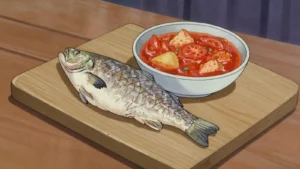 TørrfiskUnsalted cod air-dried on wooden racks until hard as board.
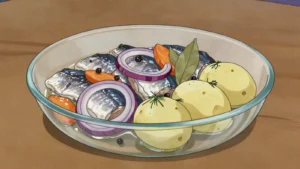 Pickled herringHerring in sweet vinegar with onion; midsummer and Christmas tables.
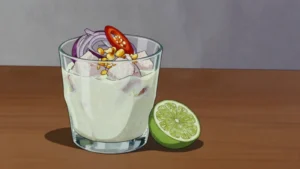 Leche de tigreThe citrus, fish and aji marinade of ceviche, drunk from a glass
 Pan bagnatRound loaf soaked in olive oil and filled with salade niçoise
 Mbongo tchobiInky fish stew flavoured with charred mbongo spice bark
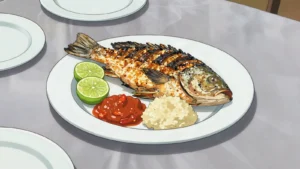 CacussoFreshwater tilapia grilled whole and served with funge and gindungo
Fish is tagged on 488 dishes from 156 countries in the atlas. These notes are written from general knowledge and carry no per-fact citation — see About.