
Ingredients
The pork
- 1.2 kgpork ribs
- cut into individual ribs
- or 1.2 kg pork belly
- or a mixture of both
- with the fat left on
The base
- 3onions, sliced thickly
- 3 tablespoonslard
- or oil
- 4 clovesgarlic, chopped
- 2bay leaves
- 6allspice berries
- 1 teaspooncaraway seeds
- optional
The gravy
- 500 mldark bread kvass
- or 500 ml dark beer
- or 400 ml water
- plus 3 tablespoons vinegar
- 100 gdark rye bread
- crusts, torn small
- or 2 tablespoons rye flour
- 300 mlpork or beef stock
- salt and black pepper
Sometimes added
- 1 tablespoontomato purée
- 2 tablespoonssoured cream
- 1 teaspoonsugar
- or a spoonful of honey
- a few dried mushrooms
- soaked
To serve
- buckwheat or rye pancakes
- or boiled potatoes
- soured cream
- pickled cucumbers
- chopped dill
Directions
- Check the label before buying it though. Use a proper dark rye bread for this. Tear it small so it breaks down. Toast it briefly in a dry pan first. Do not trim the fat away at all. Cut ribs into individual bones. Cut the belly into large chunks. Heat the lard in a large heavy pot. Get the pot genuinely hot first.
- Brown the pork in batches, not all at once. It takes time and it cannot be rushed. Lift each batch out and set it aside. Use thick slices rather than fine ones. Add them with a pinch of salt. Cook the onions for a full fifteen minutes. They should be soft, sweet and golden. Add the garlic in the last two minutes. Add the bay, allspice and caraway.
- Add any juices that collected on the plate. Add the tomato purée if you are using it. Pour in the kvass or the beer. Add the stock to the pot as well. The liquid should nearly cover the meat. Bring it to a boil and then lower it. Simmer it gently, partly covered.
- Simmer for about an hour and a quarter. The pork should become completely tender. Skim the fat off the surface as it collects. Leave some fat, since it carries flavour. Add it in the last twenty minutes.
- Stir it into the liquid thoroughly. That is exactly what should happen. Stir it often once the bread is in. If using rye flour instead, mix it first. Whisk it with a little cold liquid. Never tip dry flour into hot liquid. Add salt and plenty of black pepper. Add more vinegar if it is not sour enough.
- Add sugar or honey if it is too sharp. Stir in soured cream if you want it richer. Add it off the heat so it does not split. Those are thin buckwheat or rye pancakes.
- Serve soured cream on the side. Scatter chopped dill over the top. Leftovers keep four days refrigerated. Stir it as it heats, since bread catches. The gravy may need loosening after thawing.
Technique
- The dish is meant to be genuinely sour, not mildly tangy. That sourness — from kvass, dark beer or vinegar — is the defining characteristic of the gravy, balanced with a little sweetness. Getting that balance right is what makes it work.
- Check the kvass label. Much commercial kvass is heavily sweetened and will not work here; you want one that is genuinely sour. Dark beer, or water with vinegar, are both reasonable substitutes.
- Rye bread is the thickener, which is an old technique that predates flour-based sauces in the region. Use a real dark sourdough rye — light wheat bread does not do the same thing — and stale crusts are exactly what it is for.
- Once the bread goes in, stir often. Bread-thickened gravy catches and burns more easily than a flour-thickened one.
- If you use rye flour instead of bread, whisk it with cold liquid into a slurry first. Dry flour tipped into hot liquid forms lumps that never disperse.
- Do not trim the pork fat. Ribs and belly have the fat and connective tissue the long simmer needs; lean pork dries into stringy fibres.
- Brown the pork properly in batches. Crowding the pot makes the meat release water and turn grey, and that browning is where most of the flavour comes from.
- Add soured cream off the heat if you use it, or it splits. Not every household includes it and the plainest version has none.
- Tradition names the dish after a cook called Vereshchaka at the court of Augustus III. The atlas has found no contemporary source and records it as a story rather than history — such attributions are usually later inventions. Another explanation links the name to a verb for sizzling, describing the frying of the pork. The atlas records both without choosing.
Substitutions
- Dark beer replaces kvass and gives a similar depth with less sourness; add vinegar to compensate.
- Water with three tablespoons of vinegar replaces both and gives a sharper, simpler sourness.
- Rye flour, toasted briefly in a dry pan, replaces the bread as thickener.
- Pork belly, ribs or a mixture all work; a mixture is genuinely good.
- Oil replaces lard, though lard suits the dish and is traditional.
- Boiled potatoes replace the pancakes and soak up the gravy just as well.
Variations
- A version with soured cream stirred through at the end is richer and paler.
- Some cooks add soaked dried mushrooms, which deepens the gravy considerably.
- Machanka is the closely related Belarusian dish, a pork gravy for dipping pancakes into, and the two overlap.
- A version made with sausage alongside the ribs appears in some households.
- Related sour bread-thickened pork stews are made in Lithuania, Poland and Ukraine.
- Some versions are made much thinner and served as a soup rather than a stew.
History
Pork stewed in a sour, bread-thickened gravy and eaten with pancakes; tradition names it after a cook at King Augustus III’s court.
Frequently asked questions
What is Vereshchaka?
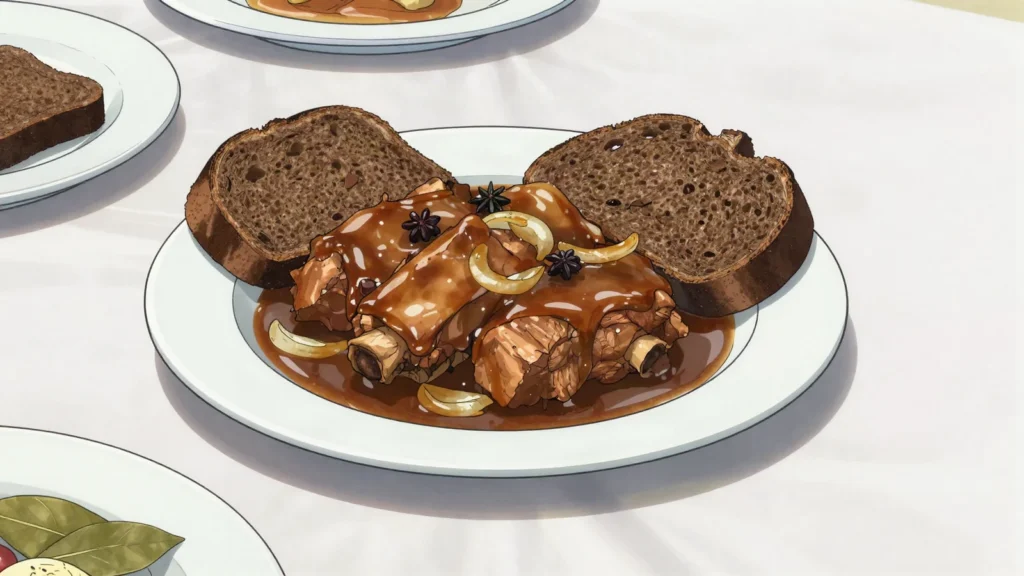
Vereshchaka is a main from Belarus: pork ribs stewed in dark rye-kvass gravy. Pork stewed in a sour, bread-thickened gravy and eaten with pancakes; tradition names it after a cook at King Augustus III’s court.
How long does Vereshchaka take to make?
Vereshchaka takes 25 minutes of preparation and 1 hour 30 minutes of cooking. The recipe makes serves 6. It is rated medium to make.
What can I substitute in Vereshchaka?
Yes, within limits. Dark beer replaces kvass and gives a similar depth with less sourness; add vinegar to compensate. Water with three tablespoons of vinegar replaces both and gives a sharper, simpler sourness. Rye flour, toasted briefly in a dry pan, replaces the bread as thickener. Pork belly, ribs or a mixture all work; a mixture is genuinely good. Oil replaces lard, though lard suits the dish and is traditional. Boiled potatoes replace the pancakes and soak up the gravy just as well.
What is the most important thing to get right in Vereshchaka?
Check the label before buying it though. Use a proper dark rye bread for this. Tear it small so it breaks down. Toast it briefly in a dry pan first. Do not trim the fat away at all. Cut ribs into individual bones. Cut the belly into large chunks. Heat the lard in a large heavy pot. Get the pot genuinely hot first.