
Ingredients
Vegetables
- 400 gcauliflower, in small florets
- 300 gcarrots, cut into batons
- 300 gsmall aubergines, halved
- 200 ggreen beans, topped and tailed
- 200 gcelery, sliced
- 2 headsgarlic, cloves peeled
- 6green chillies, left whole
- 1small cabbage wedge (200 g), shredded
Brine and seasoning
- 1.2 litreswhite wine or apple vinegar (at least 5 percent acidity)
- 3 tbspcoarse salt
- 2 tbspgolpar (Persian hogweed seed), ground
- 2 tbspdried mint
- 1 tbspdried tarragon
- 1 tbspnigella seeds
- 1 tbspcoriander seeds
- 1 tspblack peppercorns
- 2 tspground turmeric
Directions
- Wash all the vegetables and dry them absolutely. Any water left clinging dilutes the vinegar and is the usual cause of a spoiled jar.
- Cut everything to a similar size so it pickles at the same rate, then spread on clean cloths and leave in an airy place for 2–3 hours until surface dry.
- Sterilise two 1 litre jars and their lids in boiling water or a 120°C (250°F) oven for 15 minutes.
- Toss the vegetables with the salt, ground golpar, dried herbs and whole spices in a large bowl until evenly coated.
- Pack them firmly into the jars, layering the garlic and whole chillies through the mixture, leaving 3 cm of headspace.
- Pour in the vinegar to cover completely, tapping the jar and sliding a clean skewer down the sides to release air pockets. Every piece must be submerged.
- Seal, label with the date and keep in a cool, dark cupboard for at least 3 weeks; 6 weeks gives a rounder, less raw pickle. The colour will dull from bright to olive, which is correct.
- Once opened, keep in the refrigerator and always use a dry, clean spoon. Torshi keeps a year unopened.
- Serve in small dishes at every meal, beside rice, kababs and stews, in the quantity of a condiment rather than a salad.
Technique
- Torshi means sour, and unlike a lacto-ferment this is a straight vinegar pickle: acid goes in from the start, so there is no fermentation gas, no scum and no need to burp the jars.
- Golpar is the defining Persian pickling flavour, warm and slightly resinous. Without it the jar tastes generically pickled rather than Iranian.
- Use vinegar of at least 5 percent acidity and never dilute it below that for a room-temperature pickle. Weak acid plus low salt is how spoilage organisms survive.
- If any jar smells yeasty, looks cloudy or shows a slimy film, discard it. Correct torshi smells only of sharp vinegar and herbs.
Substitutions
- No golpar: a pinch of ground angelica seed or celery seed with a little ground coriander is the nearest approximation.
- Aubergine can be replaced by green tomatoes, cucumber or turnip, all traditional in different provinces.
- Apple vinegar can be swapped for distilled white vinegar, giving a sharper, cleaner jar.
Variations
- Torshi liteh is the soft, chopped, herb-heavy aubergine version from the north, mashed almost to a paste.
- Torshi bandari from the Gulf coast is fiery and includes dates and a great deal of chilli.
- Sir torshi is whole garlic heads alone, aged in vinegar for up to seven years until black and sweet.
History
Pickled vegetables, preserved in a brine of vinegar, salt and often turmeric for colour, documented across Egypt and the wider Middle East and North Africa for centuries as a practical way to extend the availability of seasonal vegetables well beyond their fresh harvest window, before refrigeration existed to keep produce fresh for extended periods. Its name and the pickling technique itself spread widely across a broad swath of formerly Ottoman and Persian-influenced territory, with closely related versions found under the same or very similar names from Egypt through Iraq, Iran and Turkey, reflecting shared regional preservation traditions developed and exchanged across many centuries of trade and cultural contact rather than any single country’s isolated invention. Torshi remains a common accompaniment across Egyptian meals, served alongside richer main dishes to add acidity and crunch.
Frequently asked questions
What is Torshi?
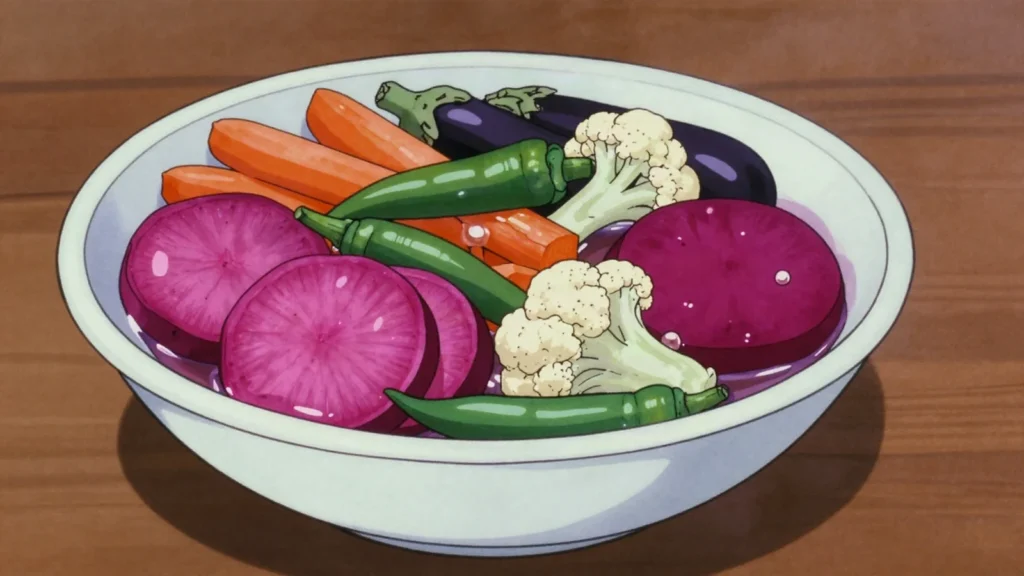
Torshi is a fermented & pickled from Egypt: salt-brined turnips, carrots, limes and peppers, stained pink with beetroot. Pickled vegetables, preserved in a brine of vinegar, salt and often turmeric for colour, documented across Egypt and the wider Middle East and North Africa for centuries as a practical way to extend the availability of seasonal vegetables well beyond their fresh harvest window, before refrigeration existed to keep produce fresh for extended periods. Its name and the pickling technique itself spread widely across a broad swath of formerly Ottoman and Persian-influenced territory, with closely related versions found under the same or very similar names from Egypt through Iraq, Iran and Turkey, reflecting shared regional preservation traditions developed and exchanged across many centuries of trade and cultural contact rather than any single country’s isolated invention. Torshi remains a common accompaniment across Egyptian meals, served alongside richer main dishes to add acidity and crunch.
How long does Torshi take to make?
Torshi takes 40 min of preparation and 3 to 6 weeks maturing of cooking. The recipe makes 2 litre jars. It is rated easy to make.
What can I substitute in Torshi?
Yes, within limits. No golpar: a pinch of ground angelica seed or celery seed with a little ground coriander is the nearest approximation. Aubergine can be replaced by green tomatoes, cucumber or turnip, all traditional in different provinces. Apple vinegar can be swapped for distilled white vinegar, giving a sharper, cleaner jar.
What is the most important thing to get right in Torshi?
Pour in the vinegar to cover completely, tapping the jar and sliding a clean skewer down the sides to release air pockets. Every piece must be submerged.