
Ingredients
The meat
- 800 glamb shoulder
- or beef chuck
- cut into 3 cm cubes
- trimmed but not fat-free
The vegetables
- 2onions, roughly chopped
- 2green peppers
- the long thin Turkish type
- chopped
- 3tomatoes, chopped
- 2 clovesgarlic, sliced
- 1small aubergine, cubed
- optional
- 2potatoes, cubed
- optional
The seasoning
- 2 tablespoonsbutter
- or 2 tablespoons olive oil
- 1 tablespoontomato purée
- 1 tablespoonred pepper paste
- biber salçası
- 1 teaspoondried oregano
- 1 teaspoondried thyme
- half a teaspoon black pepper
- 1 teaspoonsalt
- 2bay leaves
The liquid
- 150 mlwater or stock
- no more than that
- a splash of red wine, optional
To seal and serve
- a clay testi jug
- or a heavy casserole with lid
- greaseproof paper and foil
- or a dough seal, flour and water
- flatbread, to serve
- rice pilaf
- a green salad
Directions
- Steam escapes suddenly when the seal breaks. Keep hands and faces well clear of the opening. Wrap the jug in a thick cloth before striking it. Wear eye protection if you are doing this at home.
- Seal the lid with foil or with a dough rope. You lose the theatre but keep the cooking. Cut the meat into generous three centimetre cubes. If browning, get the pan genuinely hot first. Soak an unglazed jug for twenty minutes at least. Wet clay steams gently and resists cracking. Put the butter into the bottom of the pot. Add the meat, the onions and the garlic.
- Add the peppers, tomatoes and any aubergine. Add the potatoes if you are using them. Add the tomato purée and the pepper paste. Add the herbs, the salt and the black pepper. Too much liquid gives a thin, watery stew.
- Tie it down firmly with kitchen string. Mix flour and water into a stiff paste. Roll it into a rope and press it around the rim. Press a disc of dough over the top of that. The seal must be complete with no gaps at all. Put a cold clay pot into a cold oven. Never put cold clay into a hot oven.
- Cook it for about three hours at that temperature. Do not open it to check during that time. Take the pot out and let it stand ten minutes.
- Lift the far edge first so steam goes away from you. Stand it on a tray or a board, not a table. Score around the neck with a knife point first. The neck should break away cleanly. Pour the contents into a warm serving dish.
- Check the dish carefully for any fragments. Discard the broken jug once it has cooled. Serve it hot with flatbread to mop the sauce. Leftovers keep three days in the fridge.
Technique
- Breaking a clay jug produces sharp fragments and releases a sudden burst of scalding steam. Wrap it in a thick cloth, break it over a tray rather than over a serving bowl, keep faces well clear, and check the poured stew for shards before serving. Eye protection at home is not excessive.
- Add very little liquid. The pot is sealed, so nothing evaporates, and the meat and vegetables release plenty of their own. Too much water is the single most common way this dish goes wrong.
- Never put a cold clay pot into a hot oven, and soak an unglazed testi before use. Start it in a cold oven and bring them up to temperature together, or thermal shock will crack it.
- Do not fill the jug more than three quarters full. Contents expand and a sealed, overfilled pot can force its own seal.
- A heavy casserole sealed with foil under the lid, or with a rope of flour-and-water dough around the rim, reproduces the cooking honestly. What it does not reproduce is the theatre of the breaking, which is a fair trade at home.
- The jugs come from Avanos on the Kızılırmak, where the red river clay has supported potteries for thousands of years. These particular jugs are made to be broken once.
- Lamb shoulder or beef chuck, not a lean cut. Three hours of sealed cooking rewards fat and connective tissue and punishes lean meat.
Substitutions
- Beef chuck replaces lamb shoulder directly and needs the same three hours.
- Chicken thighs work in a shorter version, about ninety minutes, though it is not the traditional meat.
- A heavy lidded casserole replaces the clay jug; seal it with foil under the lid.
- Tomato purée alone replaces red pepper paste, though the depth is noticeably less. A little smoked paprika helps close the gap.
- Regular green peppers replace the long thin Turkish type; they are fleshier and slightly sweeter.
- Olive oil replaces butter, which is what some restaurants use.
- A mushroom and vegetable version, with the same seasoning and seal, is made for vegetarians in some Cappadocian restaurants.
Variations
- Chicken testi kebabi is on most Cappadocian restaurant menus and cooks in about half the time.
- A vegetarian version with mushrooms, aubergine and potato is increasingly common in the region.
- Some restaurants set the sealed jug in embers rather than an oven, which is the older method.
- Çömlek kebabı is the closely related dish cooked in a clay pot that is not broken, and is made across a wider area of Anatolia.
- Tandır kebabı and other sealed-vessel Anatolian meats belong to the same technique family.
- Some cooks add a splash of red wine to the pot, which is a modern restaurant touch rather than a traditional one.
History
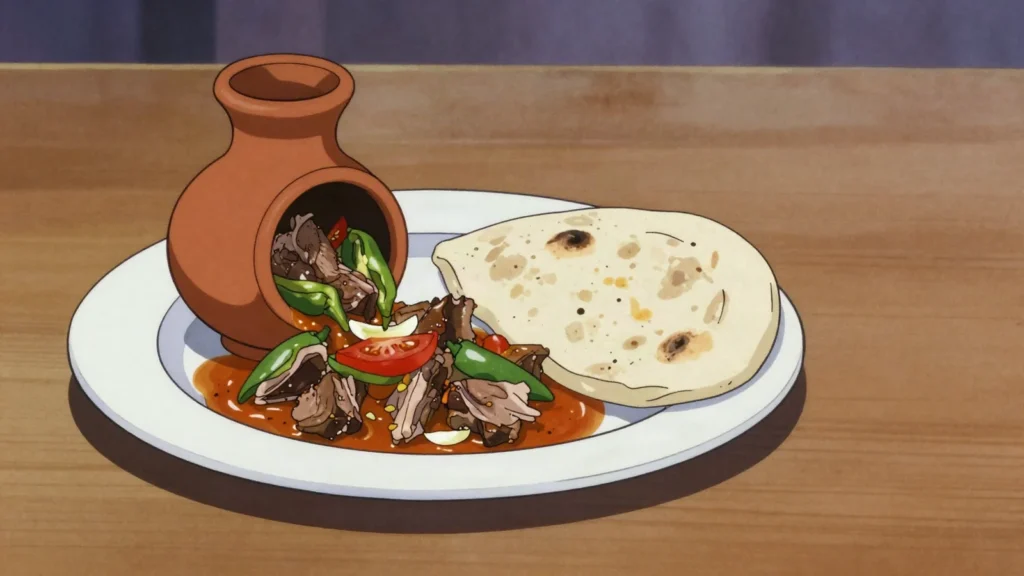
Cappadocian speciality using pottery from Avanos; the sealed jug is broken with a knife in front of diners.
Frequently asked questions
What is Testi kebabi?
Testi kebabi is a main from Turkey: meat and vegetables slow-cooked in a sealed clay jug, cracked open at the table. Cappadocian speciality using pottery from Avanos; the sealed jug is broken with a knife in front of diners.
How long does Testi kebabi take to make?
Testi kebabi takes 30 minutes of preparation and 3 hours of cooking. The recipe makes serves 4. It is rated medium to make.
What can I substitute in Testi kebabi?
Yes, within limits. Beef chuck replaces lamb shoulder directly and needs the same three hours. Chicken thighs work in a shorter version, about ninety minutes, though it is not the traditional meat. A heavy lidded casserole replaces the clay jug; seal it with foil under the lid. Tomato purée alone replaces red pepper paste, though the depth is noticeably less. A little smoked paprika helps close the gap. Regular green peppers replace the long thin Turkish type; they are fleshier and slightly sweeter. Olive oil replaces butter, which is what some restaurants use. A mushroom and vegetable version, with the same seasoning and seal, is made for vegetarians in some Cappadocian restaurants.
What is the most important thing to get right in Testi kebabi?
Tie it down firmly with kitchen string. Mix flour and water into a stiff paste. Roll it into a rope and press it around the rim. Press a disc of dough over the top of that. The seal must be complete with no gaps at all. Put a cold clay pot into a cold oven. Never put cold clay into a hot oven.