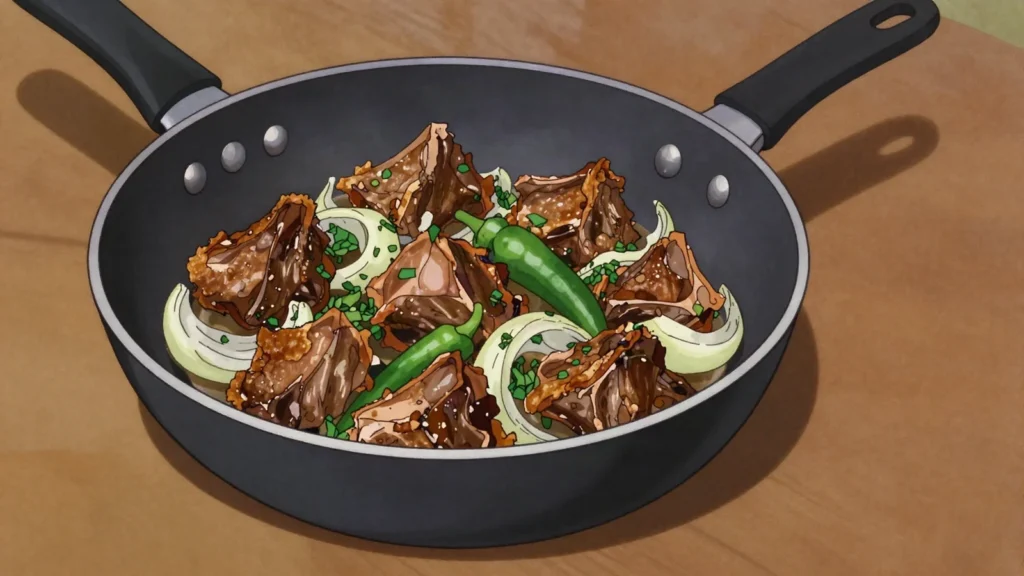

Ingredients
The meat
- 800 glamb or goat
- cut into small chunks
- shoulder or leg
- with some fat left on
The seasoning
- 2 teaspoonssalt
- 1 teaspoonblack pepper
- 1 teaspoonground cumin
- half a teaspoon ground coriander
- 1stock cube, crumbled
- optional
The pan
- 3 tablespoonsoil
- or the meat’s own rendered fat
- 2large onions, sliced
- 2or 3 hot chillies
- chopped, or to taste
- 4 clovesgarlic, sliced
- optional
- 1tomato, chopped
- optional
To finish
- juice of half a lemon
- a handful of coriander or parsley
- chopped
To serve
- flatbread
- or kisra, the sorghum flatbread
- sliced raw onion
- a chilli sauce
- salad
Directions
- Cut it into small chunks. About two centimetres. Keep them even. Large ones need longer and toughen.
- Leave some fat on the meat. Pat it dry with kitchen paper. Season it with salt, pepper and the spices. Use the widest heavy pan you have. Do not crowd the pan. Cook in two batches if the pan is small.
- Heat the pan until it is genuinely hot. Add a little oil or a piece of the fat. Add the meat in a single layer. Do not move it for two or three minutes.
- Let it sit and brown. Give it about eight minutes of searing. Cook it through if you prefer, or for anyone vulnerable. Cut it smaller if you use it. Lift the meat out and set it aside. Add the sliced onions to the pan.
- Cook them for about six minutes. They should soften and colour at the edges. Cook them a minute. Add the tomato if using.
- Cook it briefly. Some versions use it and some do not. Return the meat and any juices. Toss everything together over high heat. Give it two minutes. Season it again and taste. Squeeze over the lemon.
- Scatter the chopped herbs. Serve it immediately, hot from the pan. Bring the pan to the table if you can. Kisra is a thin fermented sorghum flatbread.
Technique
- Do not crowd the pan, and cook in two batches if it is small. Crowded meat releases liquid and boils in it, giving grey unbrowned meat — the commonest failure with any fried meat dish, and it is faster to use two batches than to fix one.
- Pat the meat dry and then leave it alone for two or three minutes once it is down. Wet meat will not brown and constant stirring gives grey meat; that undisturbed contact is where the flavour comes from.
- Use a tender cut and cut it small, about two centimetres. This cooks in twenty-five minutes, and tough cuts like shin or neck need hours — they simply stay chewy here.
- Leave the fat on. It renders and becomes the cooking fat, and many versions add no oil at all, which gives a cleaner more concentrated result.
- Keep the onions with some bite, about six minutes. They should soften and colour at the edges rather than collapsing into a paste — that texture is part of the dish.
- Keep it dry. There should be very little liquid at the end: a little buttery juice is right, a pool of sauce is not.
- Use cumin generously. It is a defining flavour of Sudanese and South Sudanese cooking rather than a background note.
- The lemon at the end is necessary rather than optional. It lifts a rich fatty dish that sits heavy without it.
- Whole-muscle lamb or goat cubes can be served slightly pink, since bacteria sit on the seared surface — unlike mince. Cook them through if you prefer or for anyone vulnerable. Goat is leaner and tougher than lamb and benefits from being cut smaller and cooked a little further.
- Meat cooked this way in the region is often very fresh, which behaves differently from aged supermarket meat of the same cut and is more forgiving.
- Stock cubes are a standard seasoning across the region rather than a shortcut.
- Kisra, the thin fermented sorghum flatbread, needs a fermented batter and a wide hot plate and is genuinely difficult to make. Any flatbread substitutes for eating this.
Substitutions
- Lamb or goat both serve; beef works, needing slightly longer.
- The meat’s own rendered fat replaces added oil and gives a cleaner result.
- Tomato can be added for a little sauce or left out for a drier dish.
- Any flatbread replaces kisra.
- Garlic is optional and used in some versions.
- Fewer chillies make it considerably milder.
Variations
- Agashe and suya in West Africa use a spice crust on grilled meat.
- Kalawi, grilled liver, is cooked at the same butchers’ fires.
- Shawarma and other grilled meats are eaten across the same region.
- A version with a little tomato is common and gives more sauce.
- Ful medames and kisra are the everyday foods alongside.
- Aradeib and gongolez are the cold drinks served with it.
History
Fried rather than grilled, in the meat’s own fat with onion and chili; it is cooked at Eid and to welcome guests, using the freshest slaughter.
Frequently asked questions
What is Shaiyah?
Shaiyah is a main from South Sudan: pan-fried chunks of lamb or goat with onion and chili. Fried rather than grilled, in the meat’s own fat with onion and chili; it is cooked at Eid and to welcome guests, using the freshest slaughter.
How long does Shaiyah take to make?
Shaiyah takes 15 minutes of preparation and 25 minutes of cooking. The recipe makes serves 4. It is rated easy to make.
What can I substitute in Shaiyah?
Yes, within limits. Lamb or goat both serve; beef works, needing slightly longer. The meat’s own rendered fat replaces added oil and gives a cleaner result. Tomato can be added for a little sauce or left out for a drier dish. Any flatbread replaces kisra. Garlic is optional and used in some versions. Fewer chillies make it considerably milder.
What is the most important thing to get right in Shaiyah?
Leave some fat on the meat. Pat it dry with kitchen paper. Season it with salt, pepper and the spices. Use the widest heavy pan you have. Do not crowd the pan. Cook in two batches if the pan is small.