
Ingredients
The shallots
- 10small shallots
- or 6 banana shallots
- sliced very thinly
The lemongrass
- 4 stalkslemongrass
- tender inner part only
- sliced very thinly
The chillies
- 6to 10 bird’s eye chillies
- sliced thinly
- or to taste
The rest
- 6kaffir lime leaves
- shredded as finely as you can
- 1 teaspoonterasi
- the fermented shrimp paste, toasted
- or leave out for a vegan version
- 1 teaspoonsalt
- or to taste
- juice of 2 limes
- or key limes
- 4 tablespoonscoconut oil
- or more
- half a teaspoon sugar
- optional
To serve
- with grilled fish or chicken
- with rice
- as one condiment among several
Directions
- Use the sharpest knife you have. Slice them across into fine rings. Use plenty. Ordinary onion is too watery and too harsh. Trim off the dry top two thirds. Peel away the tough outer layers.
- Slice it across the grain as finely as you can. Aim for paper-thin rings. Roll them tightly and slice them into threads. Remove the tough central stem first. Thick pieces will not soften.
- Slice them thinly across. Sambal matah is genuinely hot. Reduce them freely if you need to. Capsaicin oil clings to skin for hours. Wrap a small piece in foil. Toast it in a dry pan two minutes a side. It fills a house and lingers for hours.
- Keep opened blocks wrapped and refrigerated. Coconut oil is solid below about twenty-four degrees. Warm it gently to melt it. In a cool kitchen the relish will firm up.
- Put all the sliced ingredients in a bowl. Crumble in the toasted terasi. Add the salt and lime juice. Add the sugar if using. Pour the coconut oil over. Mix it with your hands. Squeeze and rub the mixture. Give it a minute or two.
- Mix everything and let it stand fifteen minutes. Heat the coconut oil until hot. Pour it over the sliced ingredients. It also makes the relish keep a little longer. Let it stand fifteen to thirty minutes. It should be sharply sour and clearly hot.
- Add lime and salt until it is assertive. Serve it in a small bowl alongside. The raw version keeps a day refrigerated. Let it come to room temperature before serving.
Technique
- Everything must be sliced extremely thinly, and that is what makes the relish work rather than a stylistic choice. These ingredients are all raw and all assertive — thick raw shallot is overwhelming, thick lemongrass is woody and inedible, and thick lime leaf never softens.
- Use only the pale tender core of the lemongrass and expect to discard most of each stalk. Four stalks give a small handful of usable core, and that is correct.
- Use the sharpest knife you have. A blunt knife crushes shallots instead of slicing them, and crushed shallot goes watery and harsh.
- Mix it with your hands, squeezing and rubbing for a minute or two. That bruises the shallot slightly, releases the oils from the lemongrass and lime leaf, and distributes the terasi — a spoon does none of it.
- Toast the terasi first, wrapped in foil, two minutes a side. It becomes nutty rather than raw and harsh and crumbles into the relish. Open the windows first — the smell fills a house and lingers for hours.
- Make it shortly before eating. The shallot softens and loses its bite and the lime dulls; freshness is the whole point of a sambal called raw.
- Use coconut oil generously and unrefined if you can. It binds the relish and its flavour belongs here — a neutral oil gives a flatter result. It solidifies below about 24 degrees, so the relish firms up in a cool kitchen and softens again at room temperature.
- Wear gloves for the slicing and the mixing. Capsaicin clings to skin for hours and transfers to eyes long after washing.
- Season it assertively — sharply sour, clearly hot, salty enough to season the food it goes on. It is a condiment used a spoonful at a time, not a salad.
- The warmed version, with hot coconut oil poured over, softens the raw shallot edge, draws out more aroma and keeps a little longer, at the cost of brightness. Purists prefer it entirely raw, since the name means raw. Both are made and the atlas does not adjudicate.
- Frozen kaffir lime leaves work well; dried have almost no aroma. Remove the tough central stem before shredding.
- Small Asian shallots are more pungent and less watery than banana shallots, and ordinary onion is both too watery and too harsh.
- Terasi is a shrimp product and shellfish allergy can cause anaphylaxis. Without it the relish is vegan and noticeably less savoury — say plainly which version you have made.
Substitutions
- Banana shallots replace small Asian shallots, giving a milder relish.
- Leaving out the terasi makes it vegan; add a little extra salt to compensate.
- Any neutral oil replaces coconut oil, at real cost to the flavour.
- Frozen kaffir lime leaves replace fresh; dried do not.
- Key limes or ordinary limes both serve.
- Fewer chillies make it considerably milder without changing anything else.
Variations
- Sambal matah warmed with hot coconut oil is the softer, longer-keeping version.
- Sambal terasi is the pounded cooked chilli and shrimp paste relish.
- Sambal ulek is chilli and salt alone, ground in a mortar.
- Sambal bawang uses fried shallots and garlic.
- Ikan bakar, the grilled fish, is the classic partner.
- A version with grated fresh coconut worked through is made in some households.
Frequently asked questions
What is Sambal Matah?
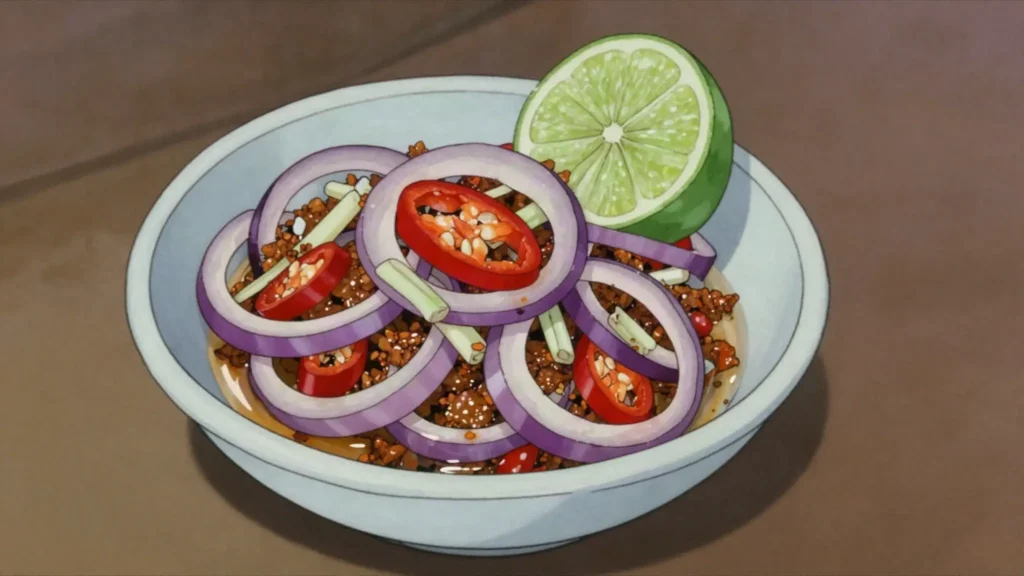
Sambal Matah is a sauce & condiment from Indonesia: raw Balinese relish of sliced shallot, lemongrass, chilli and coconut oil.
How long does Sambal Matah take to make?
Sambal Matah takes 20 minutes of preparation and 5 minutes, or none of cooking. The recipe makes makes about 1 bowl. It is rated easy to make.
What can I substitute in Sambal Matah?
Yes, within limits. Banana shallots replace small Asian shallots, giving a milder relish. Leaving out the terasi makes it vegan; add a little extra salt to compensate. Any neutral oil replaces coconut oil, at real cost to the flavour. Frozen kaffir lime leaves replace fresh; dried do not. Key limes or ordinary limes both serve. Fewer chillies make it considerably milder without changing anything else.
What is the most important thing to get right in Sambal Matah?
Everything must be sliced extremely thinly, and that is what makes the relish work rather than a stylistic choice. These ingredients are all raw and all assertive — thick raw shallot is overwhelming, thick lemongrass is woody and inedible, and thick lime leaf never softens.