
Ingredients
Noodles
- 500 gstrong white flour
- 240 mlwarm water
- 2 tspsalt
- ½ tspbaking soda, dissolved in the water
- 100 mlsunflower oil, for coating
Sauce (vaju)
- 500 glamb or beef, cut into 1 cm strips
- 4 tbspsunflower oil, or rendered tail fat
- 2onions, sliced
- 4garlic cloves, sliced
- 2bell peppers, in strips
- 200 glong beans or garlic chives (jusai), in 4 cm lengths
- 2tomatoes, chopped, plus 1 tbsp tomato paste
- 1 tspground cumin, 1 tsp coriander seed, 1 star anise, 1 tsp chilli flakes
- 2 tbspsoy sauce, 1 tbsp rice vinegar
- 300 mlwater or broth
- salt and black pepper
To serve
- chilli oil (lazjan), rice vinegar, chopped coriander
Directions
- Dissolve the salt and baking soda in the warm water, then work it into the flour to a firm dough. Knead 10 minutes, cover and rest 30 minutes. The alkali is what makes the dough stretchy enough to pull.
- Knead again for 5 minutes, then cut the dough into thick ropes, roll each under your palms to the thickness of a finger, and coil them in a deep bowl, oiling every layer generously so they cannot dry or stick.
- Cover with oiled film and rest 1 hour 30 minutes to 2 hours at room temperature. This long oiled rest is the real secret of hand-pulled noodles: the gluten relaxes until the rope stretches like elastic.
- Make the sauce meanwhile. Heat the oil in a wok until it just smokes, then sear the meat strips hard for 3–4 minutes until browned.
- Add onion and garlic and stir-fry 2 minutes, then the tomato paste, cumin, coriander, star anise and chilli, and fry 1 minute until it smells toasted.
- Add the peppers, beans and chopped tomato and stir-fry 3 minutes over high heat so they stay crisp, then pour in the water, soy and vinegar and simmer 12–15 minutes until the sauce is glossy and coats a spoon.
- Bring a large pot of water to a hard boil. Take one rope, hold it at both ends and stretch it steadily, slapping it against the table and doubling it back on itself, repeating until you have a long thin strand of even thickness.
- Drop the strands into the boiling water as you pull them and cook 2–3 minutes only, until they float and turn glassy but still bite. Lift them out and rinse briefly in warm water to stop them gumming.
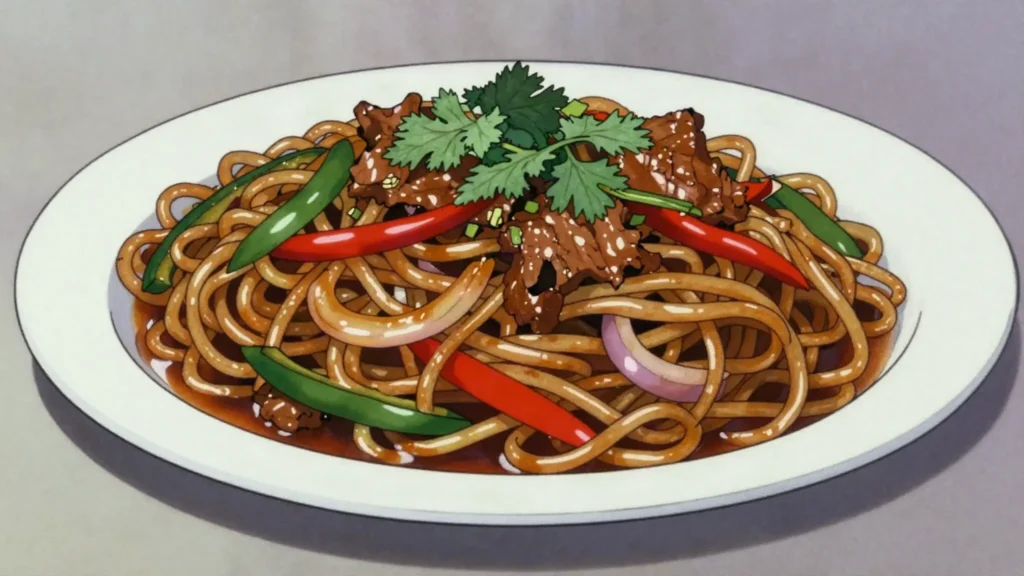
- Divide the noodles between deep bowls, ladle the vaju over the top, and serve with chilli oil and vinegar so each person can adjust their own.
- Eat immediately. Hand-pulled noodles soften within minutes and are never made ahead.
Technique
- Laghman came to Kyrgyzstan with the Dungan, Chinese-speaking Muslims who fled to the Ferghana valley in the 1870s, and it is a direct relative of Uyghur leghmen and of Lanzhou hand-pulled noodles.
- Slap and stretch, do not tug. Sudden force snaps the strand; steady tension plus the slap against the table is what thins it evenly.
- If the dough will not stretch, it has not rested long enough or the room is too cold. Give it another 30 minutes under oil.
- Guiru laghman means the sauce is served over the noodles; boso laghman means the boiled noodles are then fried with the sauce in the wok.
Substitutions
- Cannot pull noodles: roll the rested dough out and cut it into 4 mm ribbons, or use fresh Chinese wheat noodles. Dried spaghetti is a distant last resort.
- No jusai (garlic chives): use Chinese chives, spring onion greens or celery leaf.
- Beef, mutton or even chicken all work in the sauce; mutton with tail fat is the most traditional in Central Asia.
Variations
- Boso laghman, the fried version, cooked in a wok until the edges of the noodles catch.
- Suyuq laghman, served soupy in a bowl of broth, eaten in winter.
- The Dungan ashlan-fu of Karakol, a cold relative made with starch jelly and noodles in a sour chilli broth.
History
Hand-pulled noodles from Uyghur and Dungan cooks, served in broth or fried with vegetables.
Frequently asked questions
What is Laghman?
Laghman is a main from Kyrgyzstan: hand-pulled noodles fried or in broth with peppers; Dungan heritage. Hand-pulled noodles from Uyghur and Dungan cooks, served in broth or fried with vegetables.
How long does Laghman take to make?
Laghman takes 40 min plus 2 hr resting of preparation and 40 min of cooking. The recipe makes 4 servings. It is rated hard to make.
What can I substitute in Laghman?
Yes, within limits. Cannot pull noodles: roll the rested dough out and cut it into 4 mm ribbons, or use fresh Chinese wheat noodles. Dried spaghetti is a distant last resort. No jusai (garlic chives): use Chinese chives, spring onion greens or celery leaf. Beef, mutton or even chicken all work in the sauce; mutton with tail fat is the most traditional in Central Asia.
What is the most important thing to get right in Laghman?
Eat immediately. Hand-pulled noodles soften within minutes and are never made ahead.