
Ingredients
Chicken
- 600 gchicken thigh, in 2 cm dice
- 1 tbspShaoxing wine
- 1 tbsplight soy sauce
- 1 tbspcornflour
- 1egg white
Sauce
- 2 tbspChinkiang black vinegar
- 1 tbsplight soy sauce
- 1 tspdark soy sauce
- 1 tbspsugar
- 1 tspcornflour
- 2 tbspstock
Wok
- 12dried Sichuan chillies, halved and deseeded
- 1 tbspSichuan peppercorns
- 4 clovesgarlic, sliced
- 2cm ginger, sliced
- 4spring onions, in 2 cm lengths
- 3 tbspoil
To finish
- 80 groasted peanuts
Directions
- Marinate the diced chicken in the Shaoxing wine, soy, cornflour and egg white for 20 minutes.
- This is velveting, and it is what gives restaurant chicken its smooth surface. The starch and egg white form a coating that protects the meat from the fierce heat of the wok.
- Mix all the sauce ingredients in a bowl and have it beside the hob.
- Have everything cut, measured and within reach before you light the burner. The whole cook takes about three minutes and there is no time to fetch anything.
- Deseed the dried chillies, because the seeds burn bitter and contribute little heat.
- Heat the wok until it smokes, then add the oil.
- Add the Sichuan peppercorns and dried chillies and fry them for 15 to 20 seconds only.
- Twenty seconds at most. They should darken slightly and smell fragrant; blackened chilli turns the whole dish acrid and cannot be picked out.
- Add the chicken in a single layer and leave it undisturbed for 30 seconds to sear before stirring.
- Stir-fry for 2 minutes until the chicken is just cooked, then add the garlic, ginger and spring onion whites.
- Stir the sauce to re-suspend the cornflour and pour it in around the edge of the wok.
- Pour it round the rim rather than into the middle. It hits hot metal and reduces instantly instead of cooling the pan.
- Toss for 30 seconds until the sauce thickens and coats everything glossily.
- Add the peanuts and spring onion greens and toss once more.
- Peanuts go in at the very end. Cooked in the sauce they soften, and the contrast of crisp peanut against tender chicken is half the dish.
- Serve immediately with rice, because the peanuts soften within a few minutes of meeting the sauce.
- The signature is málà, numbing and hot at once: the Sichuan peppercorn does the numbing and the chilli does the heat, and a version without the peppercorn is not really kung pao.
- It is named for Ding Baozhen, a Qing governor of Sichuan whose honorary title was gōngbǎo, and the dish was briefly renamed during the Cultural Revolution for that association.
Technique
- The Western sweet-and-sticky version with sweet peppers is a different dish that borrowed the name.
- Chinkiang black vinegar is essential for the sour note and balsamic is not a substitute.
- Thigh rather than breast, which stays tender at wok heat.
Substitutions
- Dry sherry in place of Shaoxing wine.
- Cashews instead of peanuts, which is a common variation.
Variations
- Gong bao shrimp.
- The Cantonese version, sweeter and with sweet peppers.
- Vegetarian, with pressed tofu or king oyster mushroom.
History
Named for Ding Baozhen, a Qing-dynasty governor of Sichuan province in the 1800s, whose official title translated roughly to ‘palace guardian,’ or gongbao in Mandarin, from which the dish’s English name kung pao derives. Ding was said to favor a spicy stir-fry of diced chicken, peanuts and dried chilies from his home region, and the dish spread under his name after his death, becoming a fixture of Sichuan cuisine defined by its use of Sichuan peppercorn alongside dried chili, producing the specific numbing-and-hot sensation, málà, that distinguishes true Sichuan kung pao from the sweeter, milder versions common in Chinese restaurants abroad, which often drop the peppercorn and add more sugar to suit outside tastes.
Frequently asked questions
What is Kung Pao Chicken?
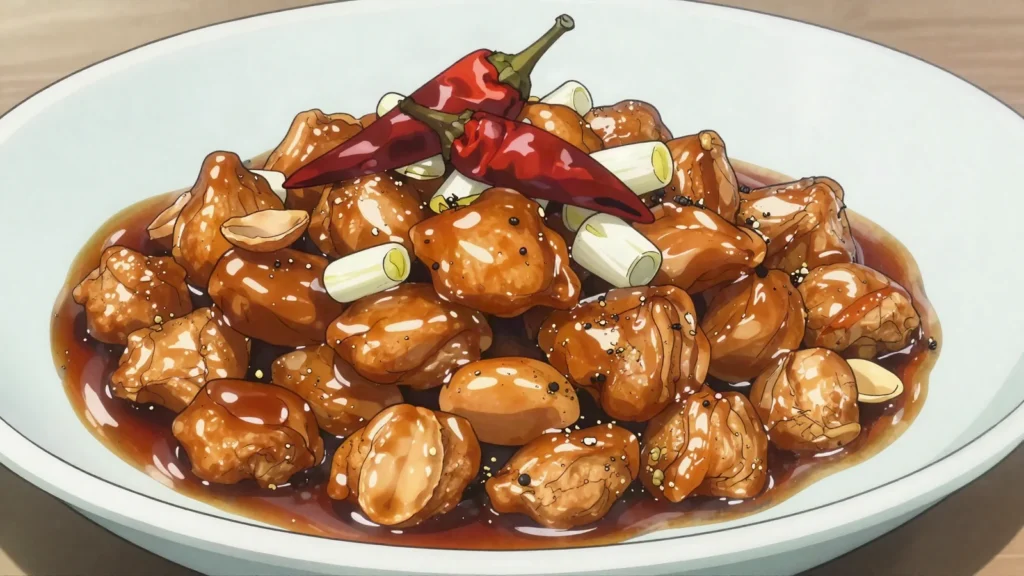
Kung Pao Chicken is a main from China: stir-fried diced chicken with peanuts and dried chilies in tangy Sichuan sauce. Named for Ding Baozhen, a Qing-dynasty governor of Sichuan province in the 1800s, whose official title translated roughly to ‘palace guardian,’ or gongbao in Mandarin, from which the dish’s English name kung pao derives. Ding was said to favor a spicy stir-fry of diced chicken, peanuts and dried chilies from his home region, and the dish spread under his name after his death, becoming a fixture of Sichuan cuisine defined by its use of Sichuan peppercorn alongside dried chili, producing the specific numbing-and-hot sensation, málà, that distinguishes true Sichuan kung pao from the sweeter, milder versions common in Chinese restaurants abroad, which often drop the peppercorn and add more sugar to suit outside tastes.
How long does Kung Pao Chicken take to make?
Kung Pao Chicken takes 25 min of preparation and 10 min of cooking. The recipe makes 4 servings. It is rated medium to make.
What can I substitute in Kung Pao Chicken?
Yes, within limits. Dry sherry in place of Shaoxing wine. Cashews instead of peanuts, which is a common variation.
What is the most important thing to get right in Kung Pao Chicken?
Have everything cut, measured and within reach before you light the burner. The whole cook takes about three minutes and there is no time to fetch anything.