
Ingredients
Grits
- 400 gcoarse maize grits, kharang
- water, for soaking and steaming
To serve
- kewa datshi, potato and cheese stew
- or ema datshi, chilli and cheese stew
- ezay, chilli relish
Equipment
- a steamer basket, or a cloth-lined colander over a pot
Directions
- Rinse the grits in a sieve under cold water. Put them in a bowl and cover with cold water by two centimetres. Leave them to soak for at least two hours.
- Drain them thoroughly in a sieve and let them stand for ten minutes. They should be damp rather than wet when they go in the steamer. Bring water to a rolling boil in the base of a steamer. Line the steamer basket with a clean cloth.
- Tip the drained grits into the cloth and spread them out. Do not press them down, since steam must pass through. Fold the cloth loosely over the top. Cover and steam them for twenty minutes.
- Tip the part-steamed grits into a bowl. Sprinkle over about a hundred millilitres of hot water. Break up any lumps with a fork or with wet hands. Let them stand for ten minutes to absorb the water. Return the grits to the cloth-lined steamer. Steam them for another twenty minutes. They should swell and turn from hard to tender.
- Take a spoonful and press a grain between your fingers. It should crush easily with no hard core. Taste it: there should be no raw floury flavour. Give them another ten minutes with a little more water if needed.
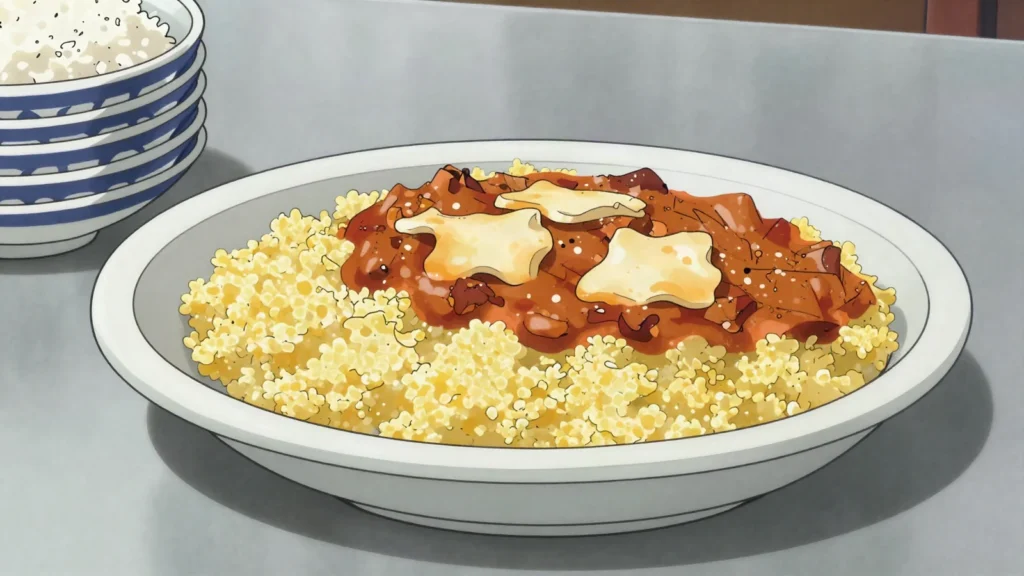
- Tip them into a warm serving bowl. They should look loose and separate rather than clumped. Salt is not usually added, since the datshi brings plenty. Now serving, which is done in the Bhutanese manner.
- Mound the kharang on a plate or in a bowl. Spoon the datshi stew beside it rather than over it. Add a spoonful of ezay chilli relish at the edge. Serve it hot, since it stiffens as it cools.
Technique
- Soak the grits for at least two hours before steaming.
- Steam, rest with hot water, then steam again, since one steaming leaves hard centres.
- Do not salt it, as the cheese stew alongside brings the salt.
Substitutions
- Coarse polenta or maize grits, if kharang is unavailable.
- A cloth-lined colander over a pot in place of a steamer.
Variations
- Mixed with rice, which is common in western Bhutan.
- Made from finer grits for a softer porridge.
- Served with ema datshi rather than kewa datshi.
History
The everyday staple of eastern Bhutan, where maize grows better than rice on the steep slopes.
Frequently asked questions
What is Kharang?
Kharang is a main from Bhutan: coarse maize grits steamed and eaten in place of rice with cheese stew. The everyday staple of eastern Bhutan, where maize grows better than rice on the steep slopes.
How long does Kharang take to make?
Kharang takes 10 min plus soaking of preparation and 45 min of cooking. The recipe makes 4 servings. It is rated easy to make.
What can I substitute in Kharang?
Yes, within limits. Coarse polenta or maize grits, if kharang is unavailable. A cloth-lined colander over a pot in place of a steamer.
What is the most important thing to get right in Kharang?
Drain them thoroughly in a sieve and let them stand for ten minutes. They should be damp rather than wet when they go in the steamer. Bring water to a rolling boil in the base of a steamer. Line the steamer basket with a clean cloth.