
Ingredients
Pastry
- 500 gpuff pastry, in two sheets
Custard
- 1 litrewhole milk
- 8egg yolks
- 200 gsugar
- 80 gcornflour
- 40 gplain flour
- 2 tspvanilla
- 150 gbutter
Cream layer
- 400 mldouble cream
- 2 tbspicing sugar
To finish
- icing sugar
Directions
- Roll each pastry sheet to fit a rectangular tin, prick them all over with a fork, and lay a second tray on top of each.
- Weighting the pastry with a tray keeps it flat. A kremówka needs two thin even sheets, not two puffed pillows, or it cannot be cut.
- Bake at 200°C (390°F) for 15 to 18 minutes until deep golden, and cool completely.
- For the custard, heat the milk with the vanilla to just below boiling.
- Whisk the yolks with the sugar, cornflour and flour until smooth and pale.
- Temper the hot milk into the yolks a ladleful at a time, then return everything to the pan.
- Cook over a medium heat, whisking constantly, until it thickens and bubbles, then cook a further 2 minutes.
- Cook it past the first bubble. The flour needs those extra two minutes or the custard tastes starchy and will not set firm.
- Beat in the butter, then press film onto the surface and cool it completely.
- Whip the cream with the icing sugar to soft peaks and fold it into the cold custard.
- Fold the cream into cold custard, never warm. Warm custard melts it and you lose all the lightness.
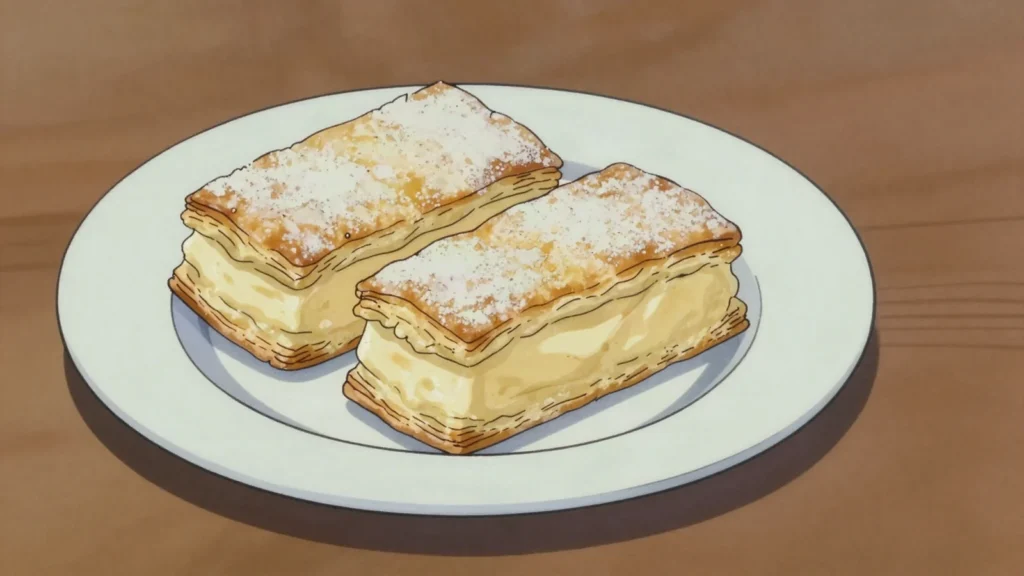
- Lay one pastry sheet in the tin, spread the cream filling thickly and evenly, and lay the second sheet on top.
- The filling should be at least as thick as both pastry sheets together, which is what makes a kremówka rather than a mille-feuille.
- Press the top sheet down only very gently.
- Chill for at least 4 hours, and overnight is better.
- Dust heavily with icing sugar and cut into squares with a long serrated knife, wiping the blade between cuts.
- Score the top sheet into portions before the final press if you want clean edges, because cutting through set puff pastry always shatters it somewhat.
- It is associated above all with Wadowice, where Pope John Paul II grew up and later mentioned eating them, which made the town’s version nationally famous.
- The Serbian krempita and Croatian kremšnita are the same Austro-Hungarian pastry, differing mainly in whether whipped cream is folded in or layered separately.
Technique
- The Wadowice version is sometimes called kremówka papieska after the papal association.
- Some recipes use only the custard with no whipped cream, which gives a denser slice.
- It must be genuinely cold to cut, which is why it is made the day before.
Substitutions
- Shop-bought puff pastry, which nearly everyone uses.
- All cornflour if you have no plain flour, for a slightly glossier custard.
Variations
- Napoleonka, the same pastry under another Polish name.
- Kremšnita, the Croatian version with a distinct whipped cream layer.
- With a rum or lemon note in the custard.
History
Known as the papal cream cake after John Paul II recalled eating it as a boy in Wadowice, which he said publicly in 1999.
Frequently asked questions
What is Kremówka?
Kremówka is a dessert from Poland: two sheets of puff pastry filled with thick custard cream. Known as the papal cream cake after John Paul II recalled eating it as a boy in Wadowice, which he said publicly in 1999.
How long does Kremówka take to make?
Kremówka takes 40 min plus 4 hr chilling of preparation and 30 min of cooking. The recipe makes 12 pieces. It is rated medium to make.
What can I substitute in Kremówka?
Yes, within limits. Shop-bought puff pastry, which nearly everyone uses. All cornflour if you have no plain flour, for a slightly glossier custard.
What is the most important thing to get right in Kremówka?
Weighting the pastry with a tray keeps it flat. A kremówka needs two thin even sheets, not two puffed pillows, or it cannot be cut.