Ingredients
Pasta pearls
- 500 gcoarse semolina
- 150 gfine semolina
- 250 mlwarm salted water, roughly
- 1 tbspolive oil
Stew
- 600 glamb shoulder, in 4 cm cubes
- 3 tbspolive oil
- 2onions, finely chopped
- 3garlic cloves, crushed
- 2 tbsptomato puree
- 2tomatoes, grated
- 150 gdried chickpeas, soaked overnight
- 2carrots, in chunks
- 2courgettes, in chunks
- 1turnip, in chunks
- 1 tspground cinnamon
- 1 tbspsweet paprika
- 1 tspground caraway
- 1 tspblack pepper
- ½ tspground ginger
- 2 tspfine salt
- 2 litreswater
To finish
- 2 tbspdried mint
- 1 bunchcoriander, chopped
- 2 tbspsmen or butter
- harissa, to serve
Directions
- Roll the pearls: put the coarse semolina in a wide shallow bowl, sprinkle over a little salted water and work it in a circular motion with the flat of your hand until small pellets form.
- Keep sprinkling water and dusting with fine semolina, rolling continuously, until the pellets grow to the size of small peppercorns, about 4 mm. Sieve out anything too small and keep working it.
- Spread the pearls on a cloth to dry for at least an hour, or in the sun for a day if you are making a batch to store.
- Brown the lamb hard in the olive oil in a heavy pot for 6 to 8 minutes, then add the onions and cook 10 minutes until golden and soft.
- Stir in the garlic and all the ground spices for 1 minute, then the tomato puree and grated tomato, and fry 5 minutes until the paste darkens and the oil separates.
- Add the drained chickpeas and the water, bring to a simmer and cook covered for 1 hour, until the chickpeas are tender and the meat yields to a fork.
- Add the carrots and turnip and simmer 15 minutes, then the courgettes for a final 10 minutes, and season.
- Steam the pearls over the stew in a couscoussier for 20 minutes, then stir them into the pot with 500 ml of the broth and simmer 10 minutes until swollen and tender but still separate. Finish with smen, dried mint and coriander, and serve in deep bowls with harissa.
Technique
- Berkoukes is hand-rolled coarse pasta, the ancestor of couscous at a larger grain, and is a winter and Ramadan dish across Algeria and eastern Morocco, where it is also called aish or mhamsa.
- Steaming the pearls before they meet the broth is what keeps them separate. Boiled straight in the pot they release starch and the dish turns to porridge.
- The rolling motion matters more than the water. Add water in the smallest sprinkles; too much at once makes lumps rather than pearls, and they will never dry evenly.
Substitutions
- Shop-bought berkoukes, mhamsa or Israeli couscous can be used and needs only the steaming and the final simmer.
- For a meat-free version common in Lent-like fasting weeks and in poorer households, build the stew on chickpeas, dried broad beans and extra vegetables with a spoon of smen.
Variations
- A Constantine version is soupier, closer to a thick broth, and is served with the pearls loose in the liquid.
- Berkoukes bel halib, a sweet version, cooks the pearls in sweetened milk with cinnamon and is eaten for breakfast.
History
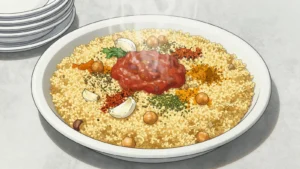
Small, hand-rolled pasta pellets, larger than couscous granules, cooked in a soup with vegetables, chickpea and often lamb, documented across Algeria as a traditional dish with roots tracing to Indigenous Amazigh, or Berber, culinary tradition native to North Africa well before the region’s later Arab influence. Its distinctive pasta pellets, rolled by hand from semolina dough into small, round shapes larger and chewier than standard couscous, reflect a specific regional grain-preparation technique closely related to but genuinely distinct from couscous itself. Berkoukes remains a traditional dish across Algeria, particularly valued as a warming, substantial soup well suited to the country’s colder winter months.
Frequently asked questions
What is Berkoukes?
Berkoukes is a soup & stew from Algeria: large hand-rolled pasta pearls stewed with vegetables, chickpeas and meat. Small, hand-rolled pasta pellets, larger than couscous granules, cooked in a soup with vegetables, chickpea and often lamb, documented across Algeria as a traditional dish with roots tracing to Indigenous Amazigh, or Berber, culinary tradition native to North Africa well before the region’s later Arab influence. Its distinctive pasta pellets, rolled by hand from semolina dough into small, round shapes larger and chewier than standard couscous, reflect a specific regional grain-preparation technique closely related to but genuinely distinct from couscous itself. Berkoukes remains a traditional dish across Algeria, particularly valued as a warming, substantial soup well suited to the country’s colder winter months.
How long does Berkoukes take to make?
Berkoukes takes 1 hr for the pasta, 20 min for the stew of preparation and 1 hr 45 min of cooking. The recipe makes 6 servings. It is rated hard to make.
What can I substitute in Berkoukes?
Yes, within limits. Shop-bought berkoukes, mhamsa or Israeli couscous can be used and needs only the steaming and the final simmer. For a meat-free version common in Lent-like fasting weeks and in poorer households, build the stew on chickpeas, dried broad beans and extra vegetables with a spoon of smen.
What is the most important thing to get right in Berkoukes?
The rolling motion matters more than the water. Add water in the smallest sprinkles; too much at once makes lumps rather than pearls, and they will never dry evenly.