
Ingredients
The beans
- 300 gfresh borlotti beans
- podded, or 150 g dried
- soaked overnight
- 200 ggreen beans
- cut into short lengths
The vegetables
- 2courgettes, cubed
- 3potatoes, cubed
- 3carrots, cubed
- 2onions, chopped
- 3tomatoes, chopped
- 2leeks, sliced
- 2.5 litreswater
- salt and black pepper
The pasta
- 100 gsmall pasta
- or broken spaghetti
- added near the end
The pistou
- 3large bunches basil
- leaves only
- 6garlic cloves
- 150 mlolive oil
- 100 ggrated parmesan
- or pecorino
- a pinch of salt
Directions
- Make it while the soup finishes cooking. The pistou is never cooked in the soup. Heat destroys the fresh basil flavour entirely. The vegetables should be cut into even small dice. Discard the soaking water and rinse them. Then they are ready for the pot. Simmer the shelling beans until they are tender. Fresh beans take about twenty-five minutes.
- Cook them separately if using dried ones. Dried beans take far longer than the vegetables. Cook them separately and combine them later. Cook the onion and leek gently in olive oil. Give them about eight minutes until soft.
- Add the potato, carrot and tomato to the pot. Stir them through the softened onion briefly. Give them about two minutes before liquid goes in. Use water rather than stock for this soup. Simmer the vegetables until they are tender. Give the potato and carrot about twenty minutes.
- Add the courgette and green beans. Give them about twelve minutes only. Add the cooked shelling beans to the pot. They are already cooked and only need warming. Add some of their cooking liquid as well. Give them about five minutes in the soup. Add the small pasta near the end of cooking. Small pasta takes about eight minutes.
- Add more water if it becomes too thick. Pound the garlic and salt to a paste first. Salt acts as an abrasive in the mortar. It helps break the garlic down completely. Pound it until it is a smooth paste. Add the basil leaves a handful at a time.
- Pound each handful down before adding more. Use a bruising circular motion rather than striking. Press and grind rather than pounding hard. The pestle should crush against the mortar wall.
- Pour the olive oil in slowly while working. Add it in a thin steady stream. Keep grinding as you pour it in. Stir the grated cheese into the finished paste. Stir it in rather than pounding it further. It should be evenly distributed throughout.
- Add more oil if it becomes too thick. It should be spoonable rather than stiff. Season the soup with salt and black pepper. Season it lightly rather than heavily. Leave room for what the pistou adds.
- Ladle the soup into bowls and bring the pistou. It is never stirred into the pot itself. Heat destroys the fresh basil flavour entirely. Adding it at the table keeps it fresh. Put out plenty for people to help themselves. The soup is served hot or merely warm. Serve good bread alongside the bowls. The soup keeps three days refrigerated. Make the pistou fresh each time you serve.
Technique
- Pistou contains no pine nuts at all, which is the defining difference from Genoese pesto — the two are related but genuinely distinct, and both contain cheese. The name comes from the Provençal word for pounded, sharing a root with pesto.
- Never stir the pistou into the pot: heat destroys the fresh basil flavour entirely. It goes on the table and each eater stirs a generous spoonful into their own bowl, which is genuinely how it is served. Make it fresh while the soup finishes, since it darkens and dulls if made in advance.
- Use water rather than stock — the vegetables make their own broth and a meat stock overwhelms the delicate flavours, which is how it is genuinely made in the region.
Substitutions
- Dried borlotti replace fresh shelling beans but must be soaked overnight and cooked separately for about an hour, since cooking them with the vegetables turns those to mush; fresh beans take about twenty-five minutes and can go straight in. Both green beans and shelling beans belong here, giving different textures.
- Rice replaces the pasta in some versions and both are genuinely made along the Riviera; the pasta reflects the Ligurian influence on the region. Pecorino, or a mixture with parmesan, replaces parmesan in the pistou.
Variations
- The pistou needs a genuinely large amount of basil — three large bunches is not a mistake, and a small handful gives a thin disappointing sauce. Pound the garlic with salt to a smooth paste first, since the salt acts as an abrasive, then add basil a handful at a time with a bruising circular motion rather than striking, and pour the oil in slowly while still grinding so it emulsifies.
- A mortar is better than a blender rather than essential: blended basil oxidises and darkens, and the blades heat and bruise it, where pounding releases the oils and keeps the colour. If using a blender, pulse briefly rather than running it long — most home cooks use one quite happily.
- Cut the vegetables into even small dice rather than chunks, so every spoonful holds a mix of everything, and stage them: potato and carrot about twenty minutes, then courgette and green beans for twelve, since courgette collapses entirely if overcooked. Season the soup only lightly, since the pistou brings both salt and a great deal of flavour.
History
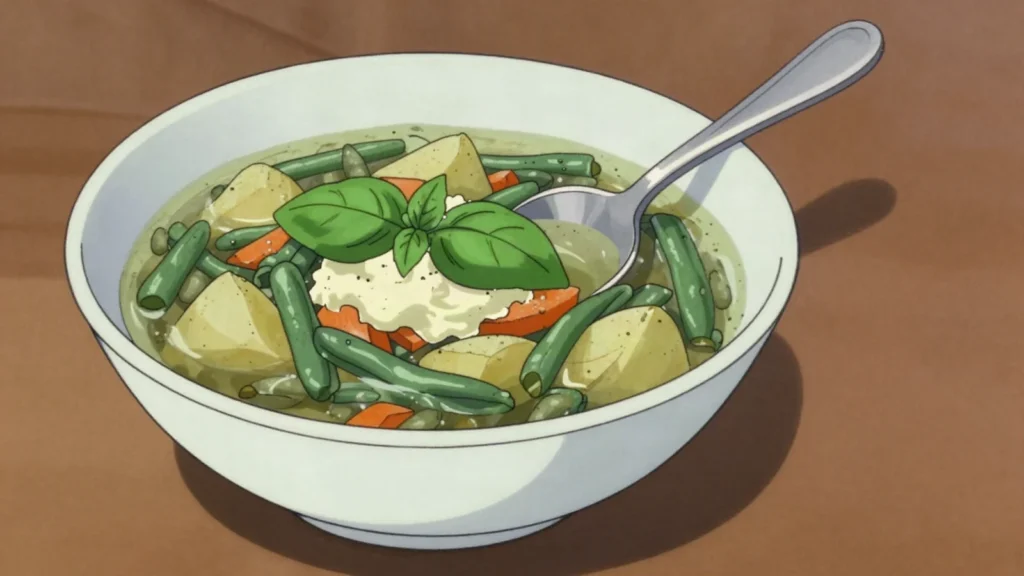
The Riviera’s answer to Genoese pesto: pistou is basil and garlic pounded without pine nuts, stirred into the soup at the table.
Frequently asked questions
What is Soupe au pistou?
Soupe au pistou is a soup & stew from Monaco: summer vegetable and bean soup finished with basil and garlic. The Riviera’s answer to Genoese pesto: pistou is basil and garlic pounded without pine nuts, stirred into the soup at the table.
How long does Soupe au pistou take to make?
Soupe au pistou takes 40 minutes of preparation and 1 hour of cooking. The recipe makes serves 8. It is rated medium to make.
What can I substitute in Soupe au pistou?
Yes, within limits. Dried borlotti replace fresh shelling beans but must be soaked overnight and cooked separately for about an hour, since cooking them with the vegetables turns those to mush; fresh beans take about twenty-five minutes and can go straight in. Both green beans and shelling beans belong here, giving different textures. Rice replaces the pasta in some versions and both are genuinely made along the Riviera; the pasta reflects the Ligurian influence on the region. Pecorino, or a mixture with parmesan, replaces parmesan in the pistou.
What is the most important thing to get right in Soupe au pistou?
Make it while the soup finishes cooking. The pistou is never cooked in the soup. Heat destroys the fresh basil flavour entirely. The vegetables should be cut into even small dice. Discard the soaking water and rinse them. Then they are ready for the pot. Simmer the shelling beans until they are tender. Fresh beans take about twenty-five minutes.