
Ingredients
Herring
- 500 gsalted herring fillets (saltsill), skin off
- cold water, for soaking
1-2-3 lag, the pickling liquor
- 100 mlättika, 12% Swedish spirit vinegar
- 200 gcaster sugar
- 300 mlwater
Aromatics
- 1red onion, thinly sliced
- 1carrot, sliced in coins
- 10whole allspice berries, lightly crushed
- 10white peppercorns
- 2bay leaves
- 1 tspyellow mustard seeds
- 1small piece horseradish, sliced, optional
To serve
- boiled new potatoes with dill
- sour cream and chopped chives
- knäckebröd and a mature cheese
- 1shot of ice-cold aquavit
Directions
- Soak the salted fillets in plenty of cold water in the fridge for 10 to 12 hours, changing the water three times. Taste a corner: it should be pleasantly salty like seawater, not harsh.
- Drain the fillets, pat them dry and cut them across into 2 cm pieces.
- Make the lag by the Swedish 1–2–3 rule: one part 12% vinegar, two parts sugar, three parts water. Heat them together just until the sugar dissolves, then cool completely. Never pour warm lag over the herring, or the flesh goes chalky.
- Add the allspice, peppercorns, bay, mustard seed and horseradish to the cold lag and let them steep 10 minutes.
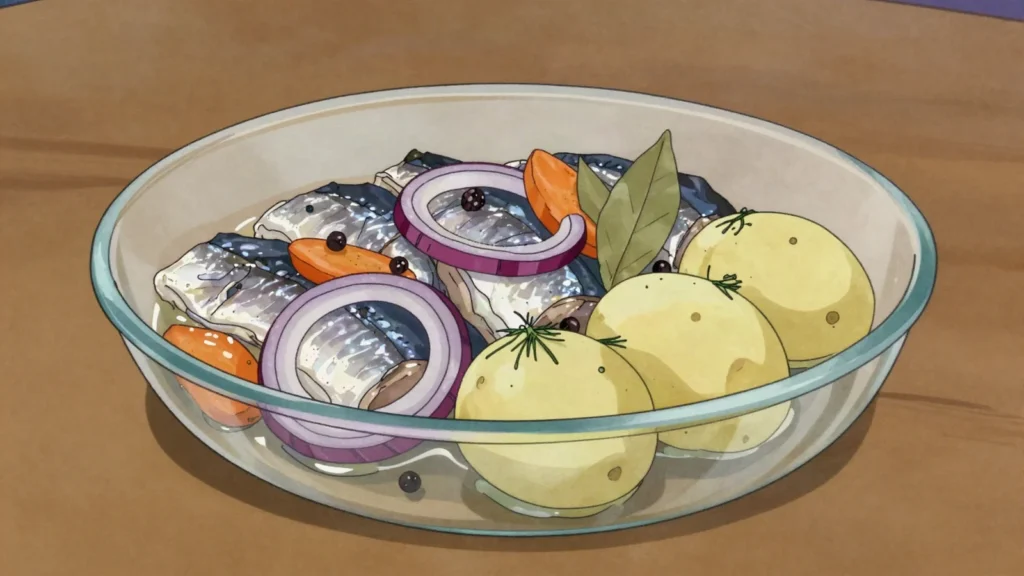
- Layer the herring, onion and carrot into a clean glass jar or a deep dish, packing them loosely so the liquid can move around every piece.
- Pour the cold lag over until everything is fully submerged, pressing down any floating onion.
- Seal and refrigerate at least 24 hours, and ideally 2 to 3 days, for the sweetness and spice to penetrate. It keeps 2 weeks cold.
- Lift the herring out with a little onion and carrot, arrange in a shallow bowl with a spoonful of the lag, and serve cold with potatoes, sour cream, crispbread, cheese and a small measure of aquavit.
Technique
- Swedish pickled herring starts from salt-cured herring, not fresh, and desalting is the step that decides the dish. Underdo it and the fish is inedible, overdo it and it turns woolly.
- Ättika at 12 percent is far stronger than table vinegar. If you use 5 percent white wine vinegar, use roughly 240 ml of it and cut the water back to 160 ml to keep the same acidity.
- Fresh herring cannot be substituted directly here; the salt cure firms the flesh and makes it safe to eat without cooking. If you cure your own from fresh, freeze it at minus 20°C (-4°F) for 24 hours first as a parasite precaution.
Substitutions
- Ready-desalted matjes fillets can go straight into the cold lag and are ready in a few hours.
- For senapssill, mustard herring, drain the pickled pieces after a day and dress them in 3 tbsp Swedish sweet mustard, 1 tbsp vinegar, 1 tsp sugar, 100 ml oil and a handful of dill.
Variations
- Glasmästarsill, glassblower’s herring, cured on the bone in a glass jar with plenty of horseradish and carrot.
- Löksill, made heavy with red onion and served at midsummer.
- Senapssill, the mustard version, which dominates the Christmas table.
History
Salted Baltic herring underpinned Hanseatic trade; pickled in vinegar with onion and allspice it appears at Midsummer, Easter and Christmas with snaps.
Frequently asked questions
What is Pickled herring?
Pickled herring is a fermented & pickled from Sweden: herring in sweet vinegar with onion; midsummer and Christmas tables. Salted Baltic herring underpinned Hanseatic trade; pickled in vinegar with onion and allspice it appears at Midsummer, Easter and Christmas with snaps.
How long does Pickled herring take to make?
Pickled herring takes 20 min of preparation and 12 hr desalting plus 24 hr curing of cooking. The recipe makes 6 servings as part of a smörgåsbord. It is rated easy to make.
What can I substitute in Pickled herring?
Yes, within limits. Ready-desalted matjes fillets can go straight into the cold lag and are ready in a few hours. For senapssill, mustard herring, drain the pickled pieces after a day and dress them in 3 tbsp Swedish sweet mustard, 1 tbsp vinegar, 1 tsp sugar, 100 ml oil and a handful of dill.
What is the most important thing to get right in Pickled herring?
Make the lag by the Swedish 1–2–3 rule: one part 12% vinegar, two parts sugar, three parts water. Heat them together just until the sugar dissolves, then cool completely. Never pour warm lag over the herring, or the flesh goes chalky.