
Ingredients
Coconut rice
- 400 glong-grain rice, rinsed until the water runs clear
- 400 mlcoconut milk
- 300 mlwater
- 3pandan leaves, knotted
- 20 gfresh ginger, sliced
- 3shallots, halved
- 1.5 tspsalt
- 1 tspsugar
Sambal ikan bilis
- 80 gdried anchovies (ikan bilis), rinsed and dried
- 15dried red chillies, soaked in hot water 20 min and deseeded
- 8shallots, roughly chopped
- 4garlic cloves
- 1 tsptoasted belacan (shrimp paste)
- 2large onions, sliced into rings
- 3 tbsptamarind pulp soaked in 100 ml water and strained
- 2 tbsppalm sugar
- 1 tspsalt
- 120 mlvegetable oil
To serve
- 80 gdried anchovies, fried crisp
- 80 graw peanuts, fried or roasted
- 4eggs, hard-boiled and halved, or fried
- 1cucumber, sliced
- Banana leaves, for lining
Directions
- Rinse the rice three or four times until the water runs clear, then drain 15 minutes. Washing off surface starch is what keeps the grains separate under coconut milk.
- Combine the rice, coconut milk, water, pandan, ginger, shallots, salt and sugar in a heavy pot. Bring to a boil uncovered, stirring gently every minute so the coconut milk does not catch or split.
- As soon as the liquid reaches the level of the rice and craters appear on the surface, cover tightly, drop the heat to its lowest and steam 15 minutes. Then rest, still covered, for 10 minutes and fluff with a fork or chopsticks.
- Make the rempah: blitz the soaked chillies, shallots, garlic and belacan to a smooth paste with a splash of water, or pound them in a mortar for a better texture.
- Heat the oil in a wok over medium heat and fry the rempah for 15–20 minutes, stirring often. This is the critical step: it is ready when the paste darkens to a deep brick red, smells sweet rather than raw, and a slick of red oil separates and pools at the edges. Do not rush it.
- Add the onion rings and fry 5 minutes until softened, then the tamarind water, palm sugar and salt. Simmer 10 minutes until thick and jammy.
- Fry the rinsed and dried ikan bilis in hot oil for 2–3 minutes until crisp and pale gold, drain, and stir most of them into the sambal, keeping some back for the plate. Fry the peanuts in the same oil for 2 minutes.
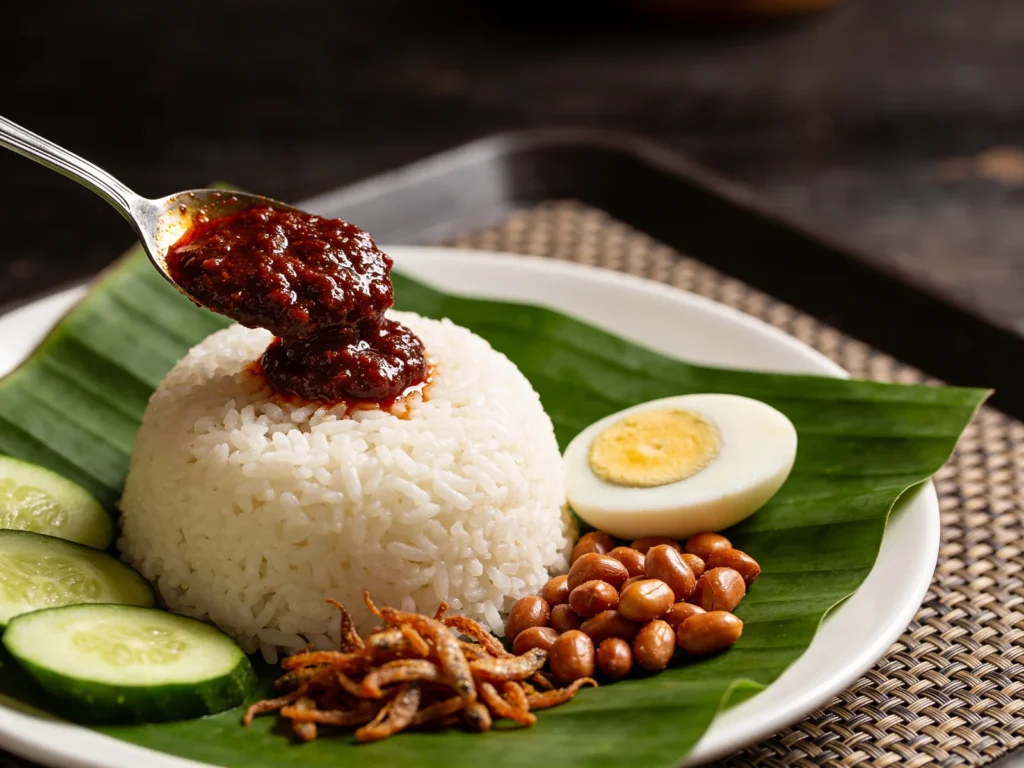
- Taste the sambal. It should be sweet, sour, salty and hot all at once, thick enough to hold its shape on a spoon and glossy with separated oil.
- To assemble, mound the coconut rice on a banana leaf, spoon a generous heap of sambal beside it, and arrange the fried anchovies, peanuts, cucumber slices and half an egg around it. For the classic bungkus, wrap the whole thing in the banana leaf and let it sit 20 minutes so the leaf perfumes the rice.
Technique
- Frying the rempah until the oil splits, pecah minyak, is the single technique that separates good sambal from raw-tasting sambal. Fifteen minutes is a minimum, not a maximum.
- Do not let coconut rice boil hard once covered. The milk splits and leaves an oily, curdled surface; a bare steam is what you want.
- Belacan must be toasted before use, wrapped in foil and dry-fried or held over a flame until it smells acrid and nutty. Raw belacan tastes harsh and one-dimensional.
- Nasi lemak is eaten at any hour in Malaysia but is above all a breakfast, sold wrapped in banana leaf and newspaper from dawn. The rice is meant to be eaten warm, not hot.
Substitutions
- No pandan leaves: use ½ tsp pandan extract, or leave them out; the rice loses its grassy vanilla note but is still good.
- No belacan: use 1 tbsp of Thai shrimp paste or, at a stretch, 2 anchovy fillets mashed in, though the ferment is different.
- Tamarind pulp can be replaced with 2 tbsp of tamarind concentrate diluted in 100 ml water.
Variations
- Nasi lemak bungkus, the small banana-leaf parcel eaten on the way to work.
- Nasi lemak with ayam goreng berempah, spiced fried chicken, the full plate version.
- Nasi lemak with rendang or with sambal sotong, squid in the same sambal base.
History
Rice cooked in coconut milk and pandan leaf, a preparation rooted in Malay cooking for generations, though the specific point at which it became closely paired with the now-standard accompaniments of sambal chili paste, fried anchovies, peanuts, cucumber and hard-boiled egg is not precisely documented. One folk explanation for the name, meaning literally ‘fatty rice,’ describes a farmer’s wife serving the dish to hungry laborers, though this account is generally treated as origin folklore rather than verified history. Long eaten as an everyday breakfast, particularly wrapped simply in banana leaf or paper for portability, nasi lemak was formally declared one of Malaysia’s national dishes, and elaborate modern versions now often add fried chicken or other proteins well beyond the traditional simple accompaniments.
Frequently asked questions
What is Nasi Lemak?
Nasi Lemak is a main from Malaysia: coconut rice with sambal, anchovies, peanuts and egg; the national dish. Rice cooked in coconut milk and pandan leaf, a preparation rooted in Malay cooking for generations, though the specific point at which it became closely paired with the now-standard accompaniments of sambal chili paste, fried anchovies, peanuts, cucumber and hard-boiled egg is not precisely documented. One folk explanation for the name, meaning literally ‘fatty rice,’ describes a farmer’s wife serving the dish to hungry laborers, though this account is generally treated as origin folklore rather than verified history. Long eaten as an everyday breakfast, particularly wrapped simply in banana leaf or paper for portability, nasi lemak was formally declared one of Malaysia’s national dishes, and elaborate modern versions now often add fried chicken or other proteins well beyond the traditional simple accompaniments.
How long does Nasi Lemak take to make?
Nasi Lemak takes 35 min of preparation and 45 min of cooking. The recipe makes 4 servings. It is rated medium to make.
What can I substitute in Nasi Lemak?
Yes, within limits. No pandan leaves: use ½ tsp pandan extract, or leave them out; the rice loses its grassy vanilla note but is still good. No belacan: use 1 tbsp of Thai shrimp paste or, at a stretch, 2 anchovy fillets mashed in, though the ferment is different. Tamarind pulp can be replaced with 2 tbsp of tamarind concentrate diluted in 100 ml water.
What is the most important thing to get right in Nasi Lemak?
Heat the oil in a wok over medium heat and fry the rempah for 15–20 minutes, stirring often. This is the critical step: it is ready when the paste darkens to a deep brick red, smells sweet rather than raw, and a slick of red oil separates and pools at the edges. Do not rush it.