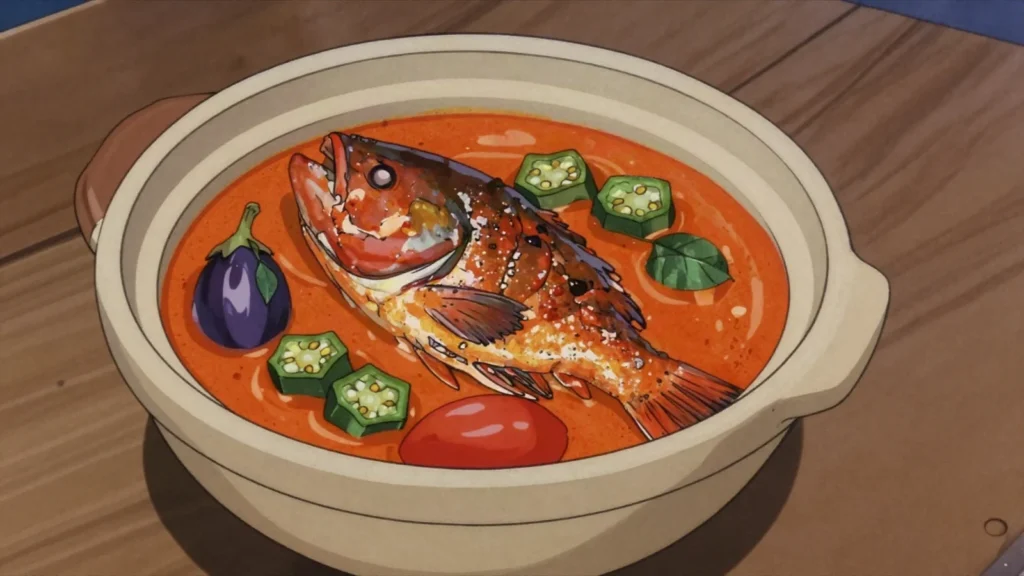

Ingredients
Fish
- 1large red snapper head, about 1 kg, split
Spice paste
- 3 tbspfish curry powder
- 1 tbspchilli powder
- 1 tspturmeric
- 6 clovesgarlic
- 3cm ginger
- 2onions
Tempering
- 1 tbspmustard seeds
- 1 tbspfenugreek seeds
- 3 sprigscurry leaves
- 3dried red chillies
- 4 tbspoil
Also
- 2tomatoes, quartered
- 8okra, trimmed
- 1aubergine, in wedges
- 3green chillies, slit
- 400 mlcoconut milk
- 3 tbsptamarind paste in 300 ml water
- salt
To serve
- rice, or bread
- with the head in the middle of the table
Directions
- Remove the gills entirely, which is essential. Gills hold blood and grit and they make the whole curry bitter and muddy if left in. Rinse it thoroughly under running water, working into every cavity.
- Rub the head with turmeric and salt and leave it for fifteen minutes, then rinse. That is standard practice across South Indian and Southeast Asian fish cooking and it takes off any muddiness. Use a fish curry powder, which is a specific blend heavier on coriander and chilli than a meat curry powder.
- Make it into a paste with a little water before it goes in the pan. Heat the oil and add the mustard seeds first. Wait until they pop before adding anything else, which is what releases their flavour.
- Add the fenugreek, dried chillies and curry leaves and let them crackle. Now the fenugreek, and the caution about it. Add them after the mustard seeds and move on within seconds. Curry leaves are essential rather than a garnish, and they should be used generously.
- Add the onions and cook until soft and golden, then the garlic and ginger. Add the curry paste and fry it for four or five minutes until the oil separates.
- Add the tamarind water and bring it to a simmer. Tamarind gives the sourness that this curry needs, and it is a defining element. Taste it: the base should be noticeably sour before the coconut milk goes in. Now the coconut milk, and the rule about it.
- Add the coconut milk and bring it back only to a bare simmer. Never let coconut milk boil hard, since it splits into oil and curds and cannot be brought back. Keep it barely trembling from this point onward. Add the aubergine first, since it takes longest, then the okra and tomato. Now the okra, which needs a word.
- Add it whole and trimmed rather than sliced. Cutting okra releases its mucilage into the curry, and here you do not want that. Trim the stem without cutting into the pod. Cover and simmer for fifteen to twenty minutes. Now the cooking time it needs.
- Turn it once, carefully, using two spatulas. Let it stand off the heat for ten minutes before serving. Serve the whole head in the pot or on a platter in the middle of the table. Serve rice or bread to soak up the curry.
Technique
- It is credited to M. J. Gomez, a Keralan cook in Singapore, around 1949.
- The gills must be removed entirely or the curry turns bitter.
- Add okra whole, since cutting it releases mucilage into the sauce.
Substitutions
- Grouper or another large fish head.
- A general fish curry powder if a specific blend is unavailable.
Variations
- The Chinese-style version, with a lighter, less coconut-heavy sauce.
- Made with fish steaks rather than a head.
- Made hotter, with more chilli.
History
A large fish head, typically red snapper, simmered in a spiced curry with vegetables and often okra, generally credited to Singapore’s Indian community, with one commonly repeated account crediting a specific Indian restaurant in Singapore during the 1950s or 1960s with creating the dish specifically to appeal to Chinese diners, who traditionally valued fish head as a delicacy, by combining that prized ingredient with South Indian curry technique. Whether that specific origin story is fully accurate in every detail is not definitively confirmed, though the dish’s genuine cross-cultural appeal, uniting Chinese appreciation for fish head with Indian curry-making, is well documented and reflects Singapore’s broader multicultural food history. It remains a distinctly Singaporean dish, less commonly found in this specific form elsewhere.
Frequently asked questions
What is Fish Head Curry?
Fish Head Curry is a main from Singapore: red snapper head in South Indian curry with okra and aubergine. A large fish head, typically red snapper, simmered in a spiced curry with vegetables and often okra, generally credited to Singapore’s Indian community, with one commonly repeated account crediting a specific Indian restaurant in Singapore during the 1950s or 1960s with creating the dish specifically to appeal to Chinese diners, who traditionally valued fish head as a delicacy, by combining that prized ingredient with South Indian curry technique. Whether that specific origin story is fully accurate in every detail is not definitively confirmed, though the dish’s genuine cross-cultural appeal, uniting Chinese appreciation for fish head with Indian curry-making, is well documented and reflects Singapore’s broader multicultural food history. It remains a distinctly Singaporean dish, less commonly found in this specific form elsewhere.
How long does Fish Head Curry take to make?
Fish Head Curry takes 30 min of preparation and 40 min of cooking. The recipe makes 4 servings. It is rated medium to make.
What can I substitute in Fish Head Curry?
Yes, within limits. Grouper or another large fish head. A general fish curry powder if a specific blend is unavailable.
What is the most important thing to get right in Fish Head Curry?
Remove the gills entirely, which is essential. Gills hold blood and grit and they make the whole curry bitter and muddy if left in. Rinse it thoroughly under running water, working into every cavity.