
Ingredients
Broth
- 1 kgbeef shank or brisket
- 1 kgpork hock, cut into rounds
- 500 gbeef bones
- 4 litreswater
- 8 stalkslemongrass, bruised and knotted
- 1onion, charred
- 5cm ginger, charred
- 3 tbspmắm ruốc, Huế shrimp paste
- 3 tbspfish sauce
- 2 tbsprock sugar
- 2 tspsalt
Chilli lemongrass oil
- 4 tbspoil
- 1 tbspannatto seeds
- 3 stalkslemongrass, finely minced
- 4shallots, minced
- 4 clovesgarlic, minced
- 2 tbspchilli flakes
To serve
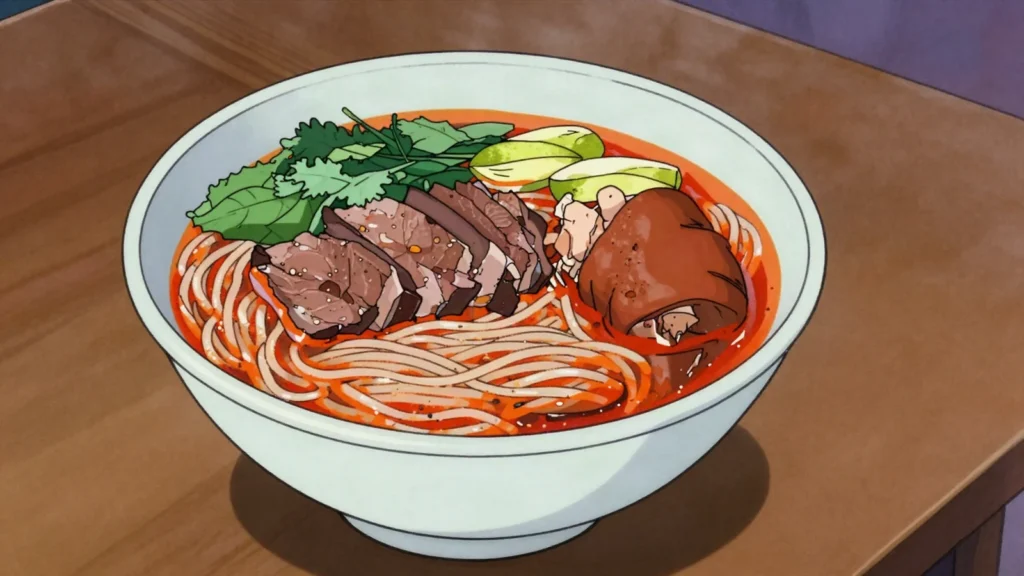
- 1 kgthick round rice noodles
- shredded banana blossom
- shredded cabbage
- bean sprouts
- Vietnamese coriander
- Thai basil
- lime wedges
- sliced chilli
Directions
- Blanch the beef, pork hock and bones in boiling water for 5 minutes, then drain and rinse the meat, the bones and the pot. This is the step that decides whether the broth is clear or muddy.
- Char the onion and the ginger directly over a gas flame until blackened in patches, then rinse off the loose ash and add them to the pot.
- Cover the meat and bones with the 4 litres of water, add the knotted lemongrass, and simmer very gently for 3 hours, skimming as it goes. Do not let it boil at any point.
- Stir the mắm ruốc into a cup of the hot broth and let the grit settle to the bottom, then pour only the clear liquid back into the pot and throw the sediment away.
- That step matters twice over: tipped in whole the paste makes the soup gritty, and left out altogether the soup is simply not bún bò Huế, whatever else it may be.
- Season with the fish sauce, rock sugar and salt. It should taste assertively savoury, faintly sweet and unmistakably funky, in that order.
- Lift the beef out after about 2 hours and the pork hock after 3, cool them both, and slice the beef thinly across the grain.
- For the chilli oil, warm the oil with the annatto seeds until it turns deep red and strain the seeds out, then fry the minced lemongrass, shallot and garlic in that oil until fragrant and stir in the chilli flakes off the heat.
- Stir most of the chilli oil into the broth and keep the rest back for the table.
- Cook the noodles separately in plenty of water and rinse them well. These are the thick round ones, and the difference from flat phở noodles is obvious the moment they are in the bowl.
- Assemble each bowl with noodles, sliced beef and pork, very hot broth ladled over, and a spoonful of the reserved chilli oil on top.
- Serve with a plate of banana blossom, cabbage, sprouts and herbs to be torn in at the table, with lime and chilli alongside.
Technique
- This is not a spicier phở. Different noodle, different aromatics, different city, and a fermented shrimp base that phở does not have.
- Decant the mắm ruốc rather than tipping it in. Every experienced cook in Huế does this and no recipe written down ever seems to mention it.
- Lemongrass in quantity is the signature. Eight stalks in the pot is not a misprint.
Substitutions
- Thai shrimp paste thinned with hot broth if you cannot find mắm ruốc, using rather less of it.
- Fine round rice noodles, which are the nearest to the correct shape if the thick ones are unavailable.
Variations
- With huyết, cubes of set pork blood, and chả cua, crab cake, which are both standard in Huế.
- The southern version, sweeter and considerably redder.
- Made with pork alone, which is the older and cheaper version.
History
A spicy beef and pork noodle soup, developed in Hue, the former imperial capital of Vietnam, generally understood to reflect the refined, sophisticated cooking style associated with Hue’s historic royal court, which developed elaborate, carefully balanced dishes distinct from the simpler everyday cooking found elsewhere in the country. Its broth, built on lemongrass and fermented shrimp paste along with a notable chili heat, gives bun bo hue a bolder, spicier flavour than pho, Vietnam’s other most internationally recognized noodle soup, reflecting genuine regional differences between northern and central Vietnamese cooking traditions. It remains especially closely associated with Hue and central Vietnam specifically, considered by many the region’s signature and most technically demanding noodle soup.
Frequently asked questions
What is Bun Bo Hue?
Bun Bo Hue is a soup & stew from Vietnam: spicy lemongrass beef noodle soup from the imperial city. A spicy beef and pork noodle soup, developed in Hue, the former imperial capital of Vietnam, generally understood to reflect the refined, sophisticated cooking style associated with Hue’s historic royal court, which developed elaborate, carefully balanced dishes distinct from the simpler everyday cooking found elsewhere in the country. Its broth, built on lemongrass and fermented shrimp paste along with a notable chili heat, gives bun bo hue a bolder, spicier flavour than pho, Vietnam’s other most internationally recognized noodle soup, reflecting genuine regional differences between northern and central Vietnamese cooking traditions. It remains especially closely associated with Hue and central Vietnam specifically, considered by many the region’s signature and most technically demanding noodle soup.
How long does Bun Bo Hue take to make?
Bun Bo Hue takes 40 min of preparation and 3 hr 30 min of cooking. The recipe makes 6 servings. It is rated hard to make.
What can I substitute in Bun Bo Hue?
Yes, within limits. Thai shrimp paste thinned with hot broth if you cannot find mắm ruốc, using rather less of it. Fine round rice noodles, which are the nearest to the correct shape if the thick ones are unavailable.
What is the most important thing to get right in Bun Bo Hue?
Cover the meat and bones with the 4 litres of water, add the knotted lemongrass, and simmer very gently for 3 hours, skimming as it goes. Do not let it boil at any point.