
Ingredients
The fish
- 600 gfirm white fish fillet
- skinless and boneless
- cod, pollock, snapper or catfish
- very cold
- checked carefully for bones
The paste
- 3 tablespoonsThai red curry paste
- or more, to taste
- see the note on shrimp paste
- 1 tablespoonfish sauce
- 1 teaspoonsugar
- 1egg
- 2 tablespoonscornflour
- or rice flour
The aromatics
- 8kaffir lime leaves
- central rib removed
- sliced into hair-fine shreds
- 100 gsnake beans
- or green beans
- sliced very thinly
The cucumber relish
- 1cucumber, seeded and diced
- 1shallot, sliced thinly
- 1red chilli, sliced
- 100 mlrice vinegar
- 80 gsugar
- half a teaspoon salt
- 2 tablespoonsroasted peanuts
- coarsely crushed
- a little coriander
For frying
- 600 mlvegetable oil
- or enough for 3 cm depth
Directions
- Use a firm white fish with low oil content. The fish must be very cold when worked. Warm fish breaks down and turns pasty. Chill it in the freezer for twenty minutes first. Not frozen, just very cold and firm.
- Check the fillet extremely carefully for bones. Pull any you find with tweezers. There is an important point about the paste. Check the label carefully if that matters. The leaves must be sliced hair-fine.
- Stack them and roll them into a tight cigar. Remove the tough central rib first. Take the time and do it properly. Slice them into very thin rounds. Cut the cold fish into rough chunks. Put the chunks into a food processor. Add the curry paste, fish sauce and sugar.
- Add the egg and the cornflour. Then run it until it forms a sticky paste. Tip the paste into a large bowl. Pick up a handful and throw it back down hard. It goes from soft to bouncy and springy.
- Fold them rather than beating them in. They should be evenly distributed. Heat the vinegar, sugar and salt in a pan. Stir until the sugar has dissolved. Bring it to a simmer for two minutes. Take it off the heat and let it cool fully. Pouring warm syrup over cucumber cooks it.
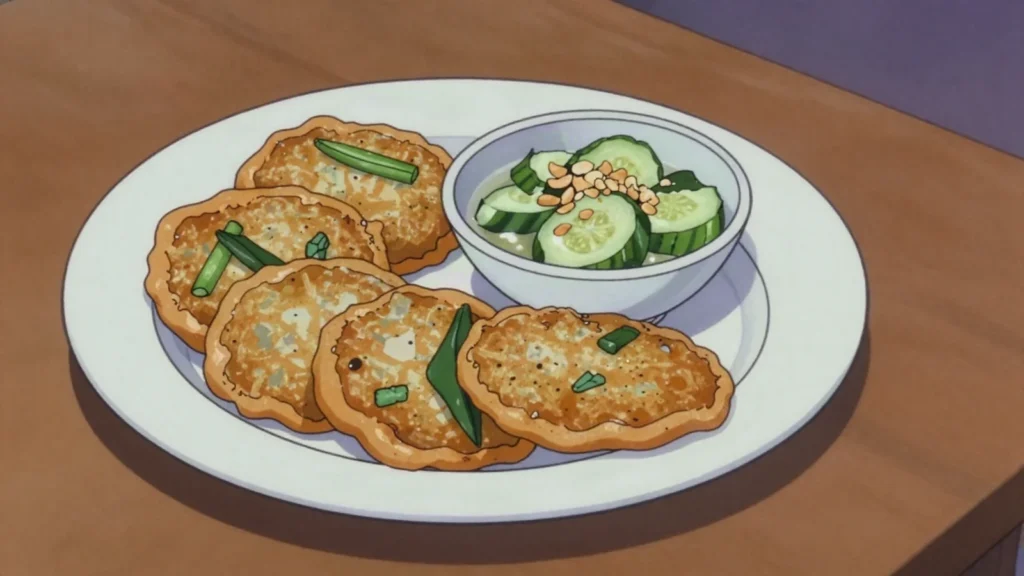
- Combine the cucumber, shallot and chilli. Pour the cooled syrup over them. Add the crushed peanuts just before serving. Scatter a little coriander over the top. Wet your hands with cold water first. Take a spoonful and roll it into a ball. Flatten it into a disc about a centimetre thick. About six centimetres across is right.
- Lay them on a tray as you shape them. Fill it no more than one third full. Never leave hot oil unattended at all. Keep a lid within easy reach of the pan. If it catches fire, turn off the heat. Heat the oil to one hundred and seventy degrees. The cakes need time to cook right through. Fry the cakes in batches of four or five. Do not crowd the pan at any point.
- Fry them about three minutes a side. They should be deep golden and firm. Press one gently to check the bounce. Break the first one open to check inside. The centre should be opaque all the way through.
- Adjust your timing after that first check. Lift them out and drain them on a rack. Let the oil recover between batches. Serve them hot with the relish alongside. Do not pour the relish over them. Serve it in a separate small bowl. They are best eaten within minutes of frying. Fry them from frozen with extra time.
Technique
- The springy, bouncy texture is the whole point, and it comes from slapping the paste hard against the bowl thirty times or more. It is genuinely how Thai cooks do it, and you can feel the paste change from soft to elastic as you work. Skip it and you get a dull, soft fish patty.
- Keep the fish very cold. Twenty minutes in the freezer before processing keeps it firm; warm fish breaks down into a pasty mixture that will not develop the right structure.
- Slice the lime leaves hair-fine, with the tough central rib removed. Stack, roll into a cigar and slice across as thinly as you can. Coarsely cut leaves are tough and chewy; fine shreds melt into the cake. This is the step that separates good from ordinary.
- Most Thai red curry paste contains kapi, fermented shrimp paste. That makes it neither vegetarian nor free of shellfish allergens. Check the label — vegetarian pastes are made and are labelled as such.
- Fry at 170 degrees rather than hotter. The cakes need time for the centre to cook, and hotter oil browns the outside first. Break the first one open to check before committing to a timing.
- Let the relish syrup cool completely before it meets the cucumber. Warm syrup cooks it and the cucumber goes limp.
- Add the crushed peanuts to the relish at the last moment, or they soften. Mention them to guests with nut allergies.
- The atlas uses both ‘kaffir lime’ and ‘makrut lime’ for the leaves. The first term is a serious racial slur in southern Africa, and makrut is increasingly the preferred name.
Substitutions
- Any firm white fish works — cod, pollock, snapper, catfish or tilapia. Avoid oily fish such as mackerel, which gives a heavy greasy result.
- Prawns replace some or all of the fish for tod mun kung, which is a distinct and equally common dish.
- Green beans replace snake beans, sliced just as thinly.
- Frozen makrut lime leaves replace fresh and work very well. Dried leaves are a poor last resort.
- Rice flour replaces cornflour directly.
- A vegetarian curry paste replaces the standard one for anyone avoiding shellfish, and the fish can be replaced with firm tofu and mushroom for a wholly vegetarian version, though the texture is quite different.
Variations
- Tod mun kung, made with prawns, is the shellfish version and is usually softer and sweeter.
- Tod mun goong pan oi, prawn cakes wrapped around sugar cane, is a restaurant elaboration.
- Some cooks add finely chopped krachai, fingerroot, which gives a distinctly Thai medicinal note.
- A version steamed rather than fried, closer to hor mok, keeps the same paste in a quite different form.
- Cambodian and Lao fish cakes belong to the same family with different spicing.
- Some vendors serve them with sweet chilli sauce rather than cucumber relish, which is common abroad but less usual in Thailand.
History
Thai fish cakes, made from a paste of ground fish, red curry paste and long bean, deep-fried until golden and slightly chewy, documented across Thailand as a popular appetizer and street food, typically served with a sweet chili dipping sauce and cucumber relish. Its distinctive chewy, springy texture, achieved through a specific technique of vigorously working the fish paste to develop its natural proteins before frying, is considered essential to a properly made tod mun pla, distinguishing it from softer, more crumbly fish cake traditions found elsewhere. Tod mun pla remains a widely eaten appetizer across Thailand, commonly found at both street food stalls and formal restaurants.
Frequently asked questions
What is Tod Mun Pla?
Tod Mun Pla is a snack from Thailand: springy curried fish cakes with cucumber-peanut relish. Thai fish cakes, made from a paste of ground fish, red curry paste and long bean, deep-fried until golden and slightly chewy, documented across Thailand as a popular appetizer and street food, typically served with a sweet chili dipping sauce and cucumber relish. Its distinctive chewy, springy texture, achieved through a specific technique of vigorously working the fish paste to develop its natural proteins before frying, is considered essential to a properly made tod mun pla, distinguishing it from softer, more crumbly fish cake traditions found elsewhere. Tod mun pla remains a widely eaten appetizer across Thailand, commonly found at both street food stalls and formal restaurants.
How long does Tod Mun Pla take to make?
Tod Mun Pla takes 30 minutes plus 1 hour chilling of preparation and 20 minutes of cooking. The recipe makes makes about 16 cakes. It is rated medium to make.
What can I substitute in Tod Mun Pla?
Yes, within limits. Any firm white fish works — cod, pollock, snapper, catfish or tilapia. Avoid oily fish such as mackerel, which gives a heavy greasy result. Prawns replace some or all of the fish for tod mun kung, which is a distinct and equally common dish. Green beans replace snake beans, sliced just as thinly. Frozen makrut lime leaves replace fresh and work very well. Dried leaves are a poor last resort. Rice flour replaces cornflour directly. A vegetarian curry paste replaces the standard one for anyone avoiding shellfish, and the fish can be replaced with firm tofu and mushroom for a wholly vegetarian version, though the texture is quite different.
What is the most important thing to get right in Tod Mun Pla?
Use a firm white fish with low oil content. The fish must be very cold when worked. Warm fish breaks down and turns pasty. Chill it in the freezer for twenty minutes first. Not frozen, just very cold and firm.