
Ingredients
Fish and rof
- 1.2 kgthiof (white grouper) or firm white fish, cut into 4 cm thick steaks on the bone
- 1large bunch flat parsley (60 g)
- 6garlic cloves
- 3spring onions
- 1green chilli
- 1stock cube or 1 tsp nététou
- 1 tspblack pepper
- 1 tspsalt
The sauce
- 200 mlgroundnut oil
- 2onions (300 g), finely chopped
- 150 gtomato paste
- 3fresh tomatoes, grated
- 2 tbspnététou (fermented locust bean)
- 40 gyet (fermented conch), rinsed, optional but classic
- 2 tbsptamarind pulp, soaked in 100 ml hot water and sieved
- 2 litreswater
- 2bay leaves
- 1whole Scotch bonnet
- Salt
Vegetables
- 300 gcassava, in batons
- 2carrots, in thick lengths
- ¼white cabbage, in wedges
- 2jaxatu (bitter aubergine) or 1 aubergine, halved
- 1sweet potato, in chunks
- 1turnip, quartered
- 150 gokra (optional)
Rice
- 800 gbroken rice (riz brisé), rinsed until the water runs clear
To serve
- 1lime, in wedges
- 1small onion, sliced and soaked in vinegar
Directions
- Pound the parsley, garlic, spring onion, chilli, nététou or stock cube, salt and pepper in a mortar to a coarse green paste. This is rof, and it is what makes the dish thieboudienne rather than a fish rice.
- Cut a deep slit in each fish steak with a small knife and pack it full of rof. Do this properly: a well-stuffed steak carries the herb flavour right into the flesh.
- Heat the groundnut oil in a wide heavy pot and fry the fish steaks 3–4 minutes a side over high heat until browned and sealed. Lift out; they will finish in the sauce.
- In the same oil, cook the onion for 12 minutes over medium heat until soft and golden, then add the tomato paste and fry it hard for 6–8 minutes, stirring, until it turns dark brick red and the oil separates and floats clear. This long frying of the tomato paste is the single most important step for colour and depth.
- Add the grated tomato, the nététou, the rinsed yet and the water. Bring to a boil, add the bay and the whole Scotch bonnet, and simmer 15 minutes.
- Add the hard vegetables, cassava, carrot and turnip first, then after 10 minutes the cabbage, sweet potato and aubergine. Simmer until each is just tender, then lift them all out and keep warm. Do not let them collapse.
- Return the fish to the sauce and poach gently 12–15 minutes until it flakes. Lift out carefully and keep warm with the vegetables. Stir the sieved tamarind water into the sauce.
- Measure the sauce: you want about 1.6 litres of well-seasoned, deep red liquid for 800 g of rice. Take out 400 ml and reserve it for serving.
- Add the rinsed broken rice to the pot, stir once, and cook uncovered until the liquid reaches the level of the rice, about 10 minutes. Then cover tightly, drop to the lowest heat and steam 20–25 minutes.
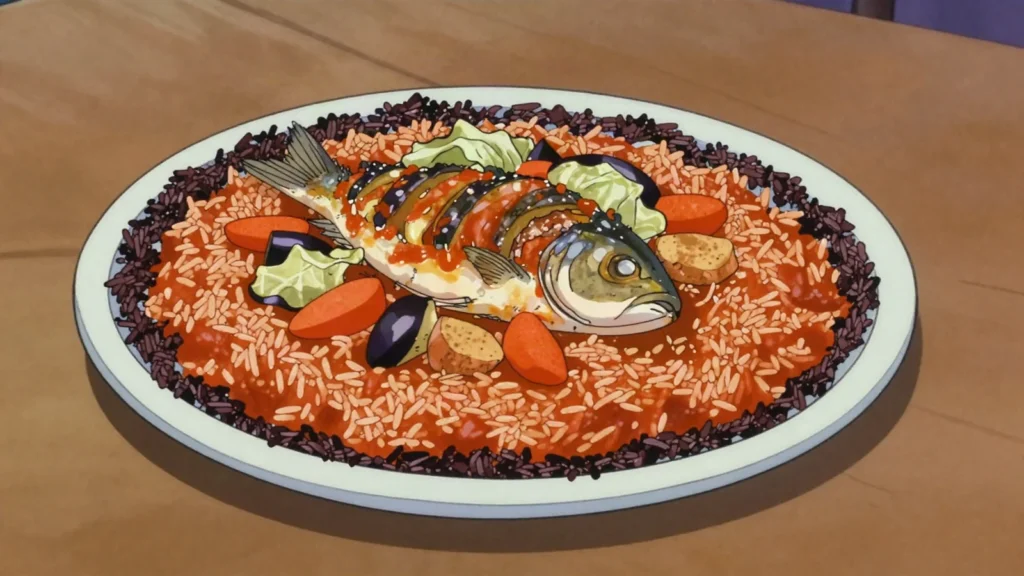
- Do not stir the rice again. A dark crust, the xoon, will form on the base of the pot; this is prized and is scraped up and shared. Pile the rice on a large platter, arrange fish and vegetables over it, pour over the reserved sauce, and serve with lime and vinegared onion.
Technique
- Thieboudienne is the national dish of Senegal, was inscribed on the UNESCO intangible heritage list in 2021, and is eaten communally from one platter with the right hand, each person working the wedge of rice in front of them.
- Broken rice is essential and not a compromise. The short fragments absorb far more sauce than whole grains and give the dense, red, slightly sticky texture that defines the dish.
- The two fermented ingredients, nététou and yet, are what make it taste Senegalese. Yet, fermented sea snail, is powerfully pungent and a little goes a long way; rinse it and use no more than 40 g.
- Thieb rouge (with tomato) is the Dakar standard; thieb blanc, cooked without tomato paste, is common in Saint-Louis, which claims to have invented the dish through the cook Penda Mbaye.
Substitutions
- No thiof? Any firm white fish on the bone will work, such as grouper, sea bass, hake or cod steaks; avoid thin fillets, which disintegrate in the sauce.
- If you cannot find yet or nététou, use 2 stock cubes and 1 tsp of dark miso, and accept that the depth will be shallower.
- Broken rice is sold in African and Asian shops; if you cannot get it, pulse ordinary long-grain rice briefly in a food processor to break some of the grains.
Variations
- Thieb bou weckh, the white version made without tomato, from Saint-Louis.
- Thiebou yapp, the same method with beef in place of fish.
- Thiebou guerte, a peanut-based version made inland.
History
Its name comes from Wolof, ceebu jën, meaning rice and fish, and the dish, considered Senegal’s national dish and shared across neighboring Mauritania and other parts of the old Wolof-influenced region, is generally credited to Penda Mbaye, a cook in Saint-Louis, a coastal city that served as an early center of French colonial trade in West Africa from the 1600s onward. Rice was not native to the region and only became widely available through the port’s trade activity, at which point local cooks combined it with fish, a coastal staple, and tomato, likely introduced through the same colonial trade networks, into what became the now-standard one-pot dish. Broken rice, considered a lower-grade byproduct elsewhere, became specifically prized in thieboudienne for how well it absorbs the fish and tomato sauce.
Frequently asked questions
What is Thieboudienne?
Thieboudienne is a main from Mauritania: herb-stuffed fish cooked with rice and vegetables; shared national platter. Its name comes from Wolof, ceebu jën, meaning rice and fish, and the dish, considered Senegal’s national dish and shared across neighboring Mauritania and other parts of the old Wolof-influenced region, is generally credited to Penda Mbaye, a cook in Saint-Louis, a coastal city that served as an early center of French colonial trade in West Africa from the 1600s onward. Rice was not native to the region and only became widely available through the port’s trade activity, at which point local cooks combined it with fish, a coastal staple, and tomato, likely introduced through the same colonial trade networks, into what became the now-standard one-pot dish. Broken rice, considered a lower-grade byproduct elsewhere, became specifically prized in thieboudienne for how well it absorbs the fish and tomato sauce.
How long does Thieboudienne take to make?
Thieboudienne takes 50 min of preparation and 1 hr 30 min of cooking. The recipe makes 6 servings. It is rated hard to make.
What can I substitute in Thieboudienne?
Yes, within limits. No thiof? Any firm white fish on the bone will work, such as grouper, sea bass, hake or cod steaks; avoid thin fillets, which disintegrate in the sauce. If you cannot find yet or nététou, use 2 stock cubes and 1 tsp of dark miso, and accept that the depth will be shallower. Broken rice is sold in African and Asian shops; if you cannot get it, pulse ordinary long-grain rice briefly in a food processor to break some of the grains.
What is the most important thing to get right in Thieboudienne?
Pound the parsley, garlic, spring onion, chilli, nététou or stock cube, salt and pepper in a mortar to a coarse green paste. This is rof, and it is what makes the dish thieboudienne rather than a fish rice.