
Ingredients
Dough
- 500 gplain flour
- 1 tspsalt
- 300 mlwarm water
- 3 tbspsunflower oil, plus 100 ml more for greasing and frying
Cheese filling
- 500 gbrinza or salty sheep cheese, crumbled
- 200 gfresh cottage-style curd cheese
- 2eggs
- 3 tbspchopped dill
- Black pepper
Other traditional fillings, choose one
- Potato: 700 g potatoes, boiled, mashed and beaten with 1 fried onion and dill
- Cabbage: 700 g sauerkraut or white cabbage, shredded and stewed slowly with 1 onion and pepper for 30 min
- Cherry: 600 g stoned sour cherries tossed with 4 tbsp sugar and 3 tbsp semolina to catch the juice
To finish
- 50 gbutter, melted, for brushing
- Sour cream, to serve
Directions
- Mix the flour, salt, water and 3 tbsp oil into a soft, slightly sticky dough and knead it for 10 minutes until it is smooth and very stretchy. The dough must be slack; a stiff one will tear when you pull it.
- Divide into 8 balls, roll each in oil, set them in a dish, cover, and rest at least 1 hour at room temperature. This rest is what lets you stretch the dough to transparency.
- Beat the filling together: cheeses, eggs, dill and pepper, or whichever filling you have chosen, and keep it cool and thick, never wet.
- Oil the work surface generously rather than flouring it. Flatten a ball with the palm, then stretch it outward with the backs of your hands from underneath, working around the edge, until you have a sheet 40–50 cm across, thin enough to read newsprint through.
- Spoon a mound of filling into the centre, then fold the sides in over it in overlapping flaps, working around the circle like closing an envelope, to make a flat round parcel about 18 cm across.
- Turn it seam-side down and press it gently flat with the palm. The many thin folds are the point: the finished plăcintă should be layered and papery, not a single thick crust.
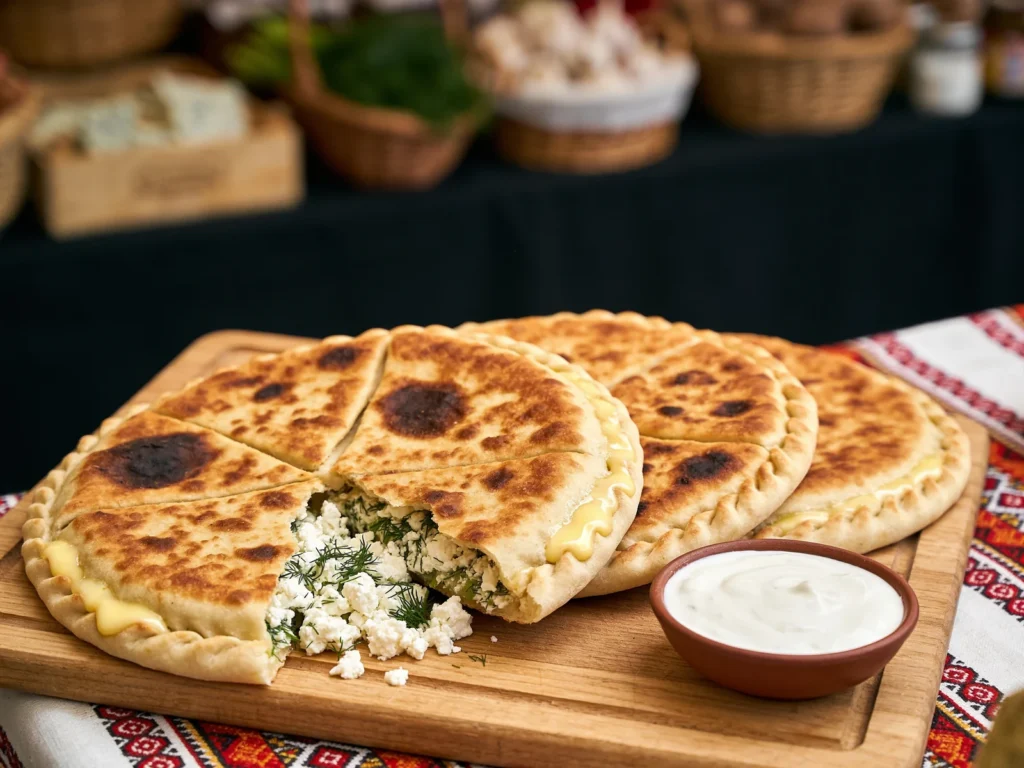
- Fry in a heavy pan in a few tablespoons of oil over medium heat, 4–5 minutes a side, pressing lightly with a spatula, until deep golden with dark blistered patches and the layers have separated visibly at the edge.
- Alternatively bake them on a tray at 200°C (400°F) for 25–30 minutes, brushing with melted butter halfway, which gives a drier, crisper pastry.
- Brush the hot plăcinte with melted butter and stack them under a cloth for a few minutes so they soften slightly.
- Cut into wedges and eat warm, with sour cream alongside for the savoury ones and a dusting of sugar on the cherry ones.
Technique
- Moldovan plăcinte are stretched, not rolled thin. The oiled surface and the long rest let you pull the dough by hand, which is what produces the many fine layers; a rolling pin will not get you there.
- Wet fillings are the usual failure. Drain cheese, cool mashed potato, squeeze sauerkraut, and use semolina under fruit to soak the juice, or the base tears and leaks into the pan.
- Fried and baked are both authentic and are made in different households; the fried version is older and richer, the baked one is what you find in a covrigărie.
- The word covers a family of pies. Vertute are the rolled-up spiral form, and plăcinte poale-n brîu are the little cheese parcels with the corners folded in, a Moldovan speciality.
Substitutions
- No brinza: feta rinsed of some of its salt, mixed half and half with ricotta or dry curd cheese, works well.
- No sour cherries: firm plums or grated apple with cinnamon are traditional autumn fillings.
- A pinch of yeast and 30 minutes of proving gives a softer, more bread-like dough some families prefer.
Variations
- Plăcinte cu brînză și mărar, cheese and dill, is the everyday standard.
- Plăcinte cu varză, with slowly stewed sauerkraut, is the winter and fasting-day version.
- Plăcinte cu vișine, with sour cherries, is served as a sweet with sour cream and sugar.
History
Thin pan-fried or baked pies filled with cheese, cabbage, potato or sour cherries, sold at every Moldovan market.
Frequently asked questions
What is Plăcinte?
Plăcinte is a bread & pastry from Moldova: flat round pies filled with brânză, potato, cabbage or cherries. Thin pan-fried or baked pies filled with cheese, cabbage, potato or sour cherries, sold at every Moldovan market.
How long does Plăcinte take to make?
Plăcinte takes 40 min of preparation and 1 hr resting, 30 min cooking of cooking. The recipe makes 8 plăcinte. It is rated medium to make.
What can I substitute in Plăcinte?
Yes, within limits. No brinza: feta rinsed of some of its salt, mixed half and half with ricotta or dry curd cheese, works well. No sour cherries: firm plums or grated apple with cinnamon are traditional autumn fillings. A pinch of yeast and 30 minutes of proving gives a softer, more bread-like dough some families prefer.
What is the most important thing to get right in Plăcinte?
Mix the flour, salt, water and 3 tbsp oil into a soft, slightly sticky dough and knead it for 10 minutes until it is smooth and very stretchy. The dough must be slack; a stiff one will tear when you pull it.