Milk fermented by bacteria that turn its sugar into lactic acid, which sets the protein into a gel and preserves it — and makes it digestible to people who cannot drink milk.
Where it comes from
Yoghurt belongs to a broad belt running from the Balkans through Anatolia, the Levant, the Caucasus, Iran and Central Asia to South Asia, where it is a daily food rather than a breakfast item. The word is Turkish; the practice is older than any of the names for it.
The two organisms in classic yoghurt, Lactobacillus bulgaricus and Streptococcus thermophilus, work together — each produces compounds the other needs — which is why yoghurt culture is passed on as a culture and not assembled from scratch.
The related soured milks are their own foods, not near-misses: kefir is fermented by a symbiotic community of bacteria and yeasts and is faintly fizzy and alcoholic; skyr, labneh and chakka are all strained to different degrees.
Varieties
- Plain set yoghurt — Fermented in the pot, so the gel is unbroken.
- Stirred / Greek-style — Strained of whey to concentrate it. Thicker, higher in protein, more acidic.
- Labneh — Strained much further, to a soft cheese. Rolled in oil and herbs, or spread.
- Skyr — Icelandic, technically a fresh cheese, strained very hard and very low in fat.
- Kefir — Fermented with grains of bacteria and yeast. Thinner, sharper, slightly effervescent.
- Dahi and chaas — South Asian set yoghurt and its thinned, salted drinking form.
- Ayran, doogh, lassi — Salted or sweet yoghurt drinks from Turkey, Iran and South Asia.
In the kitchen
Yoghurt curdles when heated because its proteins are already acid-destabilised. Stabilising it — with a little cornflour, or by tempering it with hot liquid before it goes in — is standard practice in every cuisine that cooks with it, and it is why Turkish and Persian yoghurt soups do not split.
Its acid tenderises meat surfaces and, more importantly, carries fat-soluble spice flavours into them, which is what a yoghurt marinade is actually doing.
To make it: milk heated to about 85°C and cooled to about 45°C, a spoonful of live yoghurt stirred in, held warm for several hours. The heating is what makes it set thick, by denaturing the whey proteins first.
Dishes with yoghurt
 SikarniStrained yoghurt whipped with sugar, cardamom, saffron and chopped nuts
 DhidoHand-stirred buckwheat or millet mush, eaten with gundruk and curries
 AartsThick sour curd paste from skimmed milk, eaten fresh or dried further.
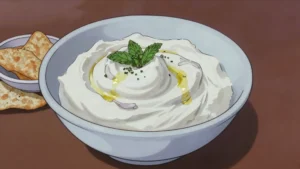 Mast-e MusirThick yoghurt mixed with soaked wild shallot, eaten as dip with crisps or rice.
 DhoklaSteamed fermented gram-flour sponge tempered with mustard seeds; Gujarati
 Ul BoovSole-shaped fried cakes stacked into a tower and topped with cream and sweets
 Shekerburacrescent pastry pinched with tweezers, filled with sugared nuts
 Tahchinsaffron-yoghurt rice cake layered with chicken, cut in golden slabs
Yoghurt is tagged on 398 dishes from 109 countries in the atlas. These notes are written from general knowledge and carry no per-fact citation — see About.