
Ingredients
Water dough
- 200 gplain flour
- 40 gicing sugar
- 60 glard or shortening
- 80 mlwater
Oil dough
- 150 gplain flour
- 75 glard or shortening
Filling
- 120 gmaltose syrup
- 40 gicing sugar
- 30 gunsalted butter, softened
- 30 gmilk powder
- 20 gplain flour
- a pinch of salt
Directions
- Stand the tub in hot water for a few minutes to loosen it. Oil the spoon before you dig into it, which helps a great deal. Making the filling comes first because it needs to chill. Beat the softened butter with the icing sugar until pale. Add the warmed maltose and beat it in thoroughly. Sift in the milk powder, the flour and the salt.
- Mix until you have a thick, pliable paste. Refrigerate it for at least an hour to firm it up. Rub the lard into the flour and icing sugar with your fingers. Add the water gradually and bring it into a dough.
- Knead it for five minutes until it is smooth and supple. It should feel soft and slightly elastic to the touch. Cover it and rest it for thirty minutes at room temperature. Making the oil dough takes only a minute. Rub the lard into the flour until it forms a paste.
- Cover it and rest it alongside the water dough. Both doughs should be at the same temperature when you combine them. Divide each dough into twelve equal pieces. Flatten one piece of water dough into a small disc. Set a piece of oil dough in the centre of it. Turn it seam side down and let it rest for ten minutes.
- Roll that ball out into a long narrow oval. Roll it up from the short end into a tight cylinder. Rest it for ten more minutes under a cloth. Turn the cylinder ninety degrees and flatten it again. Roll it into a long oval a second time. Roll it up again into a cylinder.
- Rest all twelve cylinders for fifteen minutes before filling. Filling and shaping them needs a light hand. Press one cylinder flat with your palm, cut ends up. Roll it into a round about eight centimetres across.
- Keep the centre thicker than the edges. Set a ball of chilled filling in the middle. Turn it seam side down onto the baking sheet. Press it gently flat with your palm into a disc. Do not press so hard that the filling breaks through.
- Leave good space between them on the tray. Baking them is quick and needs a moderate oven. Heat the oven to 180C with a shelf in the middle. Bake them for about ten minutes until they are set.
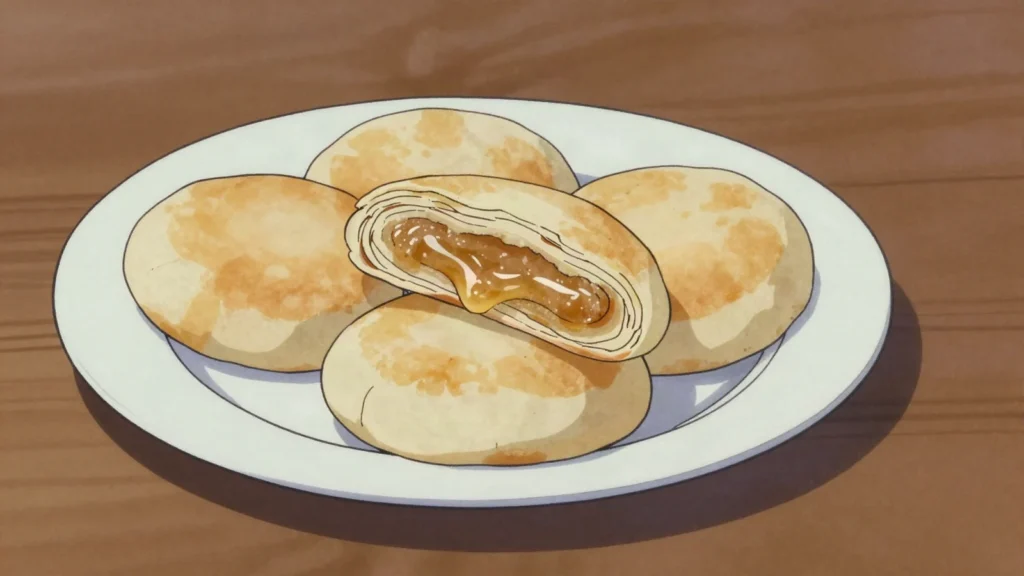
- Turn each one over carefully with a palette knife. Bake them for eight to ten minutes more. They should be pale gold rather than brown. Leave them on the tray for five minutes to firm up. The filling is molten hot when they come out of the oven. Break one open and the layers will flake everywhere.
Technique
- Maltose gives the filling its characteristic chew and mild malt flavour.
- Honey or golden syrup will make a sweet pastry but not a sun cake, since neither has the same pulling texture.
Substitutions
- Vegetable shortening replaces lard directly and makes the recipe suitable for anyone avoiding pork.
- Butter can be used in the oil dough but makes the lamination harder to control because it softens faster.
Variations
- Some Taichung bakeries add a little salt to the filling for a savoury edge.
- Modern versions are sold filled with taro, red bean or salted egg yolk.
- A smaller size is sold in boxes as a travel gift.
History
A Taichung speciality sold to railway travellers from the 1950s; the maltose-filled flaky pastry became the city’s standard souvenir.
Frequently asked questions
What is Sun Cake?
Sun Cake is a bread & pastry from Taiwan: taichung flaky pastry with sweet maltose filling. A Taichung speciality sold to railway travellers from the 1950s; the maltose-filled flaky pastry became the city’s standard souvenir.
How long does Sun Cake take to make?
Sun Cake takes 1 hour plus resting of preparation and 20 minutes of cooking. The recipe makes 12 cakes. It is rated hard to make.
What can I substitute in Sun Cake?
Yes, within limits. Vegetable shortening replaces lard directly and makes the recipe suitable for anyone avoiding pork. Butter can be used in the oil dough but makes the lamination harder to control because it softens faster.
What is the most important thing to get right in Sun Cake?
Keep the centre thicker than the edges. Set a ball of chilled filling in the middle. Turn it seam side down onto the baking sheet. Press it gently flat with your palm into a disc. Do not press so hard that the filling breaks through.