A South American tuber that became the staple crop of northern Europe, and the ingredient whose behaviour in a pan depends less on the recipe than on which of several thousand varieties is sitting on the board.
Where it comes from
The potato, Solanum tuberosum, was domesticated in the Andes — around Lake Titicaca, in what is now southern Peru and north-western Bolivia — thousands of years before it was seen anywhere else. Andean farmers still grow a range of it that the rest of the world does not: thousands of local varieties in yellows, purples, blacks and reds, many of them shapes that no machine could ever peel.
It reached Europe in the second half of the sixteenth century, by way of the Spanish, and was treated for a century mostly as animal feed and botanical curiosity. What changed was that it yields more calories per acre than grain on poor ground and does not have to be milled. By the eighteenth century it had become the thing large parts of northern and eastern Europe actually ate.
That dependence had a price. Almost everything grown in Ireland by the 1840s descended from a very narrow genetic base, and when the water mould Phytophthora infestans arrived there was nothing in the field with any resistance to it. The failures of 1845 onward killed around a million people and drove a million more out of the country. It is the standard example of what monoculture costs, and it is the reason potato breeding programmes are still preoccupied with blight.
Varieties
- Floury / starchy — High dry matter, low moisture. The cells fall apart on cooking, which is what you want for a light mash, a roast potato with a shattering crust, and chips. They collapse in a stew. Russet Burbank and King Edward are the type.
- Waxy — Lower starch, more moisture, cells that hold together. These keep their shape boiled, sliced into a gratin, or dressed while warm for a salad. Charlotte, Nicola and La Ratte are the type.
- All-rounder — In between, and what most supermarkets sell unlabelled. Maris Piper, Yukon Gold and Désirée will do most jobs without being the best at any of them.
- Maris Piper — The British chip potato. Floury enough to go fluffy inside, firm enough not to disintegrate.
- Russet Burbank — Long, dry and heavily starchy. The industrial frying potato — most frozen chips in the world are this.
- Yukon Gold — Yellow-fleshed, faintly buttery, halfway between waxy and floury. Good mashed, good roasted.
- Charlotte — Small, waxy, thin-skinned. The default salad potato in much of Europe.
- La Ratte — Knobbly, waxy, distinctly nutty. The variety behind the very rich French purées.
- Andean coloured varieties — Papa negra, papa amarilla and hundreds of others, with flesh from deep purple to bright yellow. Denser and often sweeter, and the base of Peruvian and Bolivian cooking rather than a novelty.
In the kitchen
Almost every disappointing potato dish is a floury variety asked to hold its shape or a waxy one asked to fluff up. If a recipe does not say which to use, the giveaway is the method: boiled and kept whole, or sliced and layered, wants waxy; mashed, roasted or fried wants floury.
Starting potatoes in cold water and bringing them up to the boil cooks them evenly; dropping them into water that is already boiling cooks the outside to mush before the middle is done. For roasting, parboiling and then shaking them in the pan roughens the surface, and it is that broken surface — not the fat alone — that turns into crust.
Cooked and cooled potato converts some of its starch into a resistant form that does not re-soften on reheating, which is why yesterday’s boiled potatoes fry so much better than today’s and why a reheated baked potato is never quite the same thing.
Choosing and keeping
Keep them dark, cool and dry, but not in the refrigerator: below about 4°C the starch turns to sugar, and those sugars burn to a bitter brown before the potato is cooked through. Never store them with onions, which speed each other’s spoiling.
Green skin means the tuber has seen light and has made solanine, which is bitter and, in quantity, poisonous. Cut green parts and sprouts away generously; if the potato is green under most of the skin, throw it out.
Small sprouts on an otherwise firm potato are harmless once rubbed off. A potato that has gone soft and wrinkled has lost its water and will cook to nothing.
Dishes with potato
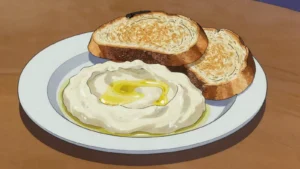 Brandaminciumwhipped salt cod and potato purée eaten on meatless days
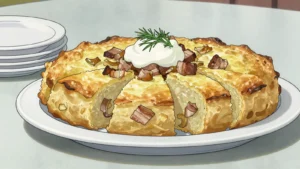 Potato babkagrated potato baked with pork belly and onions
 StoempRustic mash of potatoes and vegetables, with sausage.
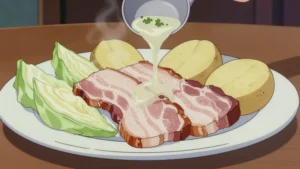 Bacon and cabbageBoiled bacon joint with cabbage and floury potatoes.
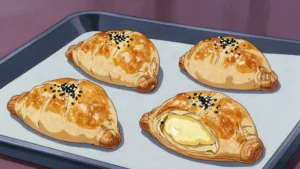 BourekasBalkan-origin filled puff pastries: cheese, potato or spinach
 Skordaliathick garlic purée bound with potato, bread or almonds
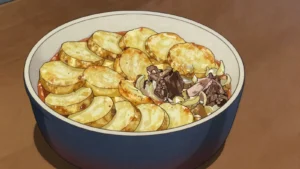 Lancashire hotpotLamb and onion casserole under sliced potatoes, baked slowly in a tall pot.
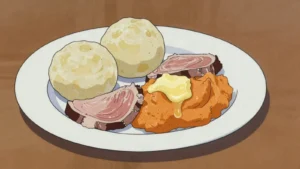 RaspeballGrey grated-potato dumplings with salted lamb, a Thursday ritual.
Potato is tagged on 363 dishes from 133 countries in the atlas. These notes are written from general knowledge and carry no per-fact citation — see About.