Ingredients
Base
- 400 gbambara groundnuts, voandzou, soaked overnight
- 200 graw peanuts
Seasoning
- 2onions, chopped
- 4 clovesgarlic
- 2chillies
- 4 tbspred palm oil
- 1 tspsalt
- black pepper
To wrap and cook
- banana leaves, softened over a flame
- string
To serve
- with cassava leaves, pondu
- with rice or fufu
Directions
- Soak the dried nuts overnight, and for a full twenty-four hours if you can. They are extremely hard when dry, considerably harder than a chickpea, and undersoaked they will never soften properly. Boil the soaked nuts in plenty of water for an hour to an hour and a half.
- Cook them well past tender, since they must be soft enough to grind smoothly and any hard nut leaves a gritty result. Test by crushing one between your fingers, which should give no resistance at all.
- Drain them, keeping a little of the cooking liquid. Roast the raw peanuts in a dry pan or in the oven until fragrant and lightly coloured. Rub off the skins between your hands once they are cool. Grind the cooked bambara nuts and roasted peanuts together into a thick paste. Traditionally this is done in a large wooden mortar, and a food processor does the job at home.
- Grind it thoroughly, since the finished cake should be smooth and dense rather than granular. Add a little of the cooking liquid if it will not come together, but keep the paste stiff. Too much liquid gives a cake that will not hold its shape when unwrapped.
- Fry the onions, garlic and chilli in red palm oil until soft and fragrant. Work the fried mixture into the ground paste along with salt and pepper. Season it firmly, since a large dense cake of ground legumes needs more salt than seems right.
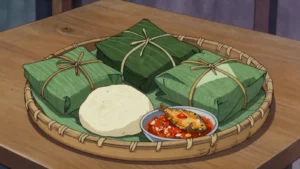
- Taste the raw paste and adjust it now, since nothing can be added later. Soften the banana leaves by passing them briefly over a flame until they turn glossy and flexible. Lay out overlapping leaves, spoon the paste into the middle and shape it into a thick loaf. Fold the leaves over tightly, tucking in the ends, and tie the parcel with string.
- Wrap it firmly, since a loose parcel lets water in and the cake becomes waterlogged. Now steam it for an hour to an hour and a half. Set the parcel on a rack over simmering water and cover the pot. Steam rather than boil it, since direct contact with water dilutes the paste and ruins the texture.
- Top up the water as it evaporates, and check it does not boil dry. It is ready when the cake is firm all the way through and holds together when the leaf is opened. Cut it into thick slices to serve. It keeps several days refrigerated and it is also eaten cold in slices.
Technique
- Zambian chikanda is made from wild orchid tubers and raises real conservation concerns.
- Bambara groundnuts are an African legume that ripens underground.
- The nuts must be soaked overnight and boiled until completely soft.
Substitutions
- Extra peanuts if bambara groundnuts cannot be found.
- Foil in place of banana leaves, accepting a loss of aroma.
Variations
- Made with more chilli, for a hotter cake.
- With smoked fish worked into the paste.
- Steamed in individual small parcels.
Frequently asked questions
What is Kikanda?
Kikanda is a main from DR Congo: bambara groundnuts and peanuts ground, wrapped in leaves and steamed into a cake.
How long does Kikanda take to make?
Kikanda takes 40 min plus overnight soaking of preparation and 1 hr 30 min of cooking. The recipe makes 6 servings. It is rated medium to make.
What can I substitute in Kikanda?
Yes, within limits. Extra peanuts if bambara groundnuts cannot be found. Foil in place of banana leaves, accepting a loss of aroma.
What is the most important thing to get right in Kikanda?
Soak the dried nuts overnight, and for a full twenty-four hours if you can. They are extremely hard when dry, considerably harder than a chickpea, and undersoaked they will never soften properly. Boil the soaked nuts in plenty of water for an hour to an hour and a half.