
Ingredients
The seed
- 400 gground melon seed
- mbika or egusi
- hulled and ground fine
The filling
- 500 gsmoked or fresh fish
- flaked, or chicken pieces
- 2onions, finely chopped
- 4garlic cloves, crushed
- 2hot chillies, chopped
- 1tomato, chopped
- salt and black pepper
To wrap and steam
- banana leaves
- or marantaceae leaves
- softened over a flame
- string, for tying
- water, for the steamer
To serve
- with rice
- or chikwangue
- or fufu
- with greens
Directions
- Cut out the thick central rib. The central rib is stiff and will not fold. Discard the tough central rib itself. That takes only a few seconds. Grind the melon seeds to a fine powder. A spice grinder does it well enough. Oil goes rancid over enough time. Discard it if it smells at all rancid. Flake the fish into a large bowl.
- Check it very carefully for bones. They do not soften in steaming at all. Put the ground seed in a large bowl. Add the very finely chopped onion. Add the garlic and the chopped chillies. Add the chopped tomato as well. Season it with salt and black pepper. Fold the flaked fish through the mixture. Mix it thoroughly but without compacting it. The fish should be evenly distributed.
- Work it through with your hands. Adding liquid is done carefully. Add a little water a spoonful at a time. The mixture should just hold together. Squeeze a handful in your palm. It should hold its shape when released. Add a little more seed if it is too wet. Fry a small spoonful in a pan. Taste it and adjust the seasoning. Lay a softened leaf flat on the board.
- Put a mound of mixture in the middle. Each parcel should hold a good handful. Fold the sides of the leaf over the filling. Turn the parcel over so the folds are underneath. Tie each parcel closed with string. Wrap the string round both ways. The parcel must not open in the steamer.
- Steam pressure pushes the folds apart. Tie it firmly in both directions. Check each one before it goes in. Put water in the bottom of a large pot. Set a rack or some sticks above it. The parcels must sit above the water.
- Lay spare leaves on the rack as well. Lay all the parcels on the rack. Cover the pot tightly with a lid. Bring the water to a steady boil. Let them steam for about an hour. Check it every twenty minutes or so. Add boiling water if it runs low. A dry pot burns very quickly indeed. Steam them longer if the centre is soft.
- Take the parcels out and let them stand. Give them about ten full minutes. Serve rice or chikwangue alongside. Add cooked greens to the plate. It keeps three days refrigerated. Steam it again briefly to reheat.
Technique
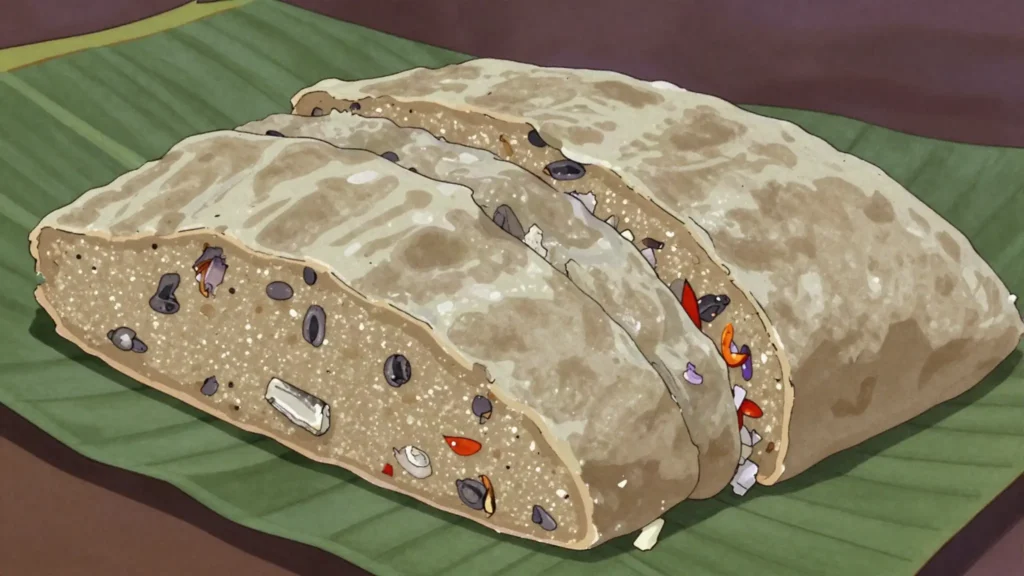
- Ground melon seed is very high in oil and protein, and steamed inside a wrapper it sets firm and sliceable rather than staying loose; that firmness is the point. The atlas also carries egusi soup, which uses the same kind of seed but as a loose stew — a genuinely different preparation.
- The mixture must be a thick stiff paste that holds its shape when squeezed: add water a spoonful at a time, since too much stops it setting firm. Fry one small spoonful and taste it before wrapping, since raw seed paste cannot be judged for salt and smoked fish brings its own.
- Ground seed is high in oil and goes rancid, tasting sharp and bitter; smell it before using it and discard it if there is any doubt. Pass the leaves over a flame for a few seconds until they darken and go limp, since fresh leaves crack when folded.
Substitutions
- Foil holds the shape where no banana or marantaceae leaves are available, though it adds no flavour.
- Chicken pieces stand in for the fish.
Variations
- Tie each parcel firmly in both directions, since steam pressure pushes the folds apart.
- It is served in the leaf for each person to open, alongside rice, chikwangue or fufu with greens.
- Kwilu and Bandundu, inland from Kinshasa, are where leaf-wrapped steamed dishes like this are commonest.
History
Ground egusi-type melon seed steamed in leaves into a firm savoury loaf, a Kwilu and Bandundu speciality.
Frequently asked questions
What is Mbika?
Mbika is a main from DR Congo: ground squash-seed patties with fish, steamed in leaves. Ground egusi-type melon seed steamed in leaves into a firm savoury loaf, a Kwilu and Bandundu speciality.
How long does Mbika take to make?
Mbika takes 40 minutes of preparation and 1 hour 15 minutes of cooking. The recipe makes serves 6. It is rated medium to make.
What can I substitute in Mbika?
Yes, within limits. Foil holds the shape where no banana or marantaceae leaves are available, though it adds no flavour. Chicken pieces stand in for the fish.
What is the most important thing to get right in Mbika?
Check it very carefully for bones. They do not soften in steaming at all. Put the ground seed in a large bowl. Add the very finely chopped onion. Add the garlic and the chopped chillies. Add the chopped tomato as well. Season it with salt and black pepper. Fold the flaked fish through the mixture. Mix it thoroughly but without compacting it. The fish should be evenly distributed.