
Ingredients
Meat
- 2.5 kgpork shoulder, skin on, scored, or a whole belly slab
- 2 tbspcoarse salt
Jerk seasoning
- 8spring onions (escallion), chopped
- 6scotch bonnet peppers
- 1onion, chopped
- 8garlic cloves
- 40 gginger
- 3 tbspfresh thyme leaves
- 3 tbspground pimento (allspice) plus 2 tbsp whole berries
- 2 tspgrated nutmeg
- 2 tspground cinnamon
- 1 tspground cloves
- 4 tbspdark soy sauce
- 3 tbspdark brown sugar
- 4 tbspwhite vinegar
- juice of 2 limes
- 3 tbspvegetable oil
- 1 tbspcoarse black pepper
Fire
- pimento wood sticks, leaves and green branches, or 4 handfuls of soaked pimento wood chips
- hardwood charcoal
Directions
- Blend all the seasoning ingredients except the whole berries into a thick dark paste, coarse rather than smooth.
- Cut deep slashes through the pork fat into the meat at 3 cm intervals. Rub the salt in first, then work the paste into every cut and all over the surface, pressing the whole pimento berries into the slashes.
- Marinate in the fridge 24–48 hours, turning once. The salt and vinegar cure the surface slightly, which is the point.
- Build a barbecue or drum pan for indirect heat at 130–140°C (275–275°F). In Portland the pork goes in a pit floored with pimento sticks and covered with a sheet of zinc; a lidded kettle is the honest home stand-in.
- Lay pimento wood and soaked chips over the coals and wait for clean blue smoke, not white billows.
- Set the pork skin side up on the cool side, close the lid and smoke for 3 hours 30 minutes to 4 hours, adding a handful of coals and wood every 45 minutes, until the meat reads 90–93°C (195–200°F) internally and a probe slides in with no resistance.
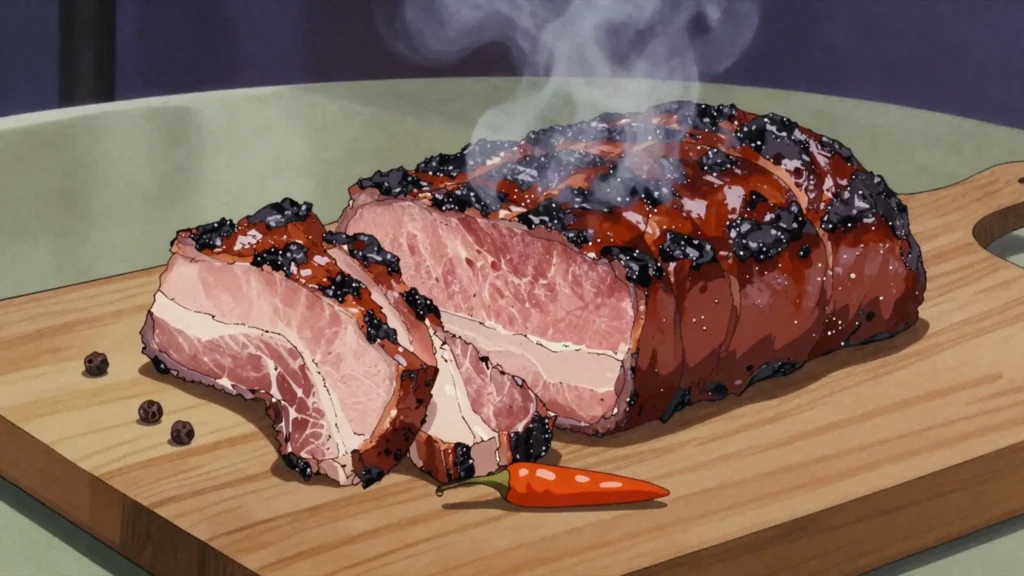
- Move the pork over the direct coals for 6–8 minutes, turning, to crisp and blister the skin and set a black-red crust.
- Rest under loose foil 20 minutes, then chop through the crust into thick chunks with a cleaver so every piece carries skin, fat and smoke.
- Serve on brown paper with festival, hard dough bread and jerk sauce, and a Red Stripe.
Technique
- Jerk pork is the oldest form of jerk: it descends from the Maroons of the Blue Mountains, who preserved wild boar with pimento and pepper and cooked it slowly over green wood in covered pits.
- Green pimento wood matters more than charcoal. Its smoke is sweet and clove-like, and the leaves are laid directly on the meat in Boston Bay.
- Pork shoulder needs to go past 90°C (195°F), well beyond safe, to melt the collagen. Pulling it at 75°C (165°F) gives tough, dry jerk.
- The crust looks burnt and should. That black-red bark is where the seasoning concentrates.
Substitutions
- No pit or barbecue: cook at 150°C (300°F) in the oven for 4 hours on a rack over water, then finish 10 minutes under a fierce grill. Add 2 tsp of smoked paprika to the paste to fake the fire.
- Pork belly makes an excellent smaller version, and cooks in 2 hours 30 minutes.
Variations
- Whole hog jerk at Boston Bay, cooked in the pit for 6 hours and chopped to order.
- Jerk pork stewed down the next day with butter beans and served over rice.
History
Maroons who escaped Spanish plantations preserved and smoked wild hog in the mountains; Boston Bay in Portland is the modern home of jerk pork.
Frequently asked questions
What is Jerk pork?
Jerk pork is a main from Jamaica: pork rubbed with pimento and scotch bonnet, smoked slowly over pimento wood. Maroons who escaped Spanish plantations preserved and smoked wild hog in the mountains; Boston Bay in Portland is the modern home of jerk pork.
How long does Jerk pork take to make?
Jerk pork takes 30 min plus 24 hr marinating of preparation and 4 hr of cooking. The recipe makes 8 servings. It is rated hard to make.
What can I substitute in Jerk pork?
Yes, within limits. No pit or barbecue: cook at 150°C (300°F) in the oven for 4 hours on a rack over water, then finish 10 minutes under a fierce grill. Add 2 tsp of smoked paprika to the paste to fake the fire. Pork belly makes an excellent smaller version, and cooks in 2 hours 30 minutes.
What is the most important thing to get right in Jerk pork?
Blend all the seasoning ingredients except the whole berries into a thick dark paste, coarse rather than smooth.