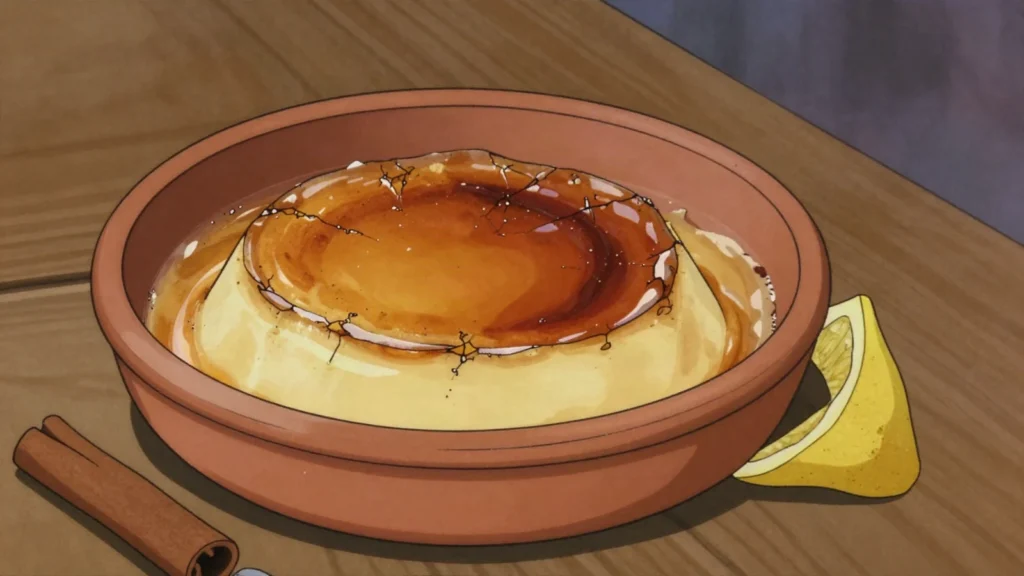

Ingredients
Custard
- 1 litrewhole milk
- 8egg yolks
- 200 gsugar
- 40 gcornflour
- peel of 1 lemon
- peel of 1 orange
- 1cinnamon stick
To finish
- 8 tbspcaster sugar
Directions
- Heat the milk with the lemon peel, orange peel and cinnamon stick until just below boiling, then take it off the heat and leave it to infuse for 20 minutes.
- Whisk the yolks with the sugar and cornflour until completely smooth.
- Strain the infused milk, then pour it slowly onto the yolks, whisking as you go.
- Return everything to the pan and cook over a medium heat, stirring constantly, until it thickens and just begins to bubble.
- This is a stovetop custard thickened with cornflour rather than an oven-baked cream custard, and that is precisely what separates it from crème brûlée: milk instead of cream, starch instead of baking, and citrus and cinnamon instead of vanilla.
- Pour into shallow earthenware dishes. Shallow matters, because it gives a high ratio of burnt sugar to custard.
- Cool, then chill for at least 4 hours until firmly set.
- Just before serving, scatter an even layer of caster sugar over each dish and burn it with a hot iron or a blowtorch.
- Burn the sugar at the last possible moment. The custard beneath is meant to stay cold, and the crust stays brittle for only a few minutes.
- It is also called crema de Sant Josep and eaten on Saint Joseph’s day, and custards very like it appear in medieval Catalan cookery manuscripts.
Technique
- Cold custard under hot sugar is the whole sensation. A warm crema catalana has missed the point.
- The traditional tool is a flat iron heated over a flame, which chars the sugar faster and more fiercely than a torch.
- Cornflour makes it far more forgiving than a baked custard. It will not split on you.
Substitutions
- A blowtorch, or a very hot grill with the dishes set on ice.
- Lime peel in place of orange, which is common in some Catalan households.
Variations
- With a little anise in the infusion.
- Served without the burnt sugar, simply chilled.
- Used as a filling for crema catalana ice cream or a xuixo.
History
Also called crema de Sant Josep and eaten on Saint Joseph’s day; similar custards appear in medieval Catalan cookery manuscripts.
Frequently asked questions
What is Crema catalana?
Crema catalana is a dessert from Spain: chilled citrus custard under crackly burnt sugar. Also called crema de Sant Josep and eaten on Saint Joseph’s day; similar custards appear in medieval Catalan cookery manuscripts.
How long does Crema catalana take to make?
Crema catalana takes 20 min plus 4 hr chilling of preparation and 25 min of cooking. The recipe makes 8 servings. It is rated medium to make.
What can I substitute in Crema catalana?
Yes, within limits. A blowtorch, or a very hot grill with the dishes set on ice. Lime peel in place of orange, which is common in some Catalan households.
What is the most important thing to get right in Crema catalana?
This is a stovetop custard thickened with cornflour rather than an oven-baked cream custard, and that is precisely what separates it from crème brûlée: milk instead of cream, starch instead of baking, and citrus and cinnamon instead of vanilla.