Ingredients
Leaves
- 1 kgcassava leaves, young and tender
- or 1 kg frozen pounded cassava leaf
- water, for washing
Protein
- 400 gsmoked fish, flaked
- 300 gdried fish or smoked meat
- or 500 g fresh fish, in pieces
Base
- 200 mlred palm oil
- 2onions, chopped
- 6garlic cloves, crushed
- 3tomatoes, chopped
- 2stock cubes
- 2piri piri chillies, chopped
- 1 litrewater
- salt and black pepper
Sometimes added
- 100 gground egusi or groundnut
- 1aubergine, chopped
- chopped okra
To serve
- boiled rice
- or cassava fufu
- or boiled plantain
Directions
- Strip the leaves from their stalks. Discard every stalk and thick stem. Wash them in several changes of cold water. Lift them out rather than pouring the water off.
- Repeat until the water runs completely clear. Keep pounding until they break down to a paste. That takes real effort and some time. Put the pounded leaf in a large pot. Cover it generously with water. Bring it to a full rolling boil uncovered. Leave the lid off for the entire boil.
- Let it boil hard for at least one hour. Stir it occasionally as it cooks. Top up with hot water as it reduces. The leaves should be completely soft.
- Warm it gently to melt it before use. Never let palm oil smoke or bleach in the pan. Warm the palm oil gently in a large pot. Add the chopped onions to the oil.
- Cook them for about eight minutes until soft. Add the garlic and the chopped chillies. Cook them for a good two minutes. Add the chopped tomatoes to the pot. Cook them down for about eight minutes. Add the smoked and dried fish.
- Rinse dried fish and check it for bones first. Crumble the stock cubes into it. Stir everything together thoroughly. Add the boiled cassava leaf to the pot. Stir it right through the palm oil base. Add water to loosen it if it is very thick.
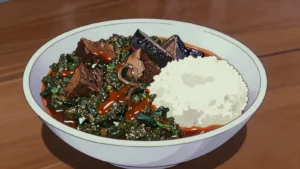
- Season it with salt and black pepper. Let it simmer gently for forty minutes. Stir it every ten minutes without fail. Add them for the last twenty minutes. Judging the finished stew takes a look. Taste it and adjust the salt and the chilli. Serving it is done hot with a starch.
Technique
- Cassava leaves contain more cyanogenic glycosides than the root, and pounding releases the enzyme that produces hydrogen cyanide.
- The long uncovered boil is a safety requirement rather than a matter of taste, since the lid would trap the vapour that must escape.
Substitutions
- Frozen pounded cassava leaf is widely sold and still needs the full long boiling.
- Smoked mackerel or any strongly smoked fish stands in for African smoked fish.
Variations
- Sierra Leone, Liberia, Congo and Angola all have their own versions under different names.
- Some households add ground egusi or groundnut to thicken it.
- A version made with fresh fish rather than smoked is lighter in flavour.
History
Cassava leaves pounded and boiled long to remove bitterness, then enriched with palm oil and smoked fish.
Frequently asked questions
What is Cassava leaf stew?
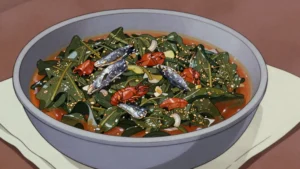
Cassava leaf stew is a soup & stew from Gabon: pounded cassava leaves with palm oil and smoked fish. Cassava leaves pounded and boiled long to remove bitterness, then enriched with palm oil and smoked fish.
How long does Cassava leaf stew take to make?
Cassava leaf stew takes 1 hour of preparation and 2 hours of cooking. The recipe makes serves 8. It is rated medium to make.
What can I substitute in Cassava leaf stew?
Yes, within limits. Frozen pounded cassava leaf is widely sold and still needs the full long boiling. Smoked mackerel or any strongly smoked fish stands in for African smoked fish.
What is the most important thing to get right in Cassava leaf stew?
Strip the leaves from their stalks. Discard every stalk and thick stem. Wash them in several changes of cold water. Lift them out rather than pouring the water off.