
Ingredients
Dough
- 500 gplain flour
- 7 ginstant yeast
- 200 mlwarm milk
- 130 gbutter or lard, softened
- 60 gicing sugar
- 2egg yolks
- 1 tspsalt
- zest of ½ lemon
Walnut filling
- 250 gwalnuts, ground
- 100 gsugar
- 100 mlmilk
- 1 tspground cinnamon
- 30 gfine breadcrumbs
- zest of ½ lemon
Poppy seed filling
- 250 gpoppy seeds, ground
- 100 gsugar
- 150 mlmilk
- 1 tbsphoney
- zest of ½ lemon
To glaze
- 1egg yolk
- 1whole egg
Directions
- Make the fillings first so that they have time to cool. Bring the milk and sugar to the boil, stir in the ground nuts or poppy seeds with the other flavourings, cook for 3 minutes to a thick spreadable paste and leave it to go completely cold. Warm filling melts the fat straight out of the dough.
- Rub the softened butter into the flour, then add the icing sugar, salt, lemon zest, egg yolks, yeast and warm milk and knead for 8 minutes into a smooth, soft dough.
- Cover and prove for about 1 hour, until well risen.
- Divide into 12 pieces and roll each into an oval about 12 cm long.
- Pipe or spoon a finger of filling down the centre of each, roll it up tightly from the long side, then roll the two ends under your palms so they taper to points.
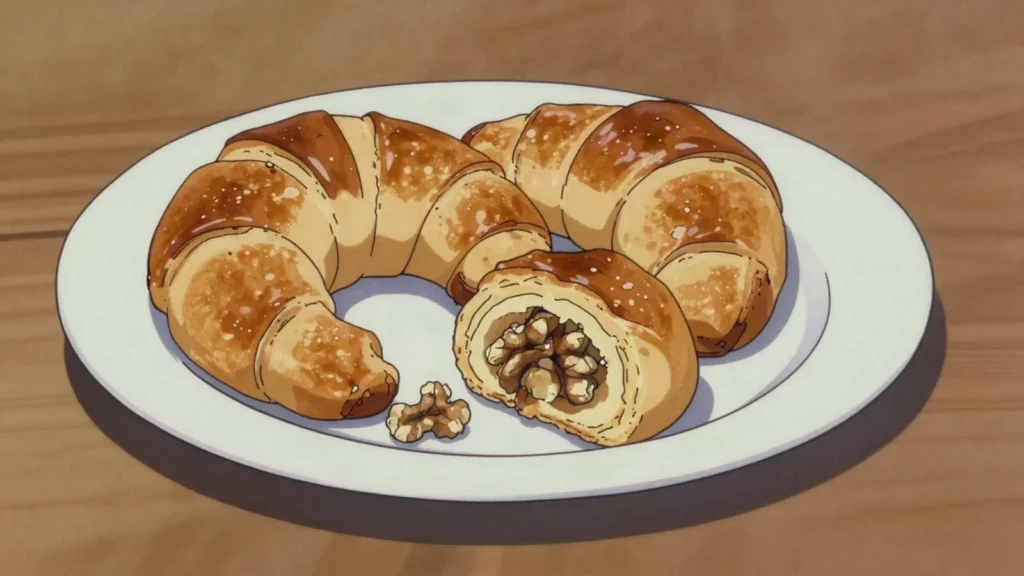
- Bend the walnut ones into narrow crescents and the poppy seed ones into wider horseshoes. The shape is the code for the filling, and it is written into the protected specification rather than left to the baker.
- Set them seam side down on lined trays and prove for a further 30 minutes.
- Brush all over with beaten egg yolk and then leave them uncovered for 15 minutes until the glaze has dried to a matt finish.
- Brush a second time, this time with whole beaten egg. This double glaze with a drying interval between coats is what produces the marbled crackle across the surface that the pastry is known for; a single coat gives a plain shine and it will not look right.
- Bake at 190°C (375°F) for 15 to 18 minutes, until deep chestnut brown.
- Cool on a rack. They are better on the second day, once the filling has had time to moisten the crumb around it.
Technique
- The double egg wash is the signature technique and the reason these look the way they do. Do not shortcut the drying time between coats.
- It has held EU protected geographical indication status since 2012, which fixes the shapes, the fillings and the minimum weight of filling.
- The filling should be a generous proportion of the whole. A thin smear of walnut in a lot of dough is not the same pastry.
Substitutions
- Ground hazelnuts in place of some of the walnuts.
- Lard rather than butter in the dough, which is the older guild practice and gives a shorter crumb.
Variations
- Made small, at about 40 g each, for a coffee tray.
- With a spoonful of rum in the walnut filling.
- With apricot jam worked into the poppy seed filling.
History
Baked by guild bakers in Pressburg, now Bratislava, from the eighteenth century; it received EU protected geographical status in 2012.
Frequently asked questions
What is Bratislavský rožok?
Bratislavský rožok is a bread & pastry from Slovakia: crescent or horseshoe pastry filled with ground walnut or poppy seed. Baked by guild bakers in Pressburg, now Bratislava, from the eighteenth century; it received EU protected geographical status in 2012.
How long does Bratislavský rožok take to make?
Bratislavský rožok takes 45 min plus 1 hr 30 min rising of preparation and 18 min of cooking. The recipe makes 12 pastries. It is rated medium to make.
What can I substitute in Bratislavský rožok?
Yes, within limits. Ground hazelnuts in place of some of the walnuts. Lard rather than butter in the dough, which is the older guild practice and gives a shorter crumb.
What is the most important thing to get right in Bratislavský rožok?
Bend the walnut ones into narrow crescents and the poppy seed ones into wider horseshoes. The shape is the code for the filling, and it is written into the protected specification rather than left to the baker.