Ingredients
Dough
- 500 gplain flour
- 7 ginstant yeast
- 60 gsugar
- 1½ tsp salt
- 1½ tsp ground cardamom
- ½ tspground coriander seed
- 60 mlvegetable oil
- 300 mlwarm water
To finish
- 1 tbspoil, for brushing
- 1 tspblack sesame or nigella seed (optional)
Directions
- Whisk the flour, yeast, sugar, salt, cardamom and coriander together, keeping the salt away from the yeast until the flour separates them.
- Add the oil and warm water and knead 10 minutes to a soft, smooth, slightly tacky dough. Cover and prove 1 hour 30 minutes, until doubled.
- Knock back and shape into a tight round. Set it on a lined tray or in a wide greased pan and flatten to about 3 cm thick and 26 cm across.
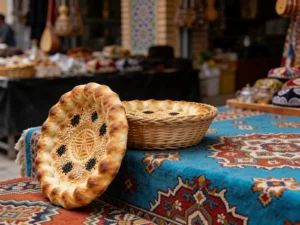
- Now score the pattern. With a sharp knife or a blunt edge, mark a circle in the centre, then cut lines radiating out from it to the rim like the spokes of a wheel — traditionally eight or twelve. Cut about 5 mm deep, no further, or the loaf tears as it rises.
- Prove another 30 minutes, brush with oil and scatter the seeds along the scored lines if using.
- Bake at 190°C (375°F) for 32–35 minutes, until deep gold and hollow underneath. Cover loosely with foil after 20 minutes if the pattern is browning faster than the loaf.
- Cool on a rack and tear along the scored lines to serve. It is broken and shared by hand at Meskel, Christmas and Eid, not sliced.
Technique
- The sun-wheel scoring is the point of the bread, not decoration added at the end — cut it before the second prove so the pattern opens as it bakes.
- Cardamom should be assertive. This is a sweet-spiced celebration bread, and a timid hand makes an ordinary loaf.
- A dark heavy pan gives the deep base colour Ethiopian and Eritrean bakers look for.
Substitutions
- Honey in place of half the sugar, which is common and gives a softer crumb.
- Milk instead of water makes a richer loaf, though the traditional version is dairy-free and so suits fasting days.
Variations
- Himbasha, the Eritrean name and near-identical bread, often with raisins worked in.
- A version with the dough enriched with butter for weddings.
History
A slightly sweet, decoratively patterned round bread, flavoured with cardamom and sometimes a touch of honey, documented across Ethiopia as a traditional bread specifically associated with celebrations and significant religious occasions, including Ethiopian Orthodox Christian holidays. Its distinctive surface pattern, typically a decorative cross or geometric design pressed or cut into the dough before baking, reflects ambasha’s specific ceremonial role within Ethiopian culture, distinguishing it visually from the everyday injera that forms the base of most Ethiopian meals. Ambasha remains closely tied to Ethiopian religious and celebratory tradition, commonly baked specifically for holidays and significant family occasions rather than routine daily eating.
Frequently asked questions
What is Ambasha?
Ambasha is a bread & pastry from Ethiopia: lightly sweet decorated celebration bread flavoured with cardamom. A slightly sweet, decoratively patterned round bread, flavoured with cardamom and sometimes a touch of honey, documented across Ethiopia as a traditional bread specifically associated with celebrations and significant religious occasions, including Ethiopian Orthodox Christian holidays. Its distinctive surface pattern, typically a decorative cross or geometric design pressed or cut into the dough before baking, reflects ambasha’s specific ceremonial role within Ethiopian culture, distinguishing it visually from the everyday injera that forms the base of most Ethiopian meals. Ambasha remains closely tied to Ethiopian religious and celebratory tradition, commonly baked specifically for holidays and significant family occasions rather than routine daily eating.
How long does Ambasha take to make?
Ambasha takes 25 min plus 2 hr rising of preparation and 35 min of cooking. The recipe makes 1 large loaf. It is rated medium to make.
What can I substitute in Ambasha?
Yes, within limits. Honey in place of half the sugar, which is common and gives a softer crumb. Milk instead of water makes a richer loaf, though the traditional version is dairy-free and so suits fasting days.
What is the most important thing to get right in Ambasha?
The sun-wheel scoring is the point of the bread, not decoration added at the end — cut it before the second prove so the pattern opens as it bakes.