
Ingredients
The leaves
- about 30 lá lốt leaves
- wild betel leaf
- Piper sarmentosum
- washed and dried
- extras for tearing
The filling
- 500 gminced beef
- not extra lean
- about 20 percent fat
- or half beef and half pork
- 4 clovesgarlic, crushed
- 2shallots, very finely chopped
- 1 stalklemongrass
- tender inner part, minced
- 2 tablespoonsfish sauce
- 1 tablespoonoyster sauce
- optional
- 1 teaspoonsugar
- 1 teaspoonblack pepper
- half a teaspoon five-spice powder
- optional
The spring onion oil
- 4spring onions, sliced
- 3 tablespoonsoil
- a pinch of salt
The dipping sauce
- 4 tablespoonsfish sauce
- 4 tablespoonswater
- 2 tablespoonssugar
- juice of 2 limes
- 2 clovesgarlic, finely chopped
- 1or 2 chillies, chopped
- or mắm nêm, the fermented anchovy sauce
To serve
- rice vermicelli, bún
- lettuce and mustard leaves
- mint, coriander, perilla
- cucumber, sliced
- pickled carrot and daikon
- roasted peanuts, crushed
- rice paper wrappers, optional
Directions
- Wash them carefully and pat them dry. Trim the stems off close to the leaf. Keep the torn ones to shred over the finished dish.
- Roll with the glossy side outward. It is a small point and it is what is done. Use minced beef with real fat in it. Extra lean mince gives dry crumbly rolls. Work it well with your hands or pulse it briefly. Put the mince in a bowl. Add the crushed garlic and chopped shallots.
- Chop the shallots very finely indeed. Coarse pieces prevent the roll from holding. Add the minced lemongrass. Use only the tender pale inner part. Slice it very thinly and then chop it fine.
- Add the fish sauce and the oyster sauce. Add the sugar, pepper and five-spice. Work it with your hand for two or three minutes. Mix in one direction rather than randomly. Cover it and refrigerate it for an hour. Marinate raw mince in the refrigerator only. Wash your hands and the bowl afterwards.
- Use a separate board for raw meat. Lay a leaf flat, glossy side down. Put a small log of mince across the base. Use about a tablespoon per leaf. Do not overfill them at any point. Fold the base over the meat.
- Roll it away from you into a tight cylinder. Tuck the sides in as you go if the leaf allows. Heat the oil until it is quite hot. Put the sliced spring onions in a heatproof bowl. Pour the hot oil over them. Add a pinch of salt. Add the fish sauce and lime juice. Add the chopped garlic and chilli. Taste it and balance it carefully. It should be sweet, sour, salty and hot together.
- Grill outdoors in open air only. A griddle pan or a hot oven grill works indoors. Brush the rolls lightly with oil. Lay them on the grill over medium heat. Grill them for about three minutes a side. The leaf should blacken and char at the edges. Cut one open and look at the centre. Minced beef should be cooked right through.
- Mince carries surface bacteria into the interior. So do not serve these rare. Heat a griddle or heavy frying pan. Cook them for about three minutes a side.
- Serve them hot from the grill. Spoon spring onion oil over them. Scatter crushed roasted peanuts over the top. Add lettuce, herbs, cucumber and pickles. Pour nước chấm over the whole bowl. Mix it all together and eat it. Diners dip a wrapper briefly in warm water. Grill them from frozen over a lower heat. Give them a few extra minutes.
Technique
- Lá lốt is Piper sarmentosum and it is not betel leaf, which is Piper betle — the plant chewed with areca nut. The English name “wild betel leaf” is entrenched and wrong; the two are related, taste quite different, and lá lốt is never used for chewing.
- There is no true substitute for lá lốt. Perilla, shiso or grape leaves hold the meat together but give none of the characteristic aroma, so the result is a good dish rather than this one. Vietnamese and Thai grocers sell it fresh, often under the misleading name.
- Mix the seasoned mince in one direction with your hand for two or three minutes until it turns noticeably tacky. That developed texture is what binds the roll, and it is a real technique rather than a flourish.
- Do not overfill. A finger-thick log per leaf cooks through; a thick roll blackens outside while the centre stays raw.
- Chop the shallots and lemongrass very finely, using only the tender pale inner part of the stalk. Coarse pieces stop a small roll from holding together and lemongrass is unpleasantly fibrous.
- Use mince with about twenty percent fat. Extra lean gives dry crumbly rolls, and the fat bastes the leaf as it grills.
- Steady medium heat: too fierce and the leaf burns to ash before the meat cooks, too gentle and it goes limp without charring. The blackened edges are wanted — that is where the aroma comes from.
- Cook minced beef right through and check by cutting one open. Mince carries surface bacteria into the interior, unlike a whole steak, so these are not served rare.
- Charcoal produces carbon monoxide, which has no colour, smell or taste and kills in enclosed spaces. Grill outdoors only, never in a garage, tent or shed, and never bring a used grill inside. A griddle pan works indoors at the cost of the smoke.
- Skewer several rolls together. It stops them unrolling and makes turning them practical.
- Roll with the glossy side of the leaf outward. It looks better once grilled and it is what is done.
- Mắm nêm, the fermented anchovy sauce, is genuinely traditional with this dish and many Vietnamese diners prefer it to nước chấm. It is pungent and an acquired taste for many people.
Substitutions
- Perilla, shiso or grape leaves hold the filling where lá lốt is unavailable, without its aroma.
- Half pork and half beef gives a softer, fattier filling and is common.
- Oyster sauce is optional; the fish sauce carries the seasoning.
- Five-spice is used in some households and left out in others.
- A griddle pan or oven grill replaces charcoal indoors.
- Soy sauce with lime, sugar and chilli replaces nước chấm for a version without fish sauce.
Variations
- Bún bò lá lốt serves the rolls over rice vermicelli with herbs and sauce poured over.
- Bò lá lốt cuốn bánh tráng has diners wrap the rolls in rice paper at the table.
- Bò nướng lá lốt made with pork rather than beef is common in some regions.
- Miang kham in Thailand uses the same leaf raw, as a wrapper for a sweet-salty mixture.
- Chả lá lốt, made with a mixed pork and fish paste, is a related northern Vietnamese dish.
- Bún chả, grilled pork patties with noodles and herbs, is eaten in much the same way.
History
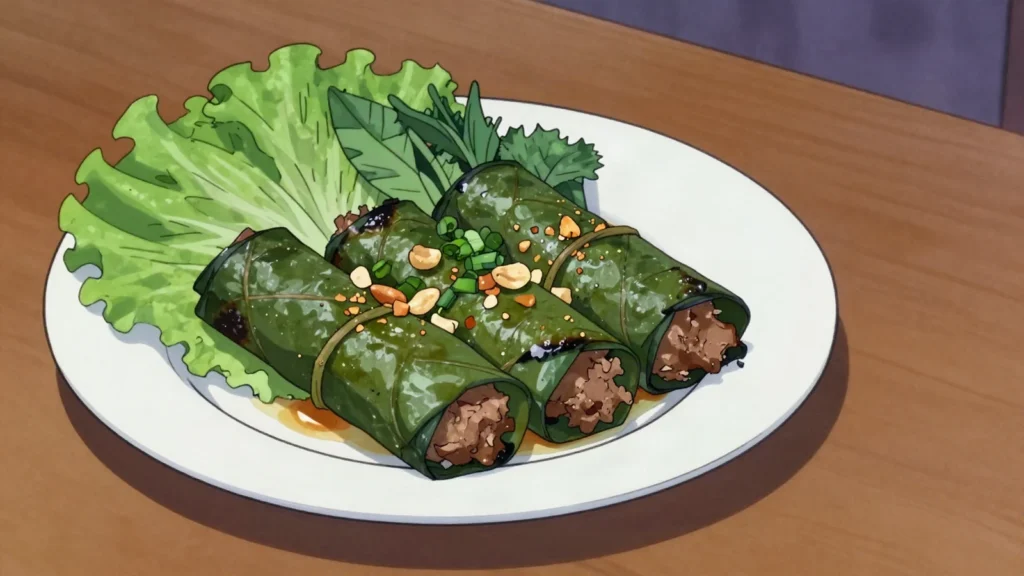
Minced beef, wrapped and grilled in betel leaf, called la lot, whose distinctive peppery, slightly bitter aroma infuses the meat as it cooks over charcoal, developed in Vietnamese cooking using la lot leaf, a plant long used in Vietnamese and wider Southeast Asian cooking both for its flavour and, according to traditional belief, for various digestive and health benefits. The wrapping and grilling technique, requiring the beef to be tightly rolled inside the leaf before cooking, allows the leaf’s aromatic oils to permeate the meat directly during grilling rather than being added only as a garnish afterward. Bo la lot is traditionally served wrapped further in rice paper with herbs and vermicelli noodles, dipped in a peanut or fish sauce, and remains a popular Vietnamese grilled dish and appetizer.
Frequently asked questions
What is Bo La Lot?
Bo La Lot is a street food from Vietnam: minced beef rolled in wild betel leaf and grilled until the leaf blackens. Minced beef, wrapped and grilled in betel leaf, called la lot, whose distinctive peppery, slightly bitter aroma infuses the meat as it cooks over charcoal, developed in Vietnamese cooking using la lot leaf, a plant long used in Vietnamese and wider Southeast Asian cooking both for its flavour and, according to traditional belief, for various digestive and health benefits. The wrapping and grilling technique, requiring the beef to be tightly rolled inside the leaf before cooking, allows the leaf’s aromatic oils to permeate the meat directly during grilling rather than being added only as a garnish afterward. Bo la lot is traditionally served wrapped further in rice paper with herbs and vermicelli noodles, dipped in a peanut or fish sauce, and remains a popular Vietnamese grilled dish and appetizer.
How long does Bo La Lot take to make?
Bo La Lot takes 40 minutes plus 1 hour marinating of preparation and 15 minutes of cooking. The recipe makes makes about 24, serves 4. It is rated medium to make.
What can I substitute in Bo La Lot?
Yes, within limits. Perilla, shiso or grape leaves hold the filling where lá lốt is unavailable, without its aroma. Half pork and half beef gives a softer, fattier filling and is common. Oyster sauce is optional; the fish sauce carries the seasoning. Five-spice is used in some households and left out in others. A griddle pan or oven grill replaces charcoal indoors. Soy sauce with lime, sugar and chilli replaces nước chấm for a version without fish sauce.
What is the most important thing to get right in Bo La Lot?
Add the fish sauce and the oyster sauce. Add the sugar, pepper and five-spice. Work it with your hand for two or three minutes. Mix in one direction rather than randomly. Cover it and refrigerate it for an hour. Marinate raw mince in the refrigerator only. Wash your hands and the bowl afterwards.