
Ingredients
The batter
- 200 grice flour
- not glutinous rice flour
- 2 tablespoonscornflour
- or 30 g cooked rice, blended in
- 1 teaspoonground turmeric
- half a teaspoon salt
- 300 mlcoconut milk
- about 150 ml water
- 2spring onions, sliced very finely
The topping
- 24raw prawns
- medium size, peeled
- or small whole prawns, shell on
- 1 tablespoonoil
- 1 clovegarlic, crushed
- a pinch of salt and pepper
- 2 tablespoonsdried shrimp
- soaked and chopped, optional
The spring onion oil
- 4spring onions, sliced
- 3 tablespoonsoil
- a pinch of salt
The dipping sauce
- 4 tablespoonsfish sauce
- 4 tablespoonswater
- 2 tablespoonssugar
- juice of 2 limes
- 2 clovesgarlic, finely chopped
- 1or 2 bird’s eye chillies, chopped
- shredded carrot and daikon, optional
To wrap and serve
- mustard leaves
- or lettuce leaves
- mint, coriander, Vietnamese perilla
- cucumber, sliced
- pickled carrot and daikon
Equipment
- a bánh khọt pan
- with round dimpled wells
- or an aebleskiver pan
- or a takoyaki pan
- or small blini pans
Directions
- Use plain rice flour rather than glutinous rice flour. Put the rice flour and cornflour in a bowl. Add the turmeric and the salt. Whisk in the coconut milk gradually. Add water until it is the consistency of single cream. It should be noticeably thin.
- Whisk until there are no lumps at all. Cover it and leave it two hours. Rest it in the refrigerator in warm weather. Whisk it thoroughly before every use. Whisk it again between batches. It settles again within minutes. Slice it as finely as you can manage. Coarse pieces disrupt the thin batter. Peel them, leaving the tails if you like.
- Pull out the dark thread and rinse. So a shellfish-free version needs several changes. Heat a little oil in a small pan. Add the crushed garlic and cook it briefly. Add the prawns with salt and pepper. Cook them for about a minute only. They should turn pink but stay underdone.
- Heat the oil until it is quite hot. Put the sliced spring onions in a heatproof bowl. Pour the hot oil straight over them. Add a pinch of salt and stir. Warm water dissolves it faster.
- Add the fish sauce and the lime juice. Add the chopped garlic and chilli. It should be sweet, sour, salty and hot at once. Taste it and adjust it carefully. Add water if it is too strong. It should be dilute enough to drink from a spoon.
- Add shredded carrot and daikon if you like. Heat the pan over a medium-high heat. Brush each well generously with oil. Use more oil than feels necessary. A dry pan gives soft pale cakes.
- Let the pan get genuinely hot. A drop of batter should sizzle immediately. Whisk the batter and ladle it into each well. Fill each about two thirds full. Set a prawn on top of each one. Sprinkle over dried shrimp if using. Put a lid over it for about two minutes. Give them another two or three minutes.
- Lift each cake out carefully. They are fragile when hot. Adjust the heat and oil after it. Every batch needs fresh oil in each well. Serve them straight from the pan while crisp. They soften within minutes of coming out. Spoon spring onion oil over them. Take a mustard leaf or a lettuce leaf. Put a cake on the leaf. Add mint, coriander and perilla.
- Add a slice of cucumber. Add pickled carrot and daikon. Wrap the whole thing into a parcel. Dip it in the nước chấm and eat it. That mouthful of crisp, soft, herb and sauce is the dish. Whisk it hard before using it. The dipping sauce keeps a week refrigerated.
Technique
- Rest the batter for two hours. Rice flour needs time to hydrate; unrested batter is gritty and cooks unevenly. It separates as it stands, so whisk it thoroughly before every ladleful and again between batches.
- Use plain rice flour, not glutinous rice flour. Glutinous flour gives a sticky chewy cake, which is entirely wrong here, and the two are sold in near-identical bags.
- Keep the batter thin — the consistency of single cream. A thick batter gives heavy stodgy cakes instead of crisp lacy edges.
- Use more oil in the wells than feels necessary, and re-oil for every batch. The oil is what crisps the edges; a dry pan gives soft pale cakes.
- Cover the pan for two minutes to steam the top, then uncover and let the edges brown for another two or three. Crisp lacy edge with a soft centre is the whole point of the dish.
- Cook the prawns for barely a minute before they go on. They finish on the cakes, and prawns cooked through twice go rubbery.
- The first batch is usually disappointing while the pan finds its temperature. Adjust the heat and oil after it and carry on.
- The dish needs a pan with wells. An aebleskiver, takoyaki, appam or paniyaram pan all substitute; a flat pan gives a pancake, not a bánh khọt.
- Serve in waves straight from the pan. They lose their crispness within minutes and cannot be held.
- Eat them wrapped: a cake in a mustard or lettuce leaf with mint, coriander, perilla and cucumber, folded up and dipped in nước chấm. That mouthful is the dish, and eating them off a plate with a fork misses it.
- Get the nước chấm balance right — sweet, sour, salty and hot at once with nothing dominating, and dilute enough to drink from a spoon. A sauce as strong as neat fish sauce is wrong.
- This dish contains prawns, fish sauce and often dried shrimp. Shellfish allergy is common and can cause anaphylaxis, so say so plainly to guests.
Substitutions
- An aebleskiver, takoyaki, appam or paniyaram pan replaces a bánh khọt pan closely.
- Small squid, mussels or minced pork replace prawns as the topping.
- A spoonful of cooked rice blended into the batter replaces the cornflour and is the traditional trick.
- Lettuce replaces mustard leaf where the peppery leaf is unavailable.
- Soy sauce with lime, sugar and chilli replaces nước chấm for a version without fish sauce.
- A mushroom or tofu topping makes a vegetarian version, though the sauce must change too.
Variations
- Bánh xèo is the large folded version of essentially the same batter, filled with pork, prawn and bean sprouts.
- Bánh căn, from Phan Thiết and Nha Trang, is a related small cake cooked in clay moulds without coconut milk.
- A version topped with mung bean paste as well as prawn is made in some places.
- Squid-topped bánh khọt is common in the coastal towns where they are sold.
- Bánh khọt served with a peanut and hoisin sauce instead of nước chấm is a Saigon variation.
- Bánh bèo, small steamed rice discs with dried shrimp, is the steamed relative from Huế.
History
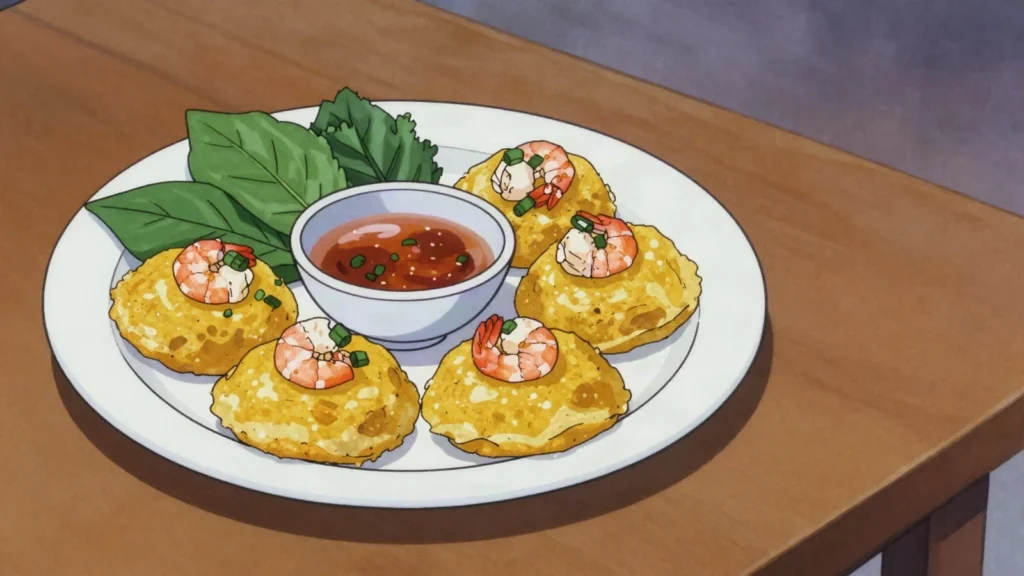
Small, crispy mini pancakes made from a rice flour and coconut milk batter, cooked in a specialized pan with small round molds, each topped with a single shrimp, developed in southern Vietnamese coastal cooking, particularly associated with Vung Tau, a coastal city, where fresh shrimp and coconut are both readily available local ingredients. Their small, bite-sized format and specific molded pan, producing dozens of small individual pancakes rather than one large crepe as in the related banh xeo, distinguishes banh khot’s preparation and presentation clearly from its larger pancake relative despite sharing a similar rice-and-coconut batter base. Banh khot is traditionally eaten wrapped in lettuce and herbs and dipped in fish sauce, similarly to several other Vietnamese dishes built around fresh wrapping and dipping.
Frequently asked questions
What is Banh Khot?
Banh Khot is a street food from Vietnam: small crisp coconut-rice cakes with a prawn on top, wrapped in mustard leaf. Small, crispy mini pancakes made from a rice flour and coconut milk batter, cooked in a specialized pan with small round molds, each topped with a single shrimp, developed in southern Vietnamese coastal cooking, particularly associated with Vung Tau, a coastal city, where fresh shrimp and coconut are both readily available local ingredients. Their small, bite-sized format and specific molded pan, producing dozens of small individual pancakes rather than one large crepe as in the related banh xeo, distinguishes banh khot’s preparation and presentation clearly from its larger pancake relative despite sharing a similar rice-and-coconut batter base. Banh khot is traditionally eaten wrapped in lettuce and herbs and dipped in fish sauce, similarly to several other Vietnamese dishes built around fresh wrapping and dipping.
How long does Banh Khot take to make?
Banh Khot takes 30 minutes plus 2 hours resting of preparation and 40 minutes of cooking. The recipe makes makes about 24, serves 4. It is rated medium to make.
What can I substitute in Banh Khot?
Yes, within limits. An aebleskiver, takoyaki, appam or paniyaram pan replaces a bánh khọt pan closely. Small squid, mussels or minced pork replace prawns as the topping. A spoonful of cooked rice blended into the batter replaces the cornflour and is the traditional trick. Lettuce replaces mustard leaf where the peppery leaf is unavailable. Soy sauce with lime, sugar and chilli replaces nước chấm for a version without fish sauce. A mushroom or tofu topping makes a vegetarian version, though the sauce must change too.
What is the most important thing to get right in Banh Khot?
Use plain rice flour rather than glutinous rice flour. Put the rice flour and cornflour in a bowl. Add the turmeric and the salt. Whisk in the coconut milk gradually. Add water until it is the consistency of single cream. It should be noticeably thin.