
Ingredients
Paste
- 700 gpork loin or lean shoulder, very fresh
- 80 gpork back fat
- 3 tbspfish sauce
- 2 tspsugar
- 1 tspsalt
- 1 tspwhite pepper
- 1 tspbaking powder
- 4 tbspiced water, plus ice
- 1 tbsppotato or tapioca starch
Wrapping
- banana leaves, softened over a flame
- string or foil
To serve
- bánh mì
- bánh cuốn
- sticky rice
Directions
- Use pork that is as fresh as you can get and cut it into cubes, then freeze them for 45 minutes until the edges are firm and crystals are just forming.
- The meat must stay below 10°C (50°F) at every moment. This is the whole technique: chả lụa gets its springy snap from proteins that bind only while cold, and pork that warms during processing turns crumbly and grainy instead — there is no fixing it afterwards.
- Blitz the cold pork in a food processor in short bursts with the fish sauce, sugar, salt, pepper, baking powder and starch.
- Add the iced water a spoonful at a time and keep blitzing until you have a smooth, pale, sticky paste that pulls away from the bowl in one mass.
- Stop and put the bowl in the freezer for ten minutes whenever the paste feels warm to the finger. Expect to do this two or three times.
- Add the back fat at the very end and blitz just enough to distribute it in small flecks.
- Test the paste: a small piece dropped in cold water should float and feel springy. If it sinks and is soft, it needs more blitzing while cold.
- Soften the banana leaves over a flame until they turn glossy and pliable, then lay them in a cross and spread the paste along the middle.
- Roll it into a tight cylinder, fold the ends in, and tie firmly with string. Wrap in foil if the leaves are torn — steam getting in makes it watery.
- Steam over boiling water for 45 to 50 minutes. Cool completely, then refrigerate four hours before slicing thin. It keeps five days.
Technique
- Keep it below 10°C (50°F) throughout, returning it to the freezer as often as needed.
- The float test before wrapping.
- Tight roll, no steam getting in, chilled before slicing.
Substitutions
- Chicken breast for chả gà, made exactly the same way.
- Foil or clingfilm and a tin, if you have no banana leaves — though the leaf gives the green edge and the smell.
- A stand mixer with a paddle on high, which works if the bowl is chilled.
Variations
- Chả quế, brushed with cinnamon and roasted rather than steamed.
- The Thai moo yor and Filipino chorizo de bola are relatives of the same steamed paste.
Frequently asked questions
What is Cha Lua?
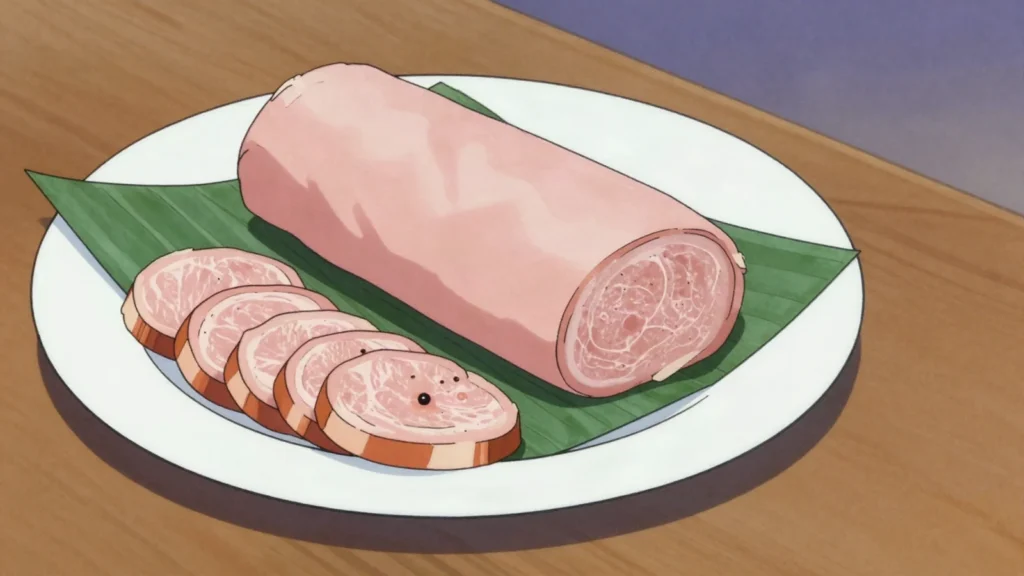
Cha Lua is a charcuterie & cured from Vietnam: pork pounded to a paste, wrapped in banana leaf and steamed into a springy roll.
How long does Cha Lua take to make?
Cha Lua takes 40 min plus 4 hours chilling of preparation and 50 min of cooking. The recipe makes makes one 700 g roll. It is rated medium to make.
What can I substitute in Cha Lua?
Yes, within limits. Chicken breast for chả gà, made exactly the same way. Foil or clingfilm and a tin, if you have no banana leaves — though the leaf gives the green edge and the smell. A stand mixer with a paddle on high, which works if the bowl is chilled.
What is the most important thing to get right in Cha Lua?
The meat must stay below 10°C (50°F) at every moment. This is the whole technique: chả lụa gets its springy snap from proteins that bind only while cold, and pork that warms during processing turns crumbly and grainy instead — there is no fixing it afterwards.