
Ingredients
Dough (impasto diretto)
- 1 kgtipo 00 flour, W 260–300
- 620 mlcold water
- 28 gfine sea salt
- 2 gfresh yeast (lievito di birra)
Topping, per pizza
- 80 gSan Marzano dell Agro Sarnese-Nocerino DOP tomatoes, crushed by hand and salted, never cooked
- 70 gfior di latte or mozzarella di bufala campana, torn and drained 30 minutes
- 3fresh basil leaves
- 1 tbspextra virgin olive oil
- 5 ggrated hard cheese, optional
Directions
- Dissolve the salt in the water, add 10 percent of the flour, then crumble in the yeast. Salt and yeast must not meet neat.
- Add the rest of the flour in stages and mix 15–20 minutes to a smooth dough at 23–25°C (75–75°F). It should pass the windowpane test and feel slack but not sticky.
- Rest the mass covered for 2 hours (puntata) at room temperature.
- Cut and ball into four 250 g panetti, sealing each with a tight underneath fold. Set them in an oiled proofing box with room to spread and prove 18–24 hours at 18–20°C (65–70°F) (appretto), until doubled, domed and full of small bubbles.
- Heat a wood-fired oven so the floor sits at 430–450°C (800–850°F) and the dome glows white. It must be at temperature a full hour before you bake.
- Turn a panetto out onto semolina-dusted bench and press from the centre outward with your fingertips, driving all the gas into a 1–2 cm rim. Never use a rolling pin, and never touch the cornicione.
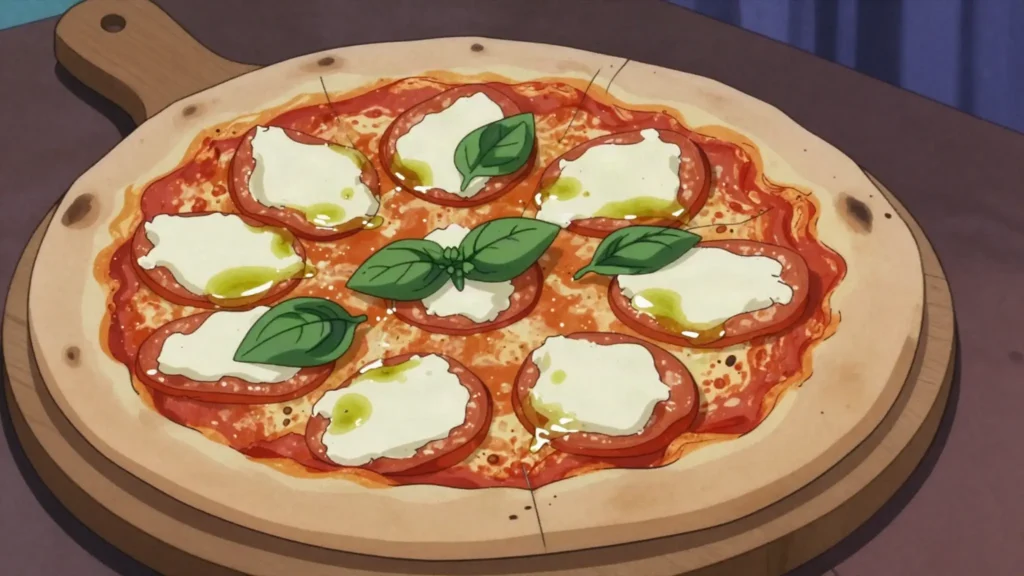
- Spread the crushed tomato in a spiral with the back of a spoon, leaving the rim bare. Scatter the drained mozzarella, tuck in the basil, and thread over the olive oil.
- Slide the pizza onto the oven floor and bake 60–90 seconds, turning it once with the peel, until the rim is puffed and freckled with leopard-spot char and the base lifts stiff off the peel.
- Eat within a minute or two, folded in four (a libretto) if you are eating it standing up.
Technique
- The Associazione Verace Pizza Napoletana defines the dish: only flour, water, salt and yeast in the dough, no oil and no sugar, and a bake of 60–90 seconds.
- Mozzarella must be torn and drained. Whole slices flood the disc and give you the grey soupy centre that ruins home pizza.
- The basil goes on before the bake in Naples, so it perfumes the cheese and does not merely wilt on top.
Substitutions
- No wood oven: bake on a 6 mm steel plate on the top shelf of a domestic oven at maximum for 45 minutes, then switch to the overhead grill for the bake, 4–5 minutes total. Expect a good pizza, not a Neapolitan one.
- Fior di latte is easier to handle than buffalo mozzarella, which holds more water; if you use bufala, tear it an hour ahead and drain it in a sieve.
Variations
- Marinara, older than the Margherita: tomato, garlic, oregano, oil, no cheese.
- Margherita extra, made with mozzarella di bufala DOP and cherry tomatoes from the Vesuvius slopes.
History
Traditionally credited to Raffaele Esposito, a Naples pizzaiolo, who in 1889 is said to have made a pizza topped with tomato, mozzarella and basil, in the red, white and green of the new Italian flag, for a visit by Queen Margherita of Savoy, who according to the story preferred it to the other pizzas presented to her. Modern food historians treat parts of that account skeptically, since the tomato-mozzarella-basil combination likely already existed in Naples beforehand rather than being invented for the occasion, but the queen’s name stuck to the dish regardless. Naples had been a center of flatbread-with-topping cooking since at least the 1700s, when tomatoes, a New World import initially viewed with suspicion elsewhere in Europe, were embraced by Naples’s poor as a cheap, practical topping.
Frequently asked questions
What is Pizza Margherita?
Pizza Margherita is a main from Italy: neapolitan wood-fired pizza with tomato, mozzarella, basil. Traditionally credited to Raffaele Esposito, a Naples pizzaiolo, who in 1889 is said to have made a pizza topped with tomato, mozzarella and basil, in the red, white and green of the new Italian flag, for a visit by Queen Margherita of Savoy, who according to the story preferred it to the other pizzas presented to her. Modern food historians treat parts of that account skeptically, since the tomato-mozzarella-basil combination likely already existed in Naples beforehand rather than being invented for the occasion, but the queen’s name stuck to the dish regardless. Naples had been a center of flatbread-with-topping cooking since at least the 1700s, when tomatoes, a New World import initially viewed with suspicion elsewhere in Europe, were embraced by Naples’s poor as a cheap, practical topping.
How long does Pizza Margherita take to make?
Pizza Margherita takes 40 min of preparation and 24 hr fermentation plus 90 seconds baking of cooking. The recipe makes 4 pizzas of 30 cm. It is rated hard to make.
What can I substitute in Pizza Margherita?
Yes, within limits. No wood oven: bake on a 6 mm steel plate on the top shelf of a domestic oven at maximum for 45 minutes, then switch to the overhead grill for the bake, 4–5 minutes total. Expect a good pizza, not a Neapolitan one. Fior di latte is easier to handle than buffalo mozzarella, which holds more water; if you use bufala, tear it an hour ahead and drain it in a sieve.
What is the most important thing to get right in Pizza Margherita?
Dissolve the salt in the water, add 10 percent of the flour, then crumble in the yeast. Salt and yeast must not meet neat.