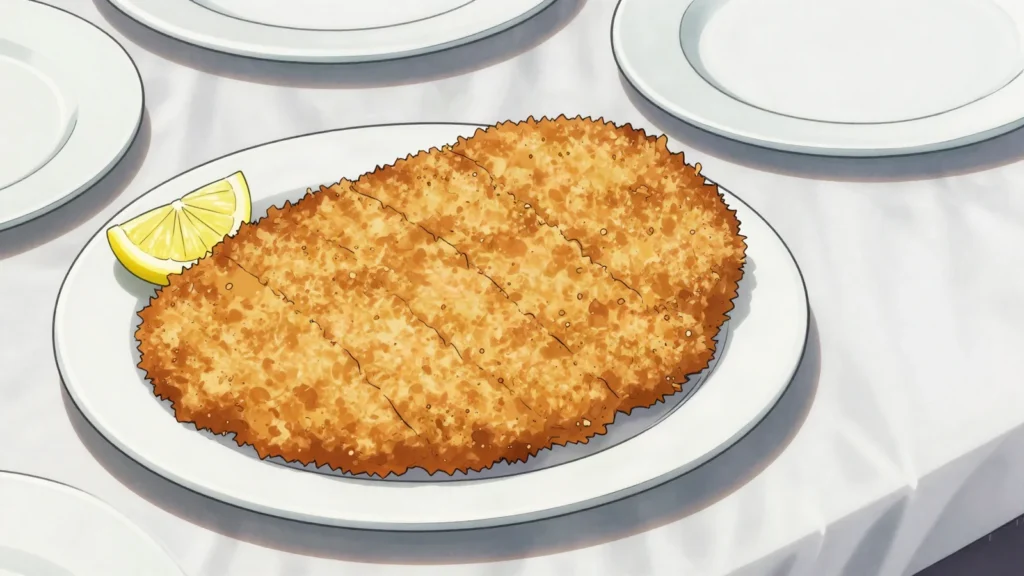

Ingredients
Schnitzel
- 4veal escalopes from the topside or cushion (about 150 g each)
- 2 tspfine salt
- white pepper
- 100 gplain flour
- 3eggs, beaten with 2 tbsp cream or milk
- 200 gfine dry breadcrumbs from stale white bread, not panko
To fry
- 400 gclarified butter (Butterschmalz), or half clarified butter and half lard
To serve
- 1lemon, cut into wedges
- Erdäpfelsalat (Austrian potato salad) or parsley potatoes
- 2 tbsplingonberry jam
- flat-leaf parsley
Directions
- Lay each escalope between two sheets of cling film and beat it out from the centre outwards with the flat side of a meat mallet, working evenly until it is 3–4 mm thick and roughly the size of a dinner plate. Use flat, pushing strokes rather than hammer blows, which tear the fibres.
- Nick the outer membrane in three or four places around the edge with a knife so the schnitzel does not curl in the pan.
- Season both sides with salt and white pepper 5 minutes before cooking, no earlier, or the surface draws moisture and the crumb will not stick.
- Set up three wide plates: flour, egg beaten with cream, and breadcrumbs. Coat in flour and shake off all the excess, then draw through the egg letting it drip briefly, then lay in the crumbs.
- Toss the crumbs over the schnitzel and pat only lightly. Never press the coating on. A loose crumb is what allows the crust to lift away from the meat in the pan, and pressing it down is the single most common mistake.
- Heat the clarified butter in a wide pan to a depth of at least 1.5 cm, to 160–170°C (325–350°F). The schnitzel must float and swim, not sit on the base of the pan.
- Slide one schnitzel in, away from you, and immediately begin swirling the pan continuously so hot fat washes over the top surface. After 60–90 seconds the crust puffs and blisters away from the meat, which is called soufflieren and is the mark of a correctly made Wiener schnitzel.
- Turn once and give it another 60–90 seconds, until an even golden blond, never dark brown. Lift onto kitchen paper, blot, and serve at once with lemon wedges, potato salad and lingonberry jam. Fry the schnitzels one or two at a time so the fat temperature never drops.
Technique
- In Austria the name is legally protected: Wiener Schnitzel must be veal. The same dish made from pork must be sold as Schnitzel Wiener Art, and although the pork version is eaten everywhere in Austria, the distinction is taken seriously on menus.
- The fat has to be deep and hot enough for the schnitzel to float. Shallow frying welds the crumb to the meat and you lose the puffed, wavy crust entirely.
- Clarified butter is the traditional fat because the milk solids have been removed and it can reach 170°C (350°F) without burning. Plain butter will blacken.
- Breadcrumbs should be fine, dry and made from stale white bread. Panko is too coarse and gives a spiky American-style crust that is not Viennese.
- The story that the dish descends from Milanese cotoletta by way of Field Marshal Radetzky is a nineteenth-century legend with no documentary support and is now generally dismissed.
Substitutions
- Pork loin, beaten thin the same way, makes the everyday Schnitzel Wiener Art and costs a fraction of veal; turkey breast is also common.
- No clarified butter? Use a neutral high-smoke-point oil with 50 g of butter added in the last 30 seconds for flavour.
Variations
- Schnitzel Wiener Art, the pork version served in most Austrian Gasthäuser.
- Pariser Schnitzel, coated in flour and egg only, with no breadcrumbs.
- Cordon bleu, the schnitzel folded around ham and cheese before breading, a staple of Austrian menus.
History
Popularly explained by a legend that Field Marshal Radetzky brought the recipe back to Vienna from Milan in the mid-1800s, after encountering the breaded veal cutlet cotoletta alla milanese during Austria’s occupation of northern Italy — a tidy story that food historians generally treat as a later invention rather than a documented fact, since breaded, fried meat cutlets appear independently in several European cuisines with no single point of origin. What is not disputed is that schnitzel, veal pounded thin, breaded and fried in butter or lard, became Vienna’s signature dish through the 1800s regardless of exactly where the technique first came from, and Austrian law today restricts the name Wiener schnitzel specifically to the veal version, with pork or turkey versions required to carry a different name.
Frequently asked questions
What is Wiener schnitzel?
Wiener schnitzel is a main from Austria: veal cutlet pounded thin, breaded, fried golden; lemon wedge. Popularly explained by a legend that Field Marshal Radetzky brought the recipe back to Vienna from Milan in the mid-1800s, after encountering the breaded veal cutlet cotoletta alla milanese during Austria’s occupation of northern Italy — a tidy story that food historians generally treat as a later invention rather than a documented fact, since breaded, fried meat cutlets appear independently in several European cuisines with no single point of origin. What is not disputed is that schnitzel, veal pounded thin, breaded and fried in butter or lard, became Vienna’s signature dish through the 1800s regardless of exactly where the technique first came from, and Austrian law today restricts the name Wiener schnitzel specifically to the veal version, with pork or turkey versions required to carry a different name.
How long does Wiener schnitzel take to make?
Wiener schnitzel takes 25 min of preparation and 20 min of cooking. The recipe makes 4 servings. It is rated medium to make.
What can I substitute in Wiener schnitzel?
Yes, within limits. Pork loin, beaten thin the same way, makes the everyday Schnitzel Wiener Art and costs a fraction of veal; turkey breast is also common. No clarified butter? Use a neutral high-smoke-point oil with 50 g of butter added in the last 30 seconds for flavour.
What is the most important thing to get right in Wiener schnitzel?
Lay each escalope between two sheets of cling film and beat it out from the centre outwards with the flat side of a meat mallet, working evenly until it is 3–4 mm thick and roughly the size of a dinner plate. Use flat, pushing strokes rather than hammer blows, which tear the fibres.