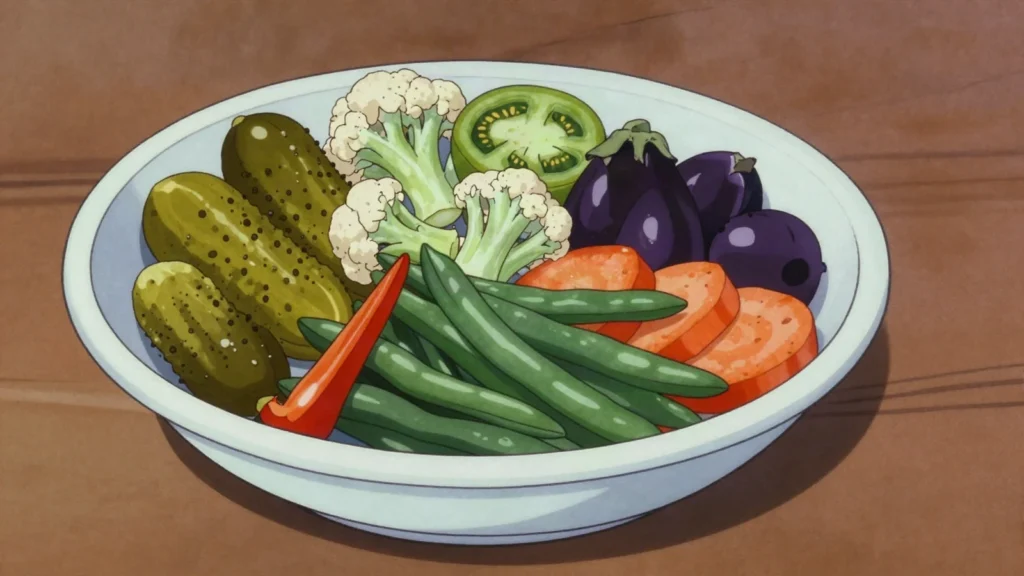

Ingredients
The vegetables
- 1.5 kgmixed firm vegetables
- small cucumbers
- cauliflower florets
- green tomatoes
- carrots, in batons
- green beans
- sweet peppers, in strips
- small aubergines
- white cabbage, in wedges
- all fresh and unblemished
- see the note
The brine
- 2 litreswater
- filtered or boiled and cooled
- not chlorinated tap water
- see the note
- 120 gnon-iodised salt
- sea salt or pickling salt
- that is about 6 percent
- see the note on strength
The aromatics
- 1 headgarlic, cloves peeled
- 2dried chillies
- or to taste
- 1 tablespooncoriander seed
- 1 tablespoonblack peppercorns
- several bay leaves
- a bunch of dill, with stalks
- a few celery leaves
- grape or cherry leaves, optional
- see the note
Equipment
- large glass jars
- or a ceramic crock
- sterilised
- a weight to hold vegetables down
- a glass disc, a small bag of brine
- or a clean stone
Directions
- Salt selects for the bacteria you want. Spoilage organisms mostly do not. Salt crystals differ enormously in density. Use non-iodised salt. Use filtered water, or boiled and cooled.
- Use only firm fresh unblemished ones. A soft or bruised vegetable is already breaking down. Wash them well in cold water. Do not scrub them sterile. Wash off soil, not the surface flora.
- Cut them into pieces of similar size. Small pieces go soft while large ones stay raw. Trim the blossom end off each one. Removing it is the standard fix for soft cucumbers. Take a few millimetres off. They keep the pickles crisp. Wash them hot, then heat them in a low oven. Or run them through a dishwasher on hot.
- Heat some of the water and dissolve the salt in it. Add the rest cold. Let the brine cool completely before using it. Hot brine cooks the vegetables and kills the bacteria.
- Layer the vegetables with the garlic and spices. Pack firmly but do not crush. Leave several centimetres at the top. Pour it over to cover everything. Everything must stay under the brine.
- Use a glass disc, a small bag of brine, or a clean stone. Cover the jar loosely. Never seal a fermenting jar tightly. Keep it at room temperature out of direct sun. Very cold and it may not start. Skim it off. Discard the batch. Vegetables gone soft and mushy throughout.
- Taste it after two weeks. Use a clean fork. The vegetables should have some bite. Serve it cold, straight from the jar. Anyone watching their salt intake should know that. Keep everything under the brine. Top up with fresh brine of the same strength if the level drops.
Technique
- Everything must stay under the brine. Anything above the surface grows mould — the brine excludes air, and air is the problem. This single rule decides whether the jar works.
- Never seal a fermenting jar tightly. Fermentation produces carbon dioxide, and a sealed jar builds pressure and can burst. Cover it with a cloth, a loose lid or an airlock, or loosen a screw lid daily.
- Do not reduce the salt. It is not seasoning here — it selects for lactic bacteria, which tolerate salt, over spoilage organisms, which mostly do not. Weak brine is how a ferment goes bad.
- Weigh the salt rather than spooning it. Crystal densities differ enormously, and a spoon of flaky salt weighs about half a spoon of fine. Use non-iodised salt: iodine inhibits the bacteria and anti-caking agents cloud the brine.
- Use filtered or boiled-and-cooled water. Chlorine in tap water suppresses the fermentation.
- Let the brine cool completely before pouring it on. Hot brine cooks the vegetables and kills the bacteria, leaving soft unfermented vegetables in salt water.
- Wash the vegetables but do not scrub them sterile. The bacteria that ferment live on their surfaces — wash off soil, not the flora.
- Trim a few millimetres off the blossom end of each cucumber, opposite the stem. It carries enzymes that soften pickles, and removing it is the standard fix for soft cucumbers.
- Grape, cherry, oak or blackcurrant leaves contain tannins that inhibit those softening enzymes and keep the pickles crisp. That is a real effect rather than folklore, though they are optional.
- Cloudy brine is correct — it is the bacteria working. Clear brine after a week means nothing is happening.
- A thin flat white wrinkled film is usually kahm yeast: harmless, unpleasant-tasting, and simply skimmed off. Fuzzy or coloured growth — blue, green, black or pink — is mould, and mould sends threads below the surface, so scraping the top does not remove it and some moulds produce toxins. Discard the batch.
- Discard it also for a slimy or ropy brine, a putrid or yeasty rather than sour smell, or vegetables gone mushy throughout. If you are unsure, throw it out — a jar of vegetables is not worth the risk.
- Leave several centimetres of headspace. Fermentation produces gas and the brine rises, and a full jar overflows.
- This is a lactic ferment, not a vinegar pickle — it makes its own acid rather than being acidified from outside, and the two taste completely different. Many turshu recipes, especially Iranian torshi, do use vinegar; both are genuine.
- Warmer ferments faster and softer, cooler slower and crisper. Around eighteen to twenty-two degrees is ideal, and refrigeration afterwards holds it where it is.
- Always use a clean fork and top up with fresh brine of the same strength if the level drops.
- This is a salty food, which anyone watching their salt intake should know. The atlas records that as fact and makes no recommendation.
Substitutions
- Almost any firm vegetable works: turnip, celeriac, kohlrabi, okra, unripe walnuts.
- Beetroot added in small amounts stains the whole jar pink, which some households want.
- A three to four percent brine ferments faster and gives a softer, less salty pickle.
- Vinegar makes the Iranian-style torshi instead, which is quicker and does not ferment.
- Any tannin-rich leaf — grape, cherry, oak, blackcurrant, horseradish — keeps things crisp.
- Coriander seed, mustard seed, fennel seed and allspice all belong in the spice mix.
Variations
- Torshi in Iran is often vinegar-based and finely chopped.
- Turşu in Turkey adds chickpeas to the jar to help start the fermentation.
- Turshiya in Bulgaria and tsarska turshiya are the Balkan versions.
- Marinuoti agurkai and other Baltic cucumber pickles use the same brine logic.
- Torshi liteh is the soft mashed Iranian version fermented to a paste.
- A single-vegetable jar of cauliflower or green tomatoes is common.
History
Cellars hold jars of pickled garlic, aubergine and plums whose sourness is meant to balance rich rice dishes.
Frequently asked questions
What is Turshu?
Turshu is a fermented & pickled from Azerbaijan: vegetables and fruit pickled in vinegar and set out beside pilaf. Cellars hold jars of pickled garlic, aubergine and plums whose sourness is meant to balance rich rice dishes.
How long does Turshu take to make?
Turshu takes 40 minutes plus 2 to 4 weeks of preparation and 10 minutes of cooking. The recipe makes makes 2 large jars. It is rated medium to make.
What can I substitute in Turshu?
Yes, within limits. Almost any firm vegetable works: turnip, celeriac, kohlrabi, okra, unripe walnuts. Beetroot added in small amounts stains the whole jar pink, which some households want. A three to four percent brine ferments faster and gives a softer, less salty pickle. Vinegar makes the Iranian-style torshi instead, which is quicker and does not ferment. Any tannin-rich leaf — grape, cherry, oak, blackcurrant, horseradish — keeps things crisp. Coriander seed, mustard seed, fennel seed and allspice all belong in the spice mix.
What is the most important thing to get right in Turshu?
Salt selects for the bacteria you want. Spoilage organisms mostly do not. Salt crystals differ enormously in density. Use non-iodised salt. Use filtered water, or boiled and cooled.