
Ingredients
Parcels
- 36young taro leaves (lu), about 500 g, stems trimmed flush and any thick veins pared back
- 6large squares of banana leaf, or 6 sheets of foil, about 25 cm square
Filling
- 600 mlthick coconut cream, first press from 2 grated mature coconuts if possible
- 1onion (150 g), very finely chopped
- 1 tspfine sea salt
- ½ tspwhite pepper
- 1 tbsplemon juice (optional)
Optional additions
- 100 ggrated fresh coconut
- 1tomato, finely diced
Directions
- Choose young taro leaves, heart-shaped, tender, unblemished, about the size of a hand. Old leaves and any part of the stalk carry far more calcium oxalate and will make the mouth itch and burn.
- Wash the leaves, pat dry, and pare down the thick central rib on the underside with a knife so the leaf folds without cracking.
- Stack 6 leaves per parcel, largest at the bottom, each rotated slightly, then cup the stack in your palm to form a bowl.
- Mix the coconut cream with the onion, salt, pepper and the lemon juice if using; it should taste slightly over-seasoned, as the leaves are bland.
- Spoon about 100 ml of the seasoned cream into each leaf cup, filling it two-thirds. Fold the leaves over one at a time, tucking as you go, to make a sealed pouch with no gaps at the seams. Any leak and the cream escapes and the parcel scorches.
- Wrap each pouch in a square of banana leaf that has been passed briefly over a flame to soften it, and tie with a strip of leaf or secure in foil.
- Cook in an umu if you have one: parcels go on the hot stones, are covered with more leaves and left 1 hour. In an oven, bake at 180°C (350°F) for 1 hour 15 minutes on a tray, or steam 1 hour 30 minutes.
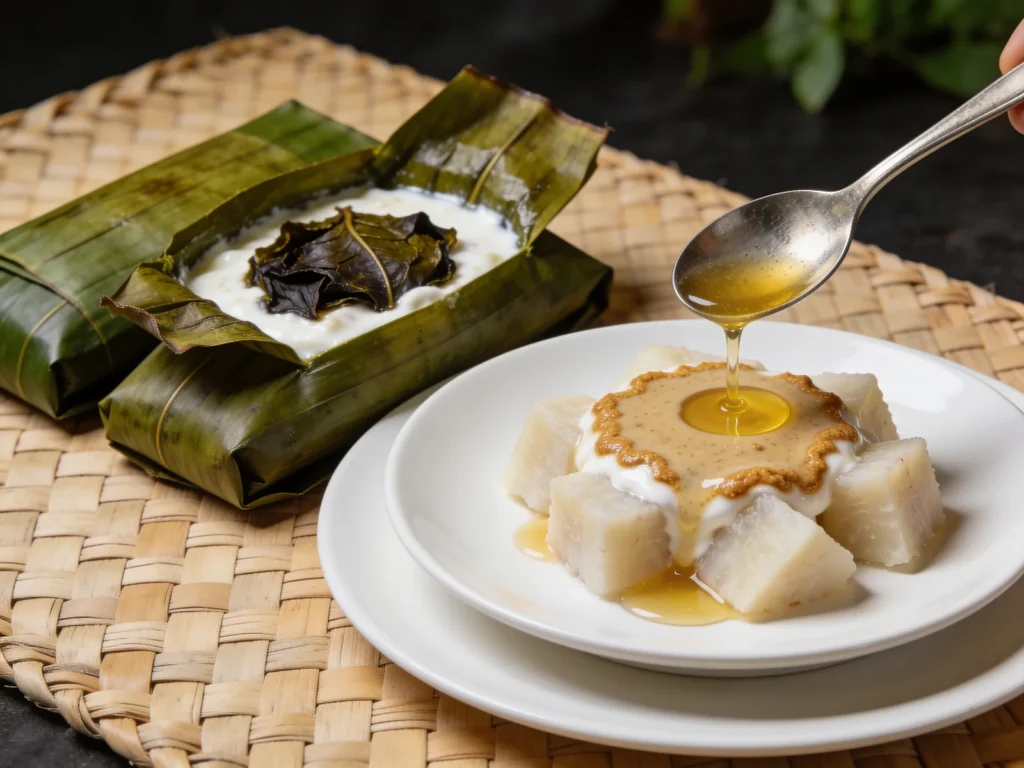
- The parcel is ready when the leaves are dark olive and completely soft with no squeak in the bite and the cream inside has thickened, curdled slightly and turned nutty gold at the edges. Rest 10 minutes.
- Serve the parcels closed, opened at the table over hot boiled taro or breadfruit; the oil that has separated from the cream is spooned over the starch.
Technique
- Taro leaves must be cooked through, without exception. Raw or undercooked leaf contains needle-like calcium oxalate crystals that cause an intense stinging in the mouth and throat. Long cooking, at least 1 hour, breaks them down completely; if a bite still prickles, it is undercooked, not badly seasoned.
- The coconut cream is meant to split. As it bakes it breaks into a thick curd and a clear golden oil, and that oil is the finest part of the dish. Do not stir it back or try to keep it emulsified.
- Traditional palusami is cooked in the umu, the above-ground stone oven, where the smoke and dry stone heat give a distinct roasted note. An oven is honest but tamer.
- In Samoa the dish is central to to’ona’i, the Sunday meal after church, and to fa’alavelave gatherings, made by the dozen.
Substitutions
- No taro leaves? Frozen taro leaves from an Asian or Pacific grocer are excellent and already trimmed; thaw and drain them first. Failing that, use large spinach or chard leaves, doubled up, and cut the cooking to 45 minutes, though the flavour is greener and less earthy.
- No banana leaf? Foil works perfectly for the outer wrap and is what most Samoan households in cities now use.
- Fresh coconut cream is best, but a good full-fat tinned coconut cream, the thick part only, gives a very close result.
Variations
- Lu sipi and lu moa are the versions of the same parcel that include meat, so they are not palusami proper.
- A version with a whole peeled onion and a slice of tomato buried in the centre of each parcel.
- Fiji and Tonga make near-identical parcels, called palusami and lupulu respectively.
History
Coconut cream wrapped in young taro leaves and traditionally cooked in an umu, an earth oven using heated stones, a cooking method documented across Samoa and much of Polynesia for centuries as a way to slow-cook food using stored heat rather than an open flame. Taro leaves must be cooked thoroughly, since eaten raw or undercooked they contain compounds that irritate the mouth and throat; that necessity likely shaped the dish’s development toward the long, slow umu-cooking method rather than a faster preparation. Palusami carries strong ceremonial weight in Samoan culture, traditionally served at major family and community gatherings, church events and formal occasions rather than treated as an everyday dish.
Frequently asked questions
What is Palusami?
Palusami is a main from Samoa: coconut cream baked in taro-leaf parcels in the umu, rich and silky. Coconut cream wrapped in young taro leaves and traditionally cooked in an umu, an earth oven using heated stones, a cooking method documented across Samoa and much of Polynesia for centuries as a way to slow-cook food using stored heat rather than an open flame. Taro leaves must be cooked thoroughly, since eaten raw or undercooked they contain compounds that irritate the mouth and throat; that necessity likely shaped the dish’s development toward the long, slow umu-cooking method rather than a faster preparation. Palusami carries strong ceremonial weight in Samoan culture, traditionally served at major family and community gatherings, church events and formal occasions rather than treated as an everyday dish.
How long does Palusami take to make?
Palusami takes 30 min of preparation and 1 hr 15 min of cooking. The recipe makes 6 parcels, serving 6 as a side or 3 as a main. It is rated medium to make.
What can I substitute in Palusami?
Yes, within limits. No taro leaves? Frozen taro leaves from an Asian or Pacific grocer are excellent and already trimmed; thaw and drain them first. Failing that, use large spinach or chard leaves, doubled up, and cut the cooking to 45 minutes, though the flavour is greener and less earthy. No banana leaf? Foil works perfectly for the outer wrap and is what most Samoan households in cities now use. Fresh coconut cream is best, but a good full-fat tinned coconut cream, the thick part only, gives a very close result.
What is the most important thing to get right in Palusami?
Taro leaves must be cooked through, without exception. Raw or undercooked leaf contains needle-like calcium oxalate crystals that cause an intense stinging in the mouth and throat. Long cooking, at least 1 hour, breaks them down completely; if a bite still prickles, it is undercooked, not badly seasoned.