
Ingredients
The pork
- 2.5 kgpork shoulder
- or belly, skin on
- 3 teaspoonscoarse salt
- 2 teaspoonsblack pepper
- 6garlic cloves, crushed
- 2 teaspoonscaraway seed
The sauerkraut
- 1.5 kgsauerkraut
- drained but not rinsed
- 2onions, chopped
- 1apple, grated
- 1 tablespooncaraway seed
- 2bay leaves
- 1 tablespoonsugar
- or to taste
- 300 mlstock or water
The rest
- 8blood sausages
- verivorst
- 1.5 kgpotatoes
- peeled and boiled
- butter, to serve
To serve
- lingonberry jam
- mustard
- at Christmas
Directions
- Leave it uncovered in the fridge. Score the skin in close parallel lines. Cut through the skin and the fat. Do not cut into the meat itself. Rub coarse salt into the scored skin.
- Salt draws out remaining moisture. Start it off in a very hot oven. Drain it well but do not rinse it. Pork must be cooked right through. Check it rather than guessing. Pat the pork skin completely dry. Use plenty of kitchen paper for it. The skin must be genuinely dry.
- Leave it uncovered in the refrigerator. Set it on a rack over a deep tray. Score the skin in close parallel lines. Space the cuts about a centimetre apart. Cut through the skin and fat only. Stop before you reach the meat. Take real care with either of them. Rub salt into the scored skin. Work the salt right into the cuts. Use coarse salt rather than fine.
- Rub garlic and caraway into the meat. Keep them off the skin entirely. Heat the oven as hot as it goes. Give it about twenty-five minutes hot. Reduce the oven to one hundred and sixty. Pork shoulder needs slow cooking. Roast it for about two and a half hours. A two and a half kilo shoulder takes that.
- Drain the sauerkraut but keep some liquid. Squeeze out the excess liquid. Keep a little of it for the pot. Do not rinse it under any water. Cook the onion in a little fat. Use rendered pork fat if you have it. Cook it for about ten minutes. It should soften and turn golden.
- Add the sauerkraut to the onion. Add the grated apple and caraway. Add the stock and the bay leaves. Simmer it for about one full hour. Sauerkraut needs long slow cooking.
- Keep it just moist rather than wet. It should not swim about in liquid. Add more stock if it dries out. Cook it with the lid off at the end. Add sugar to balance the sourness. Start with a spoonful and taste. It should not taste sweet at all.
- Bake or fry the blood sausages. They only need heating through. Bake them at one hundred and eighty degrees. Give them about twenty minutes. Turn them once partway through. Blood sausage bursts if heated fast. Prick them before cooking to prevent it.
- Use a fine needle several times. Boiling the potatoes is done alongside. Boil the peeled potatoes until tender. Start them in cold salted water. Give them about twenty minutes. Drain them and let them steam dry.
- Scatter dill over them if you like. It should pull apart with no resistance. Check the crackling before serving. It should be hard and blistered. Cut it off the joint entirely. Put it under a hot grill briefly. Let the pork rest for twenty minutes.
- Cover the meat loosely with foil. Do not cover the crackling though. Cover the meat and leave the skin bare. Serving it is always done hot. Carve the pork into thick slices. Leftovers keep three days refrigerated.
Technique
- Crackling needs the skin genuinely bone dry: pat it with kitchen paper and leave it uncovered on a rack in the refrigerator overnight, which makes a real difference. Score it in close parallel lines through skin and fat but stop before the meat, since cutting into it lets the juices out. Rub coarse salt right into the cuts, and keep garlic and caraway on the underside only, since they burn in the initial high heat.
- Blood sausage bursts if heated fast, since the filling expands inside the casing — prick each one several times with a fine needle first. It is already fully cooked and needs heating through and crisping rather than cooking.
- Pork must reach seventy-five degrees, though a slow-roasted shoulder goes well past that and is judged by texture instead: a fork twisted in it should pull it apart with no resistance, and if it clings it needs another half hour.
Substitutions
- Black pudding is the nearest substitute for verivorst, being coarser and less barley-heavy; verivorst is bought ready made now, very few make it at home, and it is sold everywhere at Christmas.
- Some cooks rinse sauerkraut to reduce the sourness and others use it unrinsed; Estonian versions tend to the sharper, so drain it and keep a little of the liquid but do not rinse. Grated apple sweetens and softens it while disappearing entirely as it cooks.
Variations
- Start the pork in the hottest oven for twenty-five minutes to blister the skin, then drop it to one hundred and sixty for the long roast — that order is what works, since shoulder is full of connective tissue that breaks down only with gentle heat.
- Cover the resting meat loosely with foil but leave the crackling bare, since trapped steam softens it; if the crackling is soft, cut it off and put it briefly under a hot grill, watching every second because it burns in moments.
- The whole meal follows the farming year rather than anything arbitrary: the pig was killed in December when the cold could preserve it, the cabbage fermented in autumn, and both came together at Christmas. Lingonberry jam is sharp rather than sweet and genuinely essential to the plate, cutting the rich pork; cranberry is the nearest substitute.
History
The Estonian Christmas dinner, built around the pig killed in December, with sauerkraut fermented earlier in the autumn.
Frequently asked questions
What is Seapraad hapukapsaga?
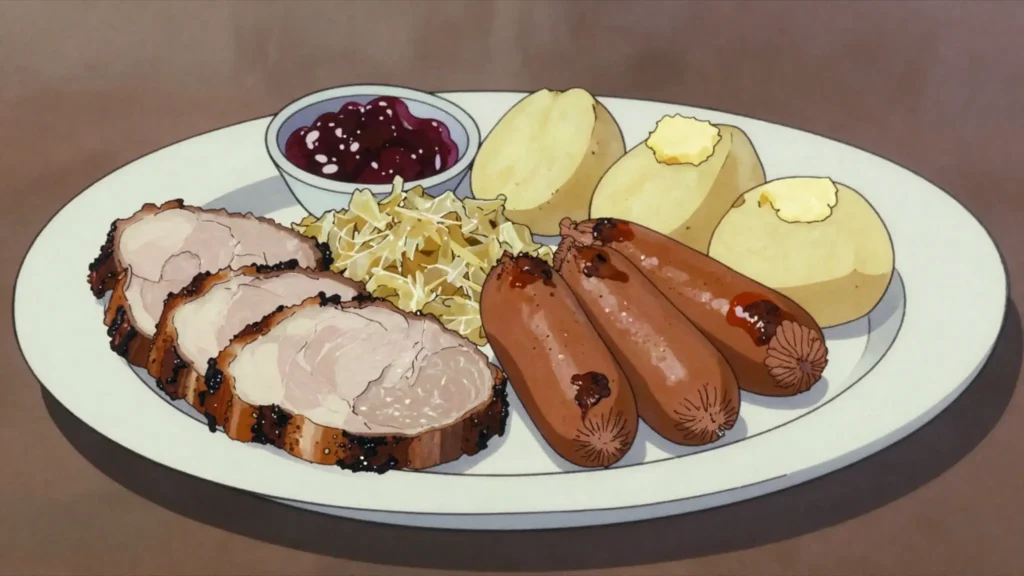
Seapraad hapukapsaga is a main from Estonia: roast pork with sauerkraut, blood sausage and boiled potatoes. The Estonian Christmas dinner, built around the pig killed in December, with sauerkraut fermented earlier in the autumn.
How long does Seapraad hapukapsaga take to make?
Seapraad hapukapsaga takes 40 minutes of preparation and 3 hours of cooking. The recipe makes serves 8. It is rated medium to make.
What can I substitute in Seapraad hapukapsaga?
Yes, within limits. Black pudding is the nearest substitute for verivorst, being coarser and less barley-heavy; verivorst is bought ready made now, very few make it at home, and it is sold everywhere at Christmas. Some cooks rinse sauerkraut to reduce the sourness and others use it unrinsed; Estonian versions tend to the sharper, so drain it and keep a little of the liquid but do not rinse. Grated apple sweetens and softens it while disappearing entirely as it cooks.
What is the most important thing to get right in Seapraad hapukapsaga?
Leave it uncovered in the fridge. Score the skin in close parallel lines. Cut through the skin and the fat. Do not cut into the meat itself. Rub coarse salt into the scored skin.